

Inside AWS specifically, this question comes up constantly: do you need a plain data lake – S3, Glue, Athena – or a full lakehouse, with an open table format like Apache Iceberg layered on top? The AWS ecosystem supports both, and AWS’s own documentation doesn’t always make the decision obvious, since most services can technically be configured either way.
This post breaks the decision down specifically within AWS’s service set – what changes technically when you add lakehouse capabilities, what it costs, and how to know which one your actual workload needs. For general background on data lakes versus data warehouses first, see our related post on data lake vs. data warehouse.
If you want the deeper AWS architecture picture beyond this comparison, our companion piece on AWS data lake architecture: how to set it up the right way covers the full build.
If you’re trying to make this call for your own AWS environment right now, our Data Lake Services team at Algoscale works through exactly this decision with clients regularly.
The Quick Answer
A plain AWS data lake – S3 storage, Glue Data Catalog, Athena for querying – is enough when your data volume is modest, a single team or a small number of teams query it, and you don’t need strict consistency guarantees. An AWS lakehouse, which adds an open table format like Apache Iceberg on top of that same S3 storage, becomes worth the added complexity once multiple teams depend on the same tables, you need reliable concurrent writes, or you’re feeding both BI and machine learning workloads from the same data.
What Counts as an “AWS Data Lake”
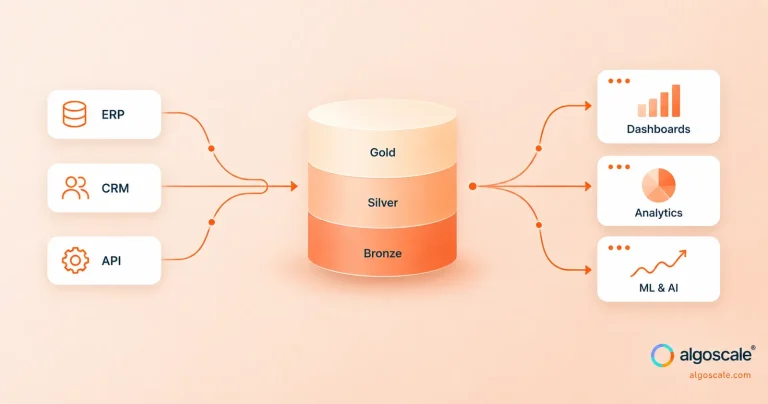
A standard AWS data lake architecture typically includes Amazon S3 as the storage layer, AWS Glue Crawlers and the Glue Data Catalog to infer and track schema, Amazon Athena for serverless SQL querying, and IAM policies for access control. This combination is genuinely capable – it supports structured, semi-structured, and unstructured data, and Athena can query directly against S3 files without any data movement. What it doesn’t provide natively is transactional consistency: concurrent writes can conflict, there’s no built-in schema enforcement preventing bad data from landing, and there’s no native way to see what a table looked like before a given change.
What Counts as an “AWS Lakehouse”
An AWS lakehouse takes that same S3-based foundation and adds an open table format – most commonly Apache Iceberg, though Delta Lake and Apache Hudi are also supported – as a transactional layer. This is combined with AWS Lake Formation for centralized, fine-grained governance, and the same S3 storage becomes queryable through multiple engines: Athena, Amazon EMR, AWS Glue ETL jobs, and Redshift Spectrum can all read and write the same Iceberg tables consistently. The result is the same underlying storage, with reliability and governance capabilities added directly on top.
Key Differences on AWS Specifically
Reliability and Concurrent Writes
Plain S3 with Glue and Athena has no built-in protection against two processes writing to the same location simultaneously – this can produce partial or corrupted results. Iceberg tables provide ACID transactions, so concurrent writes either succeed cleanly or fail without corrupting existing data.
Schema Enforcement
A plain data lake accepts whatever data Glue’s crawler infers from incoming files, with no mechanism to reject data that doesn’t match expectations. Iceberg tables support schema enforcement and controlled schema evolution, catching malformed data before it’s written rather than after.
Governance Granularity
Plain data lake access control on AWS is typically managed through S3 bucket policies and IAM, which is coarse-grained – often at the bucket or prefix level. AWS Lake Formation, paired with a table format, enables table- and column-level permissions managed centrally, which matters considerably once multiple teams share the same data.
Query Performance and Engine Flexibility
Athena can query both plain S3 data and Iceberg tables, but Iceberg’s metadata layer enables more efficient file pruning, which improves performance especially as data volume grows. Iceberg tables can also be read consistently by Athena, EMR, and Redshift Spectrum simultaneously – a plain data lake doesn’t offer the same consistency guarantees across engines reading the same data concurrently.
History and Rollback
A plain data lake has no native way to see a table’s state at a previous point in time. Iceberg’s snapshot and time travel features let you query or roll back to prior versions, which matters for both debugging and auditability.
When a Plain AWS Data Lake Is Enough
● Your data volume and query concurrency are modest, and Athena performance against plain S3 already meets your needs
● A single team or a small number of people manage and query the data, with low risk of write conflicts
● You’re in an early, exploratory phase and don’t yet know what structure your data actually needs long-term
● The overhead of managing Iceberg tables and Lake Formation permissions isn’t justified by your current scale
When You Need an AWS Lakehouse
● Multiple teams or pipelines write to the same tables, and write conflicts or partial writes have caused real problems
● You need to query the same governed data through more than one engine – for example, Athena for ad hoc queries and EMR for heavier Spark processing
● Compliance or audit requirements mean you need table- and column-level access control that S3 bucket policies alone can’t provide
● You’re feeding both BI dashboards and machine learning workloads from the same underlying data and need consistent, reliable results across both
For a deeper look at the governance side of this decision specifically, our post on data lakehouse security best practices for cloud-native organizations covers what table-level governance actually looks like once implemented.
Adding Lakehouse Capabilities to an Existing AWS Data Lake
If you already have a working S3-based data lake, moving to a lakehouse pattern doesn’t require rebuilding it. The typical path is converting existing high-value tables to Iceberg format, registering them in Lake Formation for centralized governance, and updating pipelines to write through Iceberg going forward rather than directly to raw S3 paths. This can be done incrementally, prioritizing tables where reliability or multi-team access issues are actually causing problems, rather than converting the entire lake at once.
Cost Considerations Specific to AWS
Storage costs are essentially the same either way, since Iceberg tables still live on standard S3 storage. The cost differences show up elsewhere: Athena charges based on data scanned per query, and Iceberg’s more efficient metadata pruning can meaningfully reduce scan costs for large tables compared to querying raw files directly. Lake Formation itself doesn’t carry a separate significant cost, but the engineering time to properly configure governance policies is a real, if often underestimated, part of the total cost of adopting the pattern. For most organizations past a certain data volume, the query cost savings from more efficient scanning offset the added operational complexity.
Making the Right Call for Your AWS Environment
Deciding between a plain AWS data lake and a full AWS lakehouse isn’t a decision to make in the abstract – it depends on your actual query patterns, team structure, and reliability requirements. At Algoscale, our Data Lake Services team helps organizations assess this honestly within their specific AWS environment, rather than defaulting to whichever pattern is currently getting the most attention.
To see the broader range of data engineering and analytics work we do beyond AWS-specific architecture, take a look at what Algoscale builds across the data stack.
Why Algoscale
A few things shape how we actually deliver on data lake and data engineering work, beyond the architecture and practices covered above:
● Pre-built accelerators. We don’t start every engagement from a blank slate – proprietary accelerators built from prior implementations speed up common data source integration and analytics patterns.
● Faster time to value. For a focused initial scope covering core data sources and first analytics use cases, our accelerators typically compress development timelines to around four weeks, rather than the several months a from-scratch build often takes.
● Built on a scalable framework. Our implementation approach follows a repeatable, scale-ready framework, so the architecture built for your first use case extends cleanly as data volume and teams grow, rather than requiring a redo.
● Microsoft Solution Partner for Data & AI. Algoscale holds Microsoft Solution Partner status for Data & AI, including specific expertise implementing Microsoft Fabric as a modern data warehouse.
Frequently Asked Questions
1. Can I add Iceberg to my existing S3 data lake without moving my data?
Yes. Iceberg tables sit on top of the same S3 storage and file formats you’re likely already using – converting a table typically means writing new Iceberg metadata pointing at existing or newly organized files, not physically relocating your data to a different storage system.
2. Does using Iceberg on AWS lock me into a specific query engine?
No – this is one of Iceberg’s core advantages. Athena, EMR, Glue ETL jobs, and Redshift Spectrum can all read and write the same Iceberg tables, so you’re not committed to a single engine the way some proprietary formats might require.
3. Is AWS Lake Formation required to use Iceberg tables on AWS?
No, Iceberg tables work without Lake Formation, but Lake Formation is what provides the fine-grained, centralized governance layer that makes a lakehouse pattern genuinely useful at scale. Using Iceberg without Lake Formation gets you reliability benefits without the governance benefits.
4. How much more expensive is an AWS lakehouse compared to a plain data lake?
Storage costs are essentially unchanged. Query costs can actually decrease due to more efficient scanning with Iceberg, though there’s real engineering time involved in setting up and maintaining Lake Formation governance policies, which is the primary added cost.
5. Can I run a plain data lake and a lakehouse-pattern set of tables side by side on AWS?
Yes, and this is common during a transition. Many organizations convert their highest-priority, most frequently accessed tables to Iceberg first, while lower-priority data remains in plain S3 format until there’s a clear reason to convert it.
6. Which AWS services do I need to learn that I might not already know?
If you’re already comfortable with S3, Glue, and Athena, the main additions are Apache Iceberg’s table management concepts and AWS Lake Formation’s permission model – both are learnable extensions of skills you likely already have, rather than an entirely separate skill set.