

Azure Data Lake is a way to store and manage your data at scale. Many companies already use Microsoft’s ecosystem – Dynamics, Power BI, Office 365, Azure DevOps – and often have more data than spreadsheets and traditional databases can reasonably manage. That’s where Azure Data Lake comes in: it gives you a single, scalable place to store all of that data.
Azure Data Lake is built into the Azure stack, so it’s a natural fit if you’re already using Azure. But like any cloud platform, Azure has a lot of tools and services, which can make it hard to know what to use and how to use it well. The key to making Azure Data Lake work is having a deliberate architecture behind it, not just turning services on one at a time.
In this guide, we’ll explain what Azure Data Lake architecture looks like, the core Azure services involved, how to set it up correctly, and the practices that keep it scalable, secure, and cost-efficient.
What Is an Azure Data Lake?
An Azure Data Lake is a place to store all your data in its raw form, adding structure only when you’re ready to analyze it – the same underlying idea as a data lake on any cloud platform.
What makes Azure’s approach distinct is how well its services work together. Azure Data Lake Storage Gen2 is the core of the system, built on top of Azure Blob Storage with a hierarchical namespace added – meaning data is organized into folders and directories rather than sitting as a flat list of files.
If you’re still deciding between a data lake and a traditional data warehouse, our post on what is a data lake architecture: benefits and use cases explained can help.
Core Components of Azure Data Lake Architecture
A production-ready Azure data lake usually includes the following services:
1. Storage Layer: Azure Data Lake Storage Gen2
This is the foundation of the system – the hierarchical, Blob Storage-based layer everything else builds on.
2. Ingestion Layer
This is how you get data into the system. You can use Azure Data Factory, Azure Event Hubs, or Azure Data Box, depending on your source systems and latency requirements.
3. Transformation
This is where you clean and transform the data. You can use Azure Databricks, Azure Synapse Spark pools, or Azure Data Factory Data Flows.
4. Governance: Microsoft Purview
This is how you keep track of your data and make sure it’s properly classified, discoverable, and secure.
5. Query & Analytics Layer
This is where you actually get value from your data. You can use Azure Synapse Analytics, Power BI, or Azure Databricks SQL.
6. Security Layer
This is how you keep your data safe – using Azure Active Directory, role-based access control (RBAC), and encryption.
Step-by-Step: Setting Up Your Azure Data Lake Architecture
Step 1: Define Your Data Strategy
This is the most important step. You need to know what data you have, where it comes from, and who needs to access it, before any technical setup begins.
Step 2: Provision ADLS Gen2 With a Zone Structure
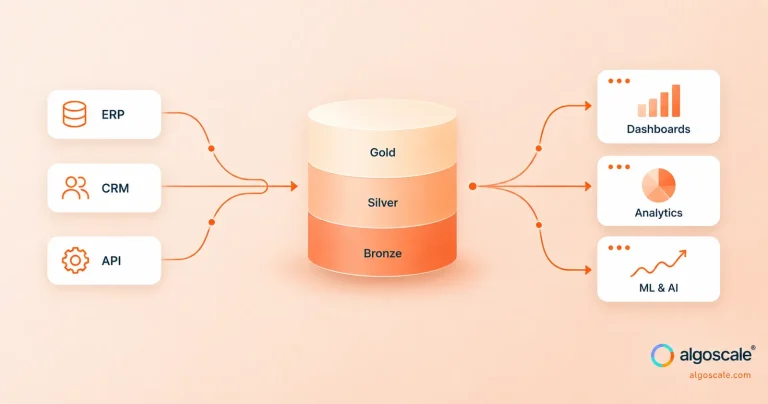
Set up your storage account and create the folders and directories that will structure your lake – typically a raw, cleansed, and curated zone.
Step 3: Build Ingestion Pipelines
This is how you get data flowing into the system on an ongoing basis.
Step 4: Set Up Microsoft Purview for Cataloging
This is how you keep track of what data exists, where it lives, and who’s responsible for it.
Step 5: Build the Transformation Pipeline
This is where you clean and transform raw data into something ready for analysis.
Step 6: Configure Security and Access Control
This is how you keep your data safe, using RBAC, ACLs, and Azure AD groups.
Step 7: Enable Analytics and BI Access
This is where the lake starts delivering value to actual business users.
Step 8: Monitor, Optimize, and Scale
This is how you make sure the system keeps running well as data volume and usage grow.
Best Practices
● Enable the hierarchical namespace from the start.
● Use the medallion architecture (raw, cleansed, curated) consistently.
● Partition by date and source.
● Automate governance through Purview from the start, not after the fact.
● Use Azure AD groups for access control rather than individual grants.
● Apply storage lifecycle policies to manage cost over time.
If you want to learn more about securing your Azure Data Lake, see our post on data lakehouse security best practices for cloud-native organizations.
Common Mistakes to Avoid
● Treating ADLS Gen2 like plain Blob Storage, without taking advantage of the hierarchical namespace.
● Skipping Purview until governance becomes a problem, rather than building it in from the start.
● Over-provisioning dedicated SQL pools before actual usage justifies the cost.
● Ignoring data lifecycle management, letting storage costs grow unchecked.
● Mixing production and development pipelines in the same workspace.
Where Microsoft Fabric Fits In
Microsoft is consolidating its data platform under Microsoft Fabric, with OneLake acting as a single, tenant-wide data lake. If you’re planning a new architecture, it’s worth understanding how this shift affects long-term platform decisions before committing to a specific approach. Our post on OneLake and the future of data warehousing covers this in more detail.
Our piece on why Microsoft Fabric is the future of data warehouse modernization goes deeper into Microsoft’s broader platform direction.
Why Work With an Azure Data Lake Implementation Partner
If you need help setting up your Azure Data Lake architecture, working with an experienced implementation partner is worth considering. At Algoscale, our Data Lake Services team has experience implementing Azure-native architectures for enterprises with complex compliance and multi-source data requirements.
Why Algoscale
● Pre-built accelerators. We don’t start every project from scratch – our accelerators, built from prior implementations, speed up common data source integration and analytics patterns.
● Faster time to value. For an initial scope covering core data sources and first analytics use cases, our accelerators typically compress development timelines to around four weeks, rather than the several months it takes to build from scratch.
● Built on a scalable framework. Our implementation approach follows a scale-ready framework, so the architecture we build for your first use case extends cleanly as your data volume and teams grow, rather than requiring a rebuild.
● Microsoft Solution Partner for Data & AI. Algoscale holds Microsoft Solution Partner status for Data & AI, including specific expertise implementing Microsoft Fabric as a modern data warehouse.
Frequently Asked Questions
1. What is the difference between Azure Data Lake Storage Gen1 and Gen2?
Azure Data Lake Storage Gen1 was a standalone service with its own file system. Gen2 is built on top of Azure Blob Storage with a hierarchical namespace added, meaning it inherits Blob Storage’s scalability, pricing tiers, and redundancy options while adding the folder-based performance benefits a data lake needs. Microsoft has fully deprecated Gen1 in favor of Gen2.
2. Do I need Azure Synapse Analytics if I’m already using Databricks?
Not necessarily. Many organizations use Databricks for transformation and machine learning while using Synapse serverless SQL pools for ad hoc querying against the same Azure Data Lake Storage Gen2 data. The two aren’t mutually exclusive, and which one leads usually depends on whether your team is more SQL-first or notebook-first.
3. How does Microsoft Purview improve data governance?
Microsoft Purview automatically scans your data estate, classifies data, builds a searchable catalog with business glossary terms, and tracks lineage from source to report. This replaces documentation that typically goes stale within months of being written manually.
4. Is Azure Data Lake Storage secure enough for regulated industries?
Yes, when configured correctly. Azure Data Lake Storage Gen2 supports encryption at rest and in transit, private endpoints, customer-managed keys, and granular RBAC plus ACL-based access control. Combined, these can meet most healthcare, financial services, and government compliance frameworks – though the configuration work to get there properly still matters.
5. How does an Azure data lake relate to Microsoft Fabric and OneLake?
OneLake, part of Microsoft Fabric, is built on Azure Data Lake Storage Gen2 and acts as a single logical data lake across an entire tenant. If you’re building new on Azure today, it’s worth evaluating whether a standalone ADLS Gen2 architecture or a Fabric/OneLake-based approach better fits your long-term platform roadmap.
6. How long does it take to implement a production-grade Azure data lake?
A basic proof-of-concept can be running within a couple of weeks. A governed architecture with Purview cataloging, RBAC/ACL security, and medallion-layer pipelines typically takes two to four months, depending on the number of source systems and compliance requirements.