

Implementing a data lake is a project, not a single technical task – and treating it like one is where a lot of implementations lose time. Some teams rush straight into building pipelines before requirements or architecture are settled, and spend months reworking early decisions. Others get stuck in extended planning cycles and never actually ship anything. A clear, phased implementation plan avoids both failure modes.
This post walks through the key steps of a data lake implementation, from initial planning through go-live and the stabilization period afterward. If your team is scoping this kind of project right now, our Data Lake Services team at Algoscale runs through exactly this kind of phased implementation regularly.
If you’re specifically migrating off an existing legacy system rather than building fresh, our companion piece on data lake migration: a practical framework for moving to the cloud covers the migration-specific version of this process.
Key Steps From Planning to Go-Live
1. Requirements and Stakeholder Alignment
Before any technical work begins, get explicit agreement on what the data lake needs to accomplish, who the initial users are, and what success actually looks like. This means talking to the business teams who’ll consume the data, not just the engineering team building it. Skipping this step is the most common reason implementations later stall on disagreements that should have been resolved before any building started.
Document specific, checkable outcomes rather than broad goals – which reports need to be supported, what data freshness is required, which teams need access on day one. Vague requirements make it impossible to know when this phase is actually finished.
2. Architecture and Platform Selection
With requirements defined, choose your cloud platform, storage structure, and core tooling. This decision should follow from the requirements gathered in step one – data volume, latency needs, existing team skills, and budget all point toward different reasonable choices. For background on what a data lake architecture is actually providing at this stage, our earlier piece on what is a data lake architecture: benefits and use cases explained is a useful reference point.
3. Data Source Inventory and Prioritization
Catalog every data source that will eventually feed the lake, and prioritize which ones matter for the initial launch versus which can be added later. Trying to onboard every source at once is a common way implementations balloon in scope and timeline. A focused initial set of high-value sources gets something real into production faster, with room to expand deliberately afterward.
4. Environment Setup and Security Foundations
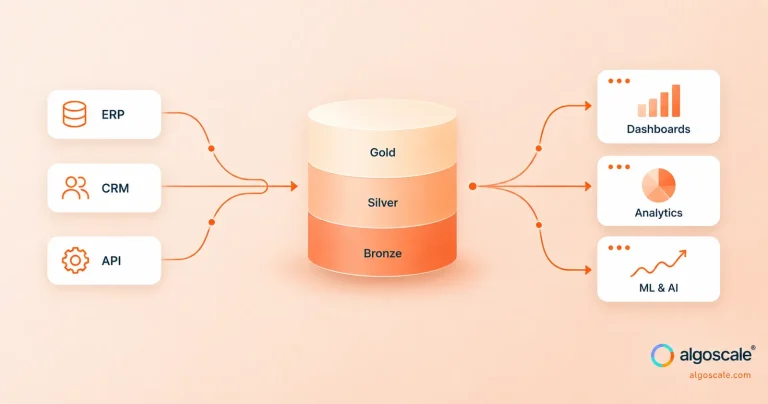
Provision your core infrastructure – storage accounts, networking, identity and access management – with security built in from the start rather than added later. This is also the point to establish your zone structure (raw, processed, curated, or an equivalent) and basic governance model. Our post on data lakehouse security best practices for cloud-native organizations covers the specific controls worth establishing at this stage, even for a lake that isn’t yet using lakehouse-specific table formats.
5. Pipeline Development
Build the ingestion and transformation pipelines for your prioritized data sources. Decide deliberately whether each pipeline follows an ETL or ELT pattern rather than defaulting inconsistently across sources – our comparison of ETL vs. ELT: which architecture is better in 2026 is a useful reference for making that call. Build pipelines for your highest-priority sources first, and resist the urge to build every planned pipeline before testing any of them end to end.
6. Testing and Validation
Before go-live, validate that data flowing through the new pipelines actually matches expectations – row counts, spot-checks against known values, and comparison against any existing systems being replaced or supplemented. This phase also includes access control testing, confirming the right people (and only the right people) can see the data they’re supposed to. Skipping thorough validation here is what turns small data quality issues into trust problems after launch.
7. Go-Live and Cutover
Once testing passes and stakeholders sign off, move the data lake into production use – connecting it to the BI tools, reports, or applications that will actually consume it. For implementations replacing or supplementing an existing system, this typically means a phased cutover rather than an abrupt switch, giving users time to validate the new system against the old one before fully relying on it.
8. Post-Launch Stabilization
The weeks immediately after go-live matter as much as the launch itself. This phase focuses on monitoring pipeline reliability, addressing issues surfaced by real usage, and gathering feedback from early users before declaring the implementation fully complete. Treating go-live as the finish line rather than the start of this phase is a common reason early data quality or performance issues go unresolved for longer than they should.

Who Should Be Involved at Each Stage
Different phases benefit from different people at the table, and planning for this in advance avoids scrambling to pull in the right stakeholders mid-project. Requirements and stakeholder alignment need genuine input from business teams and leadership, not just IT. Architecture and platform selection lean on data architects and engineering leadership. Pipeline development and testing are primarily data engineering work, though QA or analytics involvement in the testing phase catches issues engineering alone might miss. Go-live and stabilization benefit from having both engineering and the actual end users engaged, since real usage surfaces problems that internal testing sometimes doesn’t.
Common Implementation Risks
Scope creep during pipeline development. Adding “just one more source” repeatedly during the build phase is one of the most common ways a focused initial implementation turns into an unfocused, delayed one.
Skipping stakeholder sign-off at key checkpoints. Moving from one phase to the next without explicit agreement that the previous phase is actually done leads to rework later, when someone objects to a decision they didn’t realize had already been made.
Underestimating the testing and validation phase. Teams eager to hit a go-live date sometimes compress testing to make up lost time elsewhere, which is precisely the phase where cutting corners causes the most downstream damage to user trust.
Treating go-live as the project’s end rather than a milestone within it. Without a defined stabilization phase, early issues get addressed reactively and inconsistently rather than through a planned, resourced process.
Documentation Worth Keeping Throughout
A few artifacts are worth maintaining actively through every phase, rather than reconstructing after the fact. A requirements document that gets updated as decisions are made, not just written once at kickoff and forgotten. A running log of which data sources have been onboarded, in what order, and why – useful both for onboarding new team members and for defending scope decisions later if priorities get questioned. And a simple decision log captures why key architecture and platform choices were made, since “why did we choose this” is a question that comes up reliably six months after everyone remembers the original reasoning.
None of this needs to be elaborate. A shared document that’s actually kept current is more valuable than a comprehensive one that’s abandoned after the first few weeks.
Realistic Timeline Expectations
Timelines vary with scope and organizational complexity, but as a general baseline: requirements, architecture, and platform selection (steps one and two) typically take three to six weeks. Data source inventory and environment setup (steps three and four) often run in parallel, adding another two to four weeks. Pipeline development for an initial, focused set of sources (step five) commonly takes six to ten weeks depending on source complexity. Testing and validation (step six) deserves at least two to three weeks rather than being compressed at the end. All together, a realistic first implementation covering a meaningful initial scope typically runs three to five months from kickoff to a stable go-live – organizations expecting a matter of weeks are usually underestimating either the requirements phase or the testing phase, both of which are expensive to shortcut.
Getting Implementation Right the First Time
A phased, well-sequenced implementation plan is what separates a data lake that launches successfully and earns user trust from one that ships fast but requires a painful redo six months later. At Algoscale, our Data Lake Services team runs implementations through exactly this kind of structured process, scoped to whatever stage your team actually needs support with – full end-to-end delivery, or targeted help at a specific phase.
To see the broader range of data engineering and analytics work we do beyond implementation projects specifically, take a look at what Algoscale builds across the data stack.
Why Algoscale
● Pre-built accelerators. We don’t start every engagement from a blank slate – proprietary accelerators built from prior implementations speed up common data source integration and analytics patterns.
● Faster time to value. For a focused initial scope covering core data sources and first analytics use cases, our accelerators typically compress development timelines to around four weeks, rather than the several months a from-scratch build often takes.
● Built on a scalable framework. Our implementation approach follows a repeatable, scale-ready framework, so the architecture built for your first use case extends cleanly as data volume and teams grow, rather than requiring a redo.
● Microsoft Solution Partner for Data & AI. Algoscale holds Microsoft Solution Partner status for Data & AI, including specific expertise implementing Microsoft Fabric as a modern data warehouse.
Frequently Asked Questions
1. How is a data lake implementation different from a data lake migration?
An implementation typically refers to building a data lake from the ground up, whether entirely new or expanding significantly on existing infrastructure. A migration specifically involves moving data and workloads off an existing legacy system into a new environment, which adds considerations like legacy dependency mapping and cutover planning that a greenfield implementation doesn’t need to the same degree.
2. Can we skip the requirements phase if we already know roughly what we want?
It’s risky to skip entirely, even with a clear general direction. The value of this phase is surfacing disagreements or unstated assumptions between stakeholders before they cause expensive rework later – “roughly knowing what we want” often hides real differences in expectation between teams.
3. How many data sources should we include in an initial implementation?
Fewer than teams typically expect. A focused set of two to five high-value sources that get built, tested, and launched properly is usually a better foundation than a broader set that never quite reaches production-ready quality within a reasonable timeline.
4. What’s the biggest reason implementations run over their planned timeline?
Scope creep during pipeline development and underestimating the testing and validation phase are the two most common causes, more often than the core technical build itself taking longer than expected.
5. Do we need a dedicated project manager for this kind of implementation?
Not necessarily a full-time dedicated role, but someone needs to own phase sign-off, stakeholder communication, and scope discipline. Without that ownership, phases tend to blur together and scope creep becomes much harder to catch early.
6. How long should the post-launch stabilization phase last?
This varies, but two to four weeks of active monitoring and rapid issue response after go-live is a reasonable baseline before considering the implementation fully complete, with lighter-touch monitoring continuing indefinitely afterward as standard operations.