

Data lakehouse (noun) – a data storage and analytics system that combines the low cost and flexibility of a data lake with the reliability and speed of a data warehouse, so a company can store, trust, and analyze its data all in one place.
If that definition still feels a little abstract, that’s normal – “lakehouse” is a made-up word, and it only makes sense once you know what the two words it’s built from actually mean. This post breaks the term down simply, then walks through the handful of components that actually make a lakehouse work. If you want the deeper technical version afterward, we’ve also written about the core layers of a modern lakehouse architecture.
If you’re deciding whether a lakehouse is the right move for your business right now, our Data Lake Services team at Algoscale can help you figure that out.
Where the Word Comes From
“Lakehouse” is a portmanteau – a word made by mashing two other words together – combining “data lake” and “data warehouse.” That’s not just a marketing trick; it genuinely describes what the technology does.
A data lake is a place to store huge amounts of data cheaply, in whatever format it naturally comes in, without needing to organize it first. The tradeoff is that data lakes historically weren’t very reliable – data could get duplicated, corrupted, or hard to trust.
A data warehouse is a place built for fast, reliable business reporting, but it requires data to be cleaned and structured before it goes in, and it tends to be more expensive to run at large scale.
A data lakehouse takes the cheap, flexible storage from the first and adds the reliability and speed of the second – without needing to run two separate systems side by side.
The Key Components of a Data Lakehouse
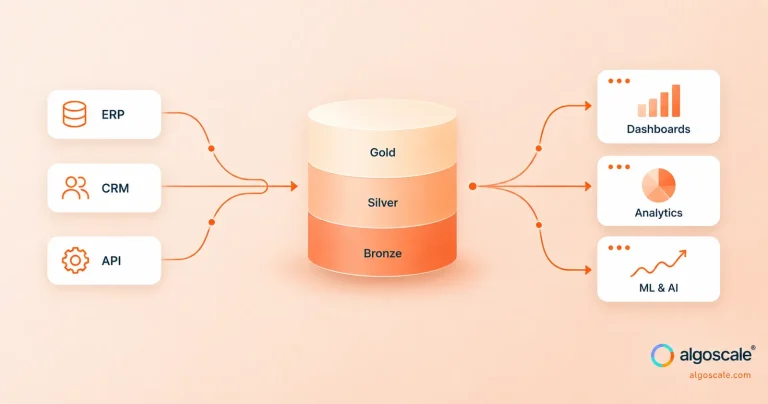
A data lakehouse isn’t one single piece of software – it’s made up of several components working together. Here are the ones that actually matter to understand.
1. Cheap, Flexible Storage
At the base of every lakehouse is inexpensive cloud storage – the same kind of storage a data lake uses. It can hold any kind of data: spreadsheets, images, logs, sensor readings, whatever your business generates, without needing to decide on structure ahead of time.
2. A Reliability Layer
This is the piece that makes a lakehouse different from a plain data lake. A technology sits on top of the storage and adds rules: it won’t let two processes overwrite each other’s work by accident, it checks that incoming data actually matches the expected format, and it keeps a history of changes so nothing gets lost silently. Without this layer, you just have a data lake – with it, you have something closer to a trustworthy database.
3. A Catalog
Think of this as the lakehouse’s index or table of contents. It keeps track of what data exists, what it means, who’s allowed to see it, and where it came from. Without a catalog, even well-organized data becomes hard to find as a company grows – nobody can answer “does this table exist, and can I trust it?” without one.
4. A Way to Process the Data
Raw data usually isn’t ready to use the moment it arrives – it needs to be cleaned, joined with other data, or summarized. This component is the computing engine that does that work, transforming messy raw data into something simple and usable.
5. Governance and Security
This is the set of rules controlling who can see what, how data is protected, and how the company stays compliant with regulations like data privacy laws. In a lakehouse, this isn’t bolted on as an afterthought – it’s meant to apply consistently across every piece of data, not just some of it.
6. A Way for People to Actually Use the Data
At the top, this is what business teams and analysts actually interact with – dashboards, reports, and tools that let people ask questions and get answers, without needing to understand any of the technical pieces underneath.

Why This Combination Actually Matters
Before lakehouses existed, companies often ran two systems side by side: a data lake for cheap storage of everything, and a separate data warehouse for the clean, trustworthy data business teams actually used for reporting. Keeping both in sync took real ongoing engineering effort, and it was common for the two systems to quietly drift out of agreement – leading to the frustrating experience of two teams pulling “the same” number and getting two different answers.
A lakehouse removes that split. There’s one place data lives, one set of rules governing it, and one version of the truth that every team pulls from – whether they’re building a dashboard, training a machine learning model, or just running an ad hoc report.
For a closer look at how this plays out in practice, see our post on data lake vs. data warehouse: which architecture is right for your business, which compares the two older approaches this design replaces.
Signs You’re Already Living With This Problem
A few situations tend to show up before a company realizes it might need a lakehouse:
● Two teams present different numbers for what should be the same metric, and nobody’s quite sure why
● Your company pays for both a data lake and a separate data warehouse, plus the engineering time to keep them roughly in sync
● A new employee takes weeks to figure out which data source is actually the “real” one
● Your team wants to start using AI or machine learning, but the data isn’t clean or accessible enough to support it
None of these mean something has gone badly wrong – they’re common growing pains as a company’s data needs outgrow its original setup. They’re just useful signals that it might be time to look at a different approach.
A Simple Example
Imagine a mid-sized retailer that used to keep sales data in one system for reporting and customer browsing data in a separate, messier system for occasional analysis. Marketing pulled numbers from one place, finance pulled from another, and the two rarely matched exactly.
Moving both into a single lakehouse means both data types live in the same governed environment. A marketing dashboard and a finance report now pull from the same underlying, validated tables – and a data science team building a recommendation model can access the same trustworthy data too, without needing a separate export process just for their use case. To see this kind of impact quantified more concretely, our post on top benefits of a data lakehouse for enterprise data modernization is worth a look.
Common Words You’ll Hear Around This Topic
A few terms tend to come up alongside “lakehouse” – here’s what they mean in one line each:
● ACID transactions – a guarantee that data updates either fully complete or don’t happen at all, so nothing ends up half-finished or corrupted.
● Schema – the structure of the data, like column names and types, similar to headers in a spreadsheet.
● Medallion architecture – a common pattern of organizing data in stages, from raw to cleaned to ready-for-reporting.
● Open table format – the specific technology (like Delta Lake or Apache Iceberg) that provides the reliability layer described above.
What This Means for Different Teams
For business and leadership teams, a lakehouse mainly means fewer arguments over whose numbers are correct, and faster access to new kinds of analysis without waiting on a lengthy IT request process.
For data and analytics teams, it means less time spent reconciling two systems, and a single, governed place to build new reports, dashboards, and models instead of juggling separate pipelines into a lake and a warehouse.
For IT and engineering leadership, it typically means a simpler overall footprint – one platform to secure, monitor, and pay for, instead of two – even though the initial setup requires real planning to get right.
Is a Lakehouse Right for Your Business?
Not every company needs to make this move immediately, but it’s worth considering if you’re maintaining two separate systems just to get both flexibility and reliability, if different teams keep reporting different numbers for what should be the same metric, or if you’re trying to support both business reporting and newer needs like AI and machine learning from the same data. At Algoscale, our Data Lake Services team helps companies figure out honestly whether this is the right move, and what it would actually take to get there.
To see the broader range of data engineering and analytics work we do beyond lakehouses specifically, take a look at what Algoscale builds across the data stack.
Why Algoscale
● Pre-built accelerators. We don’t start every engagement from a blank slate – proprietary accelerators built from prior implementations speed up common data source integration and analytics patterns.
● Faster time to value. For a focused initial scope covering core data sources and first analytics use cases, our accelerators typically compress development timelines to around four weeks, rather than the several months a from-scratch build often takes.
● Built on a scalable framework. Our implementation approach follows a repeatable, scale-ready framework, so the architecture built for your first use case extends cleanly as data volume and teams grow, rather than requiring a redo.
● Microsoft Solution Partner for Data & AI. Algoscale holds Microsoft Solution Partner status for Data & AI, including specific expertise implementing Microsoft Fabric as a modern data warehouse.
Frequently Asked Questions
1. Is “data lakehouse” just a marketing term, or is it a real technical distinction?
It’s a real technical distinction. The reliability features – like transaction guarantees and schema checking – are genuine engineering capabilities added on top of data lake storage, not just a rebrand of an existing product.
2. Do I need to replace my data warehouse to adopt a lakehouse?
Not necessarily. Many companies run a lakehouse alongside their existing warehouse for a while, gradually shifting workloads over, rather than switching everything at once.
3. Which of the key components is most important to get right first?
The reliability layer and the catalog tend to matter most early on, since they’re what prevent the “which number is right” problem that motivates most companies to consider a lakehouse in the first place.
4. Can a small company benefit from a lakehouse, or is it only for large enterprises?
Company size matters less than how many teams depend on the same data and how much that data has grown. Even a smaller company can benefit once more than one team is regularly working from the same datasets.
5. Do I need a data engineering team to build one of these?
Some technical expertise is required, but it doesn’t have to be a large in-house team – many companies work with an experienced partner for the initial build, especially if this is their first time implementing this kind of architecture.
6. How is a lakehouse different from just using a cloud storage folder for everything?
A plain storage folder has no rules preventing bad data, no way to track history, and no built-in catalog – it’s just files sitting in a location. A lakehouse adds structure, reliability, and governance on top of that storage, which is what makes it trustworthy enough for real business decisions.