

Every enterprise today is sitting on more data than it knows what to do with. Customer transactions, machine sensor readings, application logs, social signals, clickstream events, and dozens of other data streams are being generated every second. The real question is not whether your business has data. It is whether your infrastructure can hold it, govern it, and turn it into a decision fast enough to matter.
A data lake house answers that question directly. It gives enterprises a single, governed platform that combines the raw scale of a data lake with the reliability and structure of a data warehouse, without forcing teams to maintain two disconnected systems just to get both benefits.
This guide explains what a data lake house is, how it is architected, how it compares to other storage approaches, and the concrete benefits it delivers for enterprise data modernization, along with how data lake house consulting services help organizations move from fragmented infrastructure to a unified, analytics-ready platform.
What Is a Data Lake House?
A data lake house, often shortened to lakehouse, is an architecture that layers warehouse style governance, structure, and performance directly on top of a data lake’s low cost, flexible storage. It accepts any data type, structured, semi structured, or unstructured, without demanding a rigid schema upfront, while still supporting ACID transactions, indexing, and reliable querying once that data needs to be used.
This means engineering teams no longer have to choose between cheap, flexible storage and dependable, governed access. Whether the platform runs as an AWS data lake house, an Azure data lake house, or a hybrid setup spanning both, the model removes the need to copy data back and forth between a separate lake and a separate warehouse just to satisfy different teams.
A mature data lake house becomes the single foundation that supports business intelligence, machine learning, AI development, and real time operations across the entire organization, all on the same governed dataset.
How a Data Lake House Is Architected
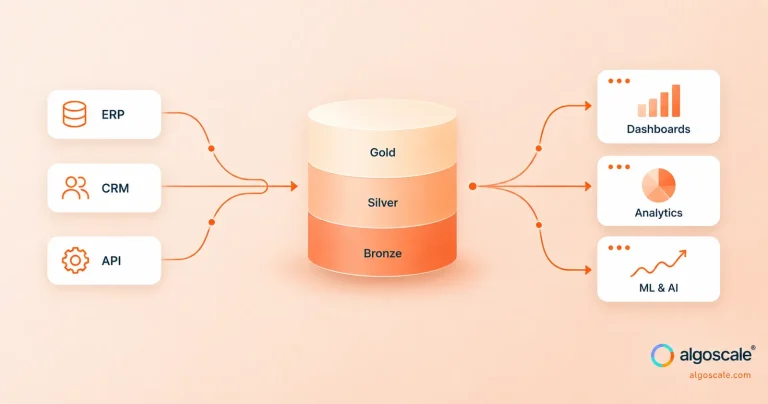
A data lake house is not a single storage bucket with a new label on it. It is a layered architecture where data moves through progressively refined zones while open table formats add database grade reliability across every layer.
Ingestion Layer
Data enters from relational databases, SaaS platforms, IoT devices, event streams, APIs, and external feeds. Ingestion pipelines handle both batch uploads and continuous real time streams, ensuring every source lands in the platform without manual intervention.
Raw Zone
Everything that enters the platform lands here in its native format. No transformations are applied at this stage. This zone preserves the complete history of every data point, which matters because a cloud data lake house often needs to reprocess raw history whenever business logic changes.
Processing Zone
Here, data is cleaned, deduplicated, validated, and enriched. Schemas are applied selectively, relationships between datasets are resolved, and automated quality checks run through the pipeline. This is where raw inputs become trusted, reliable datasets.
Curated Zone With Transactional Reliability
Processed data is organized into business ready tables using open formats such as Delta Lake, Apache Iceberg, or Apache Hudi. These formats bring ACID transactions, time travel queries, and schema evolution directly to lake scale storage, which is the defining capability that separates a true data lake house from a plain data lake.
Governance and Metadata Layer
A governance layer runs across every zone. It manages cataloging, lineage tracking, access controls, PII masking, audit trails, and quality enforcement. Without this layer, even a technically well built data lake house slowly becomes unusable as data volume grows and ownership becomes unclear.
Consumption Layer
At the top of the architecture, analysts query with SQL, data scientists work in Python and Spark, ML engineers pull from feature stores, and business users access dashboards, all on the same governed dataset, without one workload starving another.
How a Data Lake House Compares to Other Data Architectures
Enterprises evaluating a data lake house often want to know exactly where it sits relative to the systems already running in their environment.
| Dimension | Data Warehouse | Data Lake | Data Lake House |
| Data Types Supported | Structured only | Structured, semi structured, unstructured | All data types |
| Schema Approach | Schema on write (predefined) | Schema on read (applied at query time) | Hybrid: flexible ingestion with enforced structure |
| Scale | Limited, scales expensively | Petabyte scale natively | Petabyte scale with transactional reliability |
| Query Flexibility | SQL only | SQL, Spark, Python, ML frameworks | SQL, Spark, Python, ML frameworks, all on one copy |
| Governance Capabilities | Strong, table level permissions | Native limitations unless actively managed | Fine grained governance built into the storage layer |
| Cost at Scale | High, compute and storage tightly coupled | Low storage cost, variable compute cost | Balanced, optimized storage and compute efficiency |
| Real Time Support | Yes, for transactional writes | Yes, with streaming ingestion | Yes, streaming and batch on the same tables |
A data warehouse is built for fast, predictable BI queries on structured data, but it strains under unstructured data and machine learning workloads at scale. A data lake handles volume and variety well but lacks native transactional reliability. A data lake house is the only architecture designed to hold all data types, support all consumer types, and still deliver the consistency a regulated enterprise depends on, all within a single governed platform.
What Makes a Data Lake House Database Different from Traditional Storage
The storage and query layer beneath a data lake house is what turns raw object storage into a queryable, versioned, and governed system. This is where open table formats like Delta Lake, Apache Iceberg, and Apache Hudi do the real work.
Unlike a traditional relational database that enforces structure at write time, this layer stores data in open formats directly on cloud object storage while adding database grade capabilities on top. These include ACID transaction support so concurrent writes do not corrupt shared tables, time travel queries that let analysts query historical snapshots, schema evolution so new fields can be added without breaking existing pipelines, and incremental processing so only changed data gets reprocessed instead of full table scans.
This combination is exactly what separates a production grade cloud data lake house from a collection of files sitting in a storage bucket. It brings reliability and queryability to raw storage, letting BI tools and ML frameworks work confidently on the same underlying data.
Top Benefits of a Data Lake House for Enterprise Modernization
Unified Storage Without Duplicate Pipelines
A data lake house removes the need to maintain separate copies of the same data for BI and for machine learning. Teams query the same governed dataset whether they need a dashboard or a training set, which cuts down on duplicate pipelines and the inconsistencies that come from reconciling numbers across two systems that were never meant to match perfectly.
ACID Transactions on Lake Scale Data
Open table formats bring transactional reliability to data that previously lived as loosely organized files. Concurrent reads and writes, reliable updates, and rollback capability now run on top of the same low cost storage that makes a data lake economical in the first place. For enterprises running concurrent batch and streaming jobs against shared tables, this single capability removes an entire category of data corruption incidents that used to require manual cleanup.
Stronger Governance Without Losing Flexibility
Instead of choosing between strict governance in a warehouse and weak controls in a lake, a data lake house applies fine grained access policies, lineage tracking, and quality checks directly on raw and curated data. This matters for any business operating under SOC2, HIPAA, or GDPR obligations, since it removes the compromise of either over restricting access to satisfy auditors or under restricting access to keep analysts productive.
Better Cost Control Through Decoupled Compute
Storage and compute scale independently in a cloud data lake house, the same way they do in a standard data lake. Enterprises stop paying for tightly coupled warehouse infrastructure when workloads are uneven, and instead scale compute up or down based on actual demand, which matters most for businesses with seasonal spikes such as retail during the holidays or finance during quarter end reporting.
Faster AI and Machine Learning Enablement
Models train better on complete, governed datasets rather than fragmented exports pulled from multiple systems. A data lake house gives data science teams direct access to raw and curated data side by side, shortening the path from raw input to a production ready model and reducing the drift that often appears when training data is extracted through a separate, disconnected process.
Real Time and Batch Workloads on One Platform
A data lake house supports streaming ingestion and batch processing within the same architecture, which means real time fraud detection, supply chain monitoring, or customer behavior tracking no longer requires a completely separate pipeline from historical reporting.
Reduced Vendor Lock In
Because a data lake house relies on open table formats rather than proprietary storage layers, enterprises retain freedom to switch processing engines or analytics tools later without a full data migration, protecting them from the costly trap of committing to a single vendor’s storage format too early.

Data Lake House Use Cases by Industry
Data forms the competitive advantage of every high performing organization. Here is how a data lake house solves real problems across key industries.
Healthcare
Healthcare organizations generate data from electronic health records, medical imaging, wearables, lab systems, and clinical trial platforms, most of it trapped in disconnected systems. A data lake house centralizes this into one governed platform, giving clinicians complete patient histories instantly and letting AI models for disease detection and readmission risk train on complete, consistent data rather than fragmented subsets, all while maintaining audit trails for compliance.
Financial Services and Banking
Financial institutions process millions of transactions daily, and fraud patterns evolve faster than batch based detection can respond. A data lake house consolidates transaction records, behavioral signals, market data, and risk indicators into a unified platform, supporting near real time fraud detection alongside consistent risk modeling and regulatory reporting across every product line.
Retail and E-Commerce
Retail organizations collect data across stores, e-commerce platforms, loyalty programs, and supply chains, and disconnected signals lead to decisions made on partial information. A data lake house unifies point of sale records, clickstreams, and supplier data so merchandising teams see inventory in real time and marketing teams personalize campaigns based on actual purchase behavior rather than outdated segments.
Insurance
Insurance companies manage claims, underwriting, and policyholder data alongside external risk feeds, and fragmentation across legacy systems slows underwriting and makes fraud detection reactive. A data lake house creates a unified view across every policyholder and product, supporting AI driven risk scoring and faster, auditable regulatory reporting.
Manufacturing
Manufacturing environments generate high velocity data from sensors, quality systems, and supply chain platforms that are rarely connected to analytics. A data lake house ingests all of it in real time, enabling predictive maintenance models that catch failure signatures early and supply chain teams that adjust procurement before shortages hit production.
Measuring the Shift: Before vs After Data Lake House Adoption
| Area | Before Data Lake House Adoption | After Data Lake House Adoption |
| Data Duplication | Multiple copies maintained across warehouse and lake | Single governed copy serving BI and ML alike |
| Query Performance | Inconsistent, dependent on the processing layer | Indexing, caching, and ACID support improve consistency |
| Governance Enforcement | Fragmented across disconnected systems | Centralized, fine grained access and lineage controls |
| Time to Insight | Delayed by manual reconciliation between systems | Faster, since teams query one unified dataset |
| Infrastructure Cost | High due to duplicate storage and compute | Reduced through decoupled, optimized storage and compute |
| AI/ML Readiness | Limited by fragmented, inconsistent training data | Strong, with direct access to clean, complete datasets |
Our Data Lake Consulting Services
Algoscale’s enterprise data lake house consulting services are built on one principle: your architecture should accelerate decisions, not delay them. We map your current data landscape from every source to every bottleneck and design platforms that prevent the costly mistakes that come with poorly planned implementations.
Data Lake Strategy and Architecture Design
Before writing a single line of infrastructure code, our consultants assess your existing systems, document every data source and integration point, and identify the bottlenecks costing your teams time and money. We then design a zone based architecture tailored to your specific workloads rather than imposing a template, connected through a unified metadata fabric that keeps the entire platform coherent as it grows.
Enterprise Data Lake House Implementation
Our implementation practice covers multi cloud and hybrid deployments across AWS, Azure, and GCP with a vendor neutral approach. Whether the target environment is an AWS data lake house or an Azure data lake house, we design medallion architectures for progressive data refinement, configure schema on read flexibility with governance guardrails, and build both streaming and batch ingestion pipelines optimized for your data volumes and latency requirements.
Data Lake Migration and Modernization
Organizations moving off legacy platforms face two risks: losing data integrity during migration and disrupting analytics operations that business teams depend on daily. Our migration approach runs automated ETL to ELT conversion while preserving existing business logic, executes parallel validation across large datasets, and maintains parallel system operation until side by side verification confirms every dataset has been transferred accurately.
Data Governance and Security Implementation
Governance is embedded into the foundation before any data is ingested, not added as an afterthought. We build policy based access controls, automated data lineage that tracks every transformation, metadata cataloging that makes data discoverable across teams, PII detection and masking for regulatory compliance, and data quality frameworks that prevent unreliable data from reaching analytics consumers.
ML and Analytics Enablement
A data lake house only delivers value when teams can actually access and use it. We build model deployment pipelines, feature stores with versioning and reproducibility controls, integration with the BI tools your teams already use, and self-service access frameworks that let business users explore curated data without engineering support, supporting real time analytics alongside batch workloads without architectural conflict.
Platform Optimization and Cost Engineering
Many platforms accumulate inefficiency quietly over time through poor partition strategies, suboptimal storage formats, and idle compute resources. We audit existing environments and optimize total cost of ownership through intelligent storage tiering, compute auto-scaling, query tuning, and format conversion, continuously fine-tuning the platform as usage patterns evolve.
Ongoing Support and Managed Services
A data lake house is a living system that changes as your business grows. As your long-term data partner, Algoscale provides round the clock monitoring with proactive issue detection, performance tuning as workloads grow, schema evolution management, tool upgrades, and quarterly architecture reviews that keep your platform aligned with evolving business needs.
Why Choose Algoscale for Data Lake House Consulting Services
Most data lake house consulting services firms sell a platform and call it a strategy. Algoscale architects outcomes. With 890 petabytes of production data under management, $47M in cloud cost savings delivered, and 4.8x faster data processing achieved for clients, our track record reflects real execution rather than theoretical frameworks.
Our consultants are platform agnostic. Whether the right fit is an Azure data lake house, an AWS data lake house, GCP Cloud Storage, or a hybrid of all three, we optimize for long term performance, governance, and usability rather than vendor preference.
We have delivered zero failed audits across SOC2, HIPAA, and GDPR for clients operating in regulated industries. From fraud detection systems processing billions of transactions daily to healthcare platforms managing millions of patient records, our architectures are built to perform under real world conditions.
Algoscale’s team includes 27 cloud certified architects, a production patterns library documenting solutions to over 200 common failure scenarios, and optimization playbooks that compress 18 month learning curves into 6 week implementations.
Building a Future Ready Data Lake House Foundation
A data lake house is not just a storage upgrade. It is a strategic architectural capability that determines how fast an organization can move from raw data to decision-ready intelligence. Built correctly with proper zone architecture, transactional table formats, and consumption-ready layers, it becomes the foundation for everything from real time operations to enterprise AI. Built poorly, it inherits the same swamp-like problems a mismanaged data lake suffers from, only with more moving parts to untangle.
The difference comes down to architecture, governance, and expertise applied from the start, which is exactly what Algoscale’s data lake house consulting services are built to deliver.
Connect with Algoscale’s data lake house team to assess your current data architecture and build a platform that accelerates decisions at scale.