

A lot of lakehouse projects stall out in the same place: a team spends weeks debating Delta Lake versus Apache Iceberg versus Apache Hudi, or Databricks versus Snowflake versus a native cloud stack, before they’ve actually defined what the lakehouse needs to do. The tooling decision matters, but it’s not actually the first decision – and treating it like the starting point is one of the most common reasons lakehouse projects lose momentum before they produce anything useful.
This post lays out a practical roadmap for building a data lakehouse – not a single architectural decision, but a sequence of phases that gets you from an idea to a working, adopted platform. If you’re planning this kind of build right now, our Data Lake Services team at Algoscale has guided organizations through this exact roadmap across a range of platforms and industries.
For the underlying technical architecture this roadmap builds toward, our complete technical breakdown of lakehouse architecture is a useful companion read.
What “Building a Lakehouse” Actually Involves
A lakehouse isn’t a product you install – it’s an architecture pattern you implement through a series of decisions and builds, each of which affects the ones that follow. Treating it as a single project with a single finish line tends to produce either analysis paralysis (endless tool comparisons with nothing built) or the opposite failure mode (a rushed build that locks in poor early decisions). A phased roadmap avoids both by sequencing decisions in the order they actually need to happen.
The Roadmap: Six Phases
Phase 1: Define Use Cases and Success Criteria
Before evaluating a single platform or table format, get specific about what the lakehouse needs to do in its first six months. Is the immediate driver consolidating fragmented reporting? Enabling a specific machine learning initiative? Replacing an aging, expensive warehouse? The answer shapes nearly every decision downstream – a lakehouse optimized for ML workloads looks different in its early build priorities than one optimized purely for BI consolidation.
Define what success looks like concretely: specific reports migrated, specific query performance targets, specific teams onboarded. Vague goals like “modernize our data platform” make it impossible to know when this phase is actually done.
Phase 2: Choose Your Platform and Table Format
With use cases defined, platform and table format decisions become much more tractable. Heavy ML and AI workloads point toward platforms like Databricks with Delta Lake. Multi-engine flexibility and avoiding vendor lock-in point toward Apache Iceberg, now supported natively across Snowflake, AWS, and Google Cloud. Existing cloud investment and team skill sets should weigh heavily here – the “best” choice in the abstract is far less important than the best fit for what your team can actually operate well.
This is also the point to decide on your primary cloud provider (or confirm your existing one), since storage, compute, and catalog choices all follow from that decision.
Phase 3: Design Your Zone Structure and Governance Model
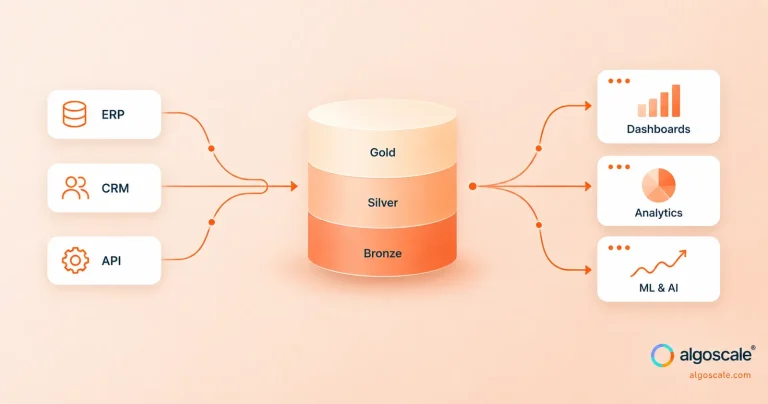
Before writing a single pipeline, define your medallion structure (bronze/silver/gold or an equivalent), your catalog strategy, and your access control model. This is the phase most commonly skipped or rushed – teams want to see data flowing quickly – but retrofitting governance onto a lakehouse that’s already accumulated dozens of ungoverned tables is dramatically more expensive than designing it up front.
Decide, at minimum: who owns each zone, what quality bar data must meet to move between zones, and who can access what. You don’t need a perfect answer here, but you need a documented starting point.
For a deeper look at how this structure becomes a genuine organizational asset rather than just a technical pattern, see our post on creating a single source of truth using data lakehouse architecture.
Phase 4: Build Your First Pipelines
With platform and structure decided, build a small number of pipelines end to end – ideally covering the highest-priority use cases identified in Phase 1, not the easiest ones to build. A handful of pipelines that fully prove out ingestion, transformation, and the bronze-to-gold flow are worth more at this stage than dozens of shallow, half-finished ones.
Decide your ETL versus ELT approach deliberately here rather than defaulting to whatever the team is most familiar with – our comparison of ETL vs. ELT: which architecture is better in 2026 is a useful reference for making that call intentionally.
Phase 5: Enable Consumption
A lakehouse only delivers value once people are actually using it. This phase connects BI tools to gold-layer tables, sets up SQL access for analysts, and – if relevant to your use cases – connects ML workflows directly to governed data. This is also the point to gather real feedback from early users, since assumptions made in Phase 1 often need adjusting once people are actually querying the platform.
Phase 6: Operationalize and Iterate
Once the initial build is live and adopted, shift focus to sustainability: monitoring, cost tracking, automated table maintenance, and a defined process for onboarding new use cases and teams without each one requiring a bespoke setup. This phase doesn’t end – a lakehouse that stops iterating tends to drift back toward the ungoverned sprawl it was built to avoid.
Team and Roles Needed Along the Way
Different phases lean on different skills, and it’s worth planning for this rather than assuming one team composition covers the whole roadmap. Early phases (1-3) benefit from strong involvement from business stakeholders and data architects defining requirements and structure. Middle phases (4-5) lean heavily on data engineering to build pipelines and analytics engineering to enable consumption. The final phase benefits from platform or DevOps-oriented skills focused on monitoring, cost, and operational sustainability. Few organizations have all of this depth in-house from day one, which is often exactly where a managed services partner fits into the roadmap for specific phases rather than the whole project.
Common Roadmap Mistakes
Choosing tooling before defining use cases. This is the single most common failure mode – teams pick a platform based on what’s trending rather than what their actual workloads need, then spend months working around a poor fit.
Skipping governance design until it becomes painful. Teams eager to show progress often build pipelines before deciding on zone structure or access control, then face an expensive retrofit once dozens of ungoverned tables already exist.
Trying to migrate everything at once. Attempting a full, organization-wide migration in Phase 4 instead of proving the pattern with a focused set of pipelines first tends to produce a slower, higher-risk rollout with no early wins to build momentum or confidence.
Treating Phase 6 as optional. A lakehouse that reaches production and then gets no further investment in monitoring, cost management, or governance maintenance tends to degrade back toward the problems it was built to solve.
To understand the tangible payoff that makes this investment worthwhile, our post on top benefits of a data lakehouse for enterprise data modernization covers the business case in more depth.
How Long Should This Actually Take
Timelines vary significantly based on organizational complexity, but a reasonable baseline: Phases 1-3 (definition, platform choice, and structural design) typically take four to eight weeks for a mid-sized organization. Phase 4 (initial pipeline build) often takes another six to twelve weeks depending on data source complexity. Phase 5 (enabling consumption) can run in parallel with the tail end of Phase 4. Phase 6 is ongoing by design.
A realistic expectation for a first working, adopted lakehouse covering a meaningful initial use case is three to six months – organizations expecting a two-week turnaround are usually setting themselves up for a rushed Phase 3 that causes problems later.
Measuring Progress Along the Way
It’s worth defining checkpoints beyond just “is the platform technically running.” A roadmap that’s actually working shows measurable signs at each stage: by the end of Phase 3, stakeholders can clearly articulate the governance model without checking documentation. By the end of Phase 4, your first pipelines are producing data that matches trusted existing reports within an acceptable margin. By the end of Phase 5, real business users – not just the project team – are voluntarily choosing to query the lakehouse instead of falling back to old habits. These checkpoints matter more than a rigid calendar, since a roadmap that hits dates without hitting adoption hasn’t actually succeeded.
Getting Support Along the Roadmap
Not every organization needs – or wants – a partner for the entire roadmap above. Some need help specifically with Phase 2 and 3 decisions where experience genuinely accelerates good choices; others want full support through to Phase 6. At Algoscale, our Data Lake Services team scopes engagements around wherever your team actually needs support along this roadmap, rather than a one-size-fits-all package.
To see the broader range of data engineering and analytics work we do beyond lakehouse builds specifically, take a look at what Algoscale builds across the data stack.
Why Algoscale
● Pre-built accelerators. We don’t start every engagement from a blank slate – proprietary accelerators built from prior implementations speed up common data source integration and analytics patterns.
● Faster time to value. For a focused initial scope covering core data sources and first analytics use cases, our accelerators typically compress development timelines to around four weeks, rather than the several months a from-scratch build often takes.
● Built on a scalable framework. Our implementation approach follows a repeatable, scale-ready framework, so the architecture built for your first use case extends cleanly as data volume and teams grow, rather than requiring a redo.
● Microsoft Solution Partner for Data & AI. Algoscale holds Microsoft Solution Partner status for Data & AI, including specific expertise implementing Microsoft Fabric as a modern data warehouse.
Frequently Asked Questions
1. Do we need to complete each phase fully before starting the next one?
Not strictly – some overlap is normal and expected, particularly between Phase 4 and 5. But skipping the substance of a phase entirely (especially Phase 3’s governance design) to move faster tends to create problems that cost more time later than the phase would have taken to do properly.
2. How do we choose between Delta Lake, Iceberg, and Hudi in Phase 2?
This decision should follow directly from your Phase 1 use cases and existing platform investment. Delta Lake fits naturally on Databricks. Iceberg offers the broadest multi-engine flexibility across Snowflake, AWS, and Google Cloud. Hudi is worth prioritizing if streaming ingestion is a dominant workload. None is universally “best” – fit to your actual environment matters more.
3. Can we start this roadmap without a dedicated data engineering team?
Yes, particularly for Phases 1-3, which lean more on business and architectural input than deep engineering execution. Phases 4-6 benefit significantly from data engineering expertise, whether in-house or brought in for that portion of the roadmap.
4. What’s the minimum viable version of Phase 3’s governance design?
At minimum: documented zone ownership, a basic access control model, and a defined data quality bar for promoting data between zones. It doesn’t need to be exhaustive – it needs to exist and be followed, with room to mature over time.
5. How do we know if we’re ready to move from Phase 4 to Phase 5?
When your initial pipelines are reliably producing accurate, validated gold-layer data that matches expectations from Phase 1’s success criteria. Moving to broad consumption before pipelines are trustworthy just relocates data quality problems to a more visible audience.
6. What happens if our use cases change significantly after we’ve already built out Phases 2-3?
This is normal, not a failure – Phase 6’s ongoing iteration exists specifically to accommodate this. A well-designed governance structure and reasonably chosen platform can usually absorb evolving use cases without requiring you to restart the entire roadmap from Phase 1.