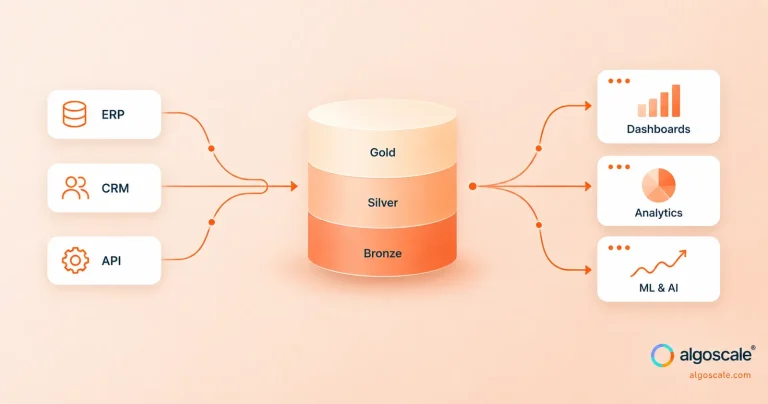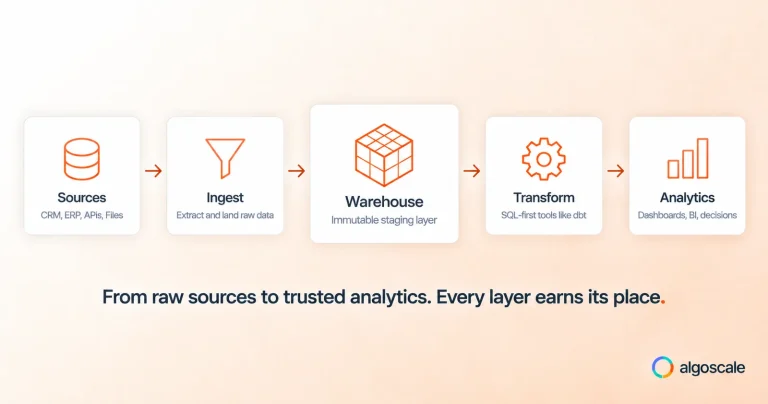


Ask someone to sketch a lakehouse architecture on a whiteboard, and you’ll usually get two boxes: storage and compute. That’s not wrong, exactly, but it’s a big simplification of what a production lakehouse actually consists of. A working lakehouse is a stack of distinct layers, each doing a specific job, and understanding where those boundaries sit is what makes the architecture maintainable as it grows.
This post walks through those layers one at a time – including one that most architecture diagrams skip entirely, even though it’s often the difference between a lakehouse that different teams actually trust and one that quietly produces conflicting numbers. If you’re designing or auditing a lakehouse architecture, our Data Lake Services team at Algoscale works through exactly this layer-by-layer thinking with clients.
For a deeper technical dive into the storage and table-format side specifically, our complete technical breakdown of lakehouse architecture is a useful companion read.
Why Thinking in Layers Matters
Separating a lakehouse into distinct layers isn’t just a diagramming convention – it has real practical value. When each layer has a clear job and a clean interface to the layers around it, you can swap the tool at any single layer without tearing out the rest of the architecture. This is one of the genuine advantages of the lakehouse pattern over a monolithic proprietary warehouse: because the layers are built on open formats and standard interfaces, a change in your processing engine or BI tool doesn’t require re-architecting your storage or catalog.
The Core Layers
1. Ingestion Layer
This is where data enters the lakehouse from source systems – databases, applications, event streams, SaaS platforms, IoT devices. The ingestion layer’s job is getting data in reliably, whether through batch extraction, change data capture, or real-time streaming, without applying heavy transformation logic here. Keeping ingestion focused on reliable delivery, rather than mixing in business logic, keeps this layer simple and easy to reason about when something breaks.
2. Storage Layer
Underneath everything sits cloud object storage – S3, Azure Data Lake Storage Gen2, or Google Cloud Storage – holding data as files, typically in the columnar Parquet format. This layer’s only real job is durable, low-cost storage. It doesn’t understand tables, transactions, or schemas on its own; that intelligence lives in the layer directly above it.
3. Table Format Layer
This is the layer that turns raw files into something that behaves like a reliable database table. Open table formats – Delta Lake, Apache Iceberg, Apache Hudi – sit directly on top of storage and add ACID transactions, schema enforcement, and time travel. This layer is what actually makes a “lakehouse” different from a plain data lake, and it’s worth understanding as its own distinct layer rather than lumping it in with storage.
4. Metadata and Catalog Layer
Above the table format sits the catalog – tracking what tables exist, their schemas, their lineage, and who can access them. This layer is what lets multiple compute engines safely read and write the same tables, and what makes a lakehouse with thousands of tables navigable instead of an unsearchable pile of files. Unity Catalog, AWS Glue Data Catalog, and Hive Metastore all live at this layer.
5. Processing and Compute Layer
This layer does the actual work – transformation, aggregation, and query execution. Because the layers below are open, multiple engines can operate here: Apache Spark for large-scale transformation, Trino or Presto for federated querying, or vendor-optimized engines like Databricks’ Photon. Teams can choose different engines for different workloads without duplicating the underlying data.
6. Semantic Layer
This is the layer most architecture diagrams leave out, and it’s frequently where “which number is right” problems actually originate. The semantic layer defines business metrics and logic once – how “active customer” or “monthly revenue” is calculated – so every downstream tool references the same definition instead of each BI dashboard or analyst reimplementing the calculation slightly differently. Tools like dbt’s semantic layer, Cube, or a well-governed set of curated gold-layer views all serve this function. Skipping this layer doesn’t mean it disappears – it just means the logic gets duplicated, inconsistently, across every consumption tool instead.
For a broader look at why this consistency matters organizationally, see our post on creating a single source of truth using data lakehouse architecture.
7. Consumption Layer
At the top, BI tools, SQL clients, and machine learning frameworks all read from the layers below – ideally through the semantic layer rather than querying raw gold tables directly with duplicated logic. This is where the lakehouse actually delivers value to end users, and increasingly, it’s also where AI applications and generative AI features draw their grounding data from. Our post on how generative AI benefits from a data lakehouse foundation covers this specific consumption pattern in more depth.
Cross-Cutting Layers
Two additional layers don’t sit in the vertical stack – they cut across every layer described above.
Governance and security need to apply consistently from ingestion through consumption: access control, encryption, audit logging, and compliance mapping can’t be bolted onto just one layer without leaving gaps everywhere else. Our post on data lakehouse security best practices for cloud-native organizations covers what this looks like in practice.
Orchestration and observability coordinate how data actually moves through every layer – scheduling pipelines, monitoring data quality, and alerting when something breaks – and provide visibility into the health of the entire stack rather than just one piece of it. Tools like Airflow, Dagster, or cloud-native orchestration services typically live here.
How These Layers Map to Popular Platforms
The seven-layer model holds regardless of which specific platform you’re using – what changes is which tool sits at each layer. On Databricks, storage sits on cloud object storage, the table format layer is typically Delta Lake, the catalog is Unity Catalog, and processing runs through Spark and Photon. On Snowflake, the platform increasingly supports Iceberg tables at the table format layer while providing its own catalog and processing engine. Native cloud stacks (AWS Glue plus Athena, or Azure Synapse plus ADLS Gen2) assemble these layers from separate first-party services rather than one unified platform. Our comparison of Snowflake vs. Databricks for enterprise analytics goes deeper into how these platforms differ in practice, even though the underlying layer structure is conceptually the same across all of them.
Why Layer Boundaries Matter When Choosing Tools
Because open table formats decouple storage from processing, and catalogs decouple metadata from any single engine, you’re rarely locked into one vendor’s tooling at every layer simultaneously. A team can run Spark for heavy transformation and Trino for ad hoc querying against the exact same Iceberg tables, without duplicating data or maintaining two separate copies. This is a genuinely different flexibility model than a traditional proprietary warehouse, where storage and compute are typically much more tightly coupled.
Common Mistakes When Layers Get Collapsed
Skipping the semantic layer entirely. Business logic gets embedded directly into individual BI dashboards, and every dashboard slowly drifts out of sync with every other one.
Mixing transformation logic into the ingestion layer. This makes debugging harder, since a failure could originate from either data arrival issues or transformation bugs, and untangling which one happened becomes unnecessarily difficult.
Treating governance as an add-on rather than a cross-cutting layer. Applying security controls inconsistently across layers – strong at the catalog level but weak at the storage level, for instance – leaves real gaps that a layer-by-layer review would catch.
No dedicated orchestration and observability layer. Without this, pipeline failures get discovered by users noticing wrong numbers rather than by monitoring catching the problem first.
Auditing Your Own Architecture Layer by Layer
If you’re inheriting an existing lakehouse rather than building one from scratch, it’s worth walking through each layer and asking a simple question: is this layer doing one clear job, or has it absorbed responsibilities that belong somewhere else? A storage layer that’s accumulated ad hoc access control logic because the catalog layer was never properly configured is a common example – the fix isn’t necessarily new tooling, it’s moving the responsibility back to where it belongs.
This kind of audit also surfaces where layers are missing entirely rather than just blurred. A lakehouse with strong storage, table format, and processing layers but no real semantic layer will still function – it just accumulates the “which number is right” problem quietly, right up until it becomes visible in an executive meeting. Catching that gap through a structured review is considerably cheaper than catching it that way.
Designing Your Own Layered Architecture
Getting each layer right – and keeping the boundaries between them clean – is what separates a lakehouse architecture that scales smoothly from one that turns into a tangle of tightly-coupled dependencies within a year. At Algoscale, our Data Lake Services team designs lakehouse architectures with this layered thinking built in from the start, including the semantic layer that most initial builds skip until it becomes a painful retrofit.
To see the full range of data engineering and analytics work we do beyond architecture design specifically, take a look at what Algoscale builds across the data stack.
Why Algoscale
● Pre-built accelerators. We don’t start every engagement from a blank slate – proprietary accelerators built from prior implementations speed up common data source integration and analytics patterns.
● Faster time to value. For a focused initial scope covering core data sources and first analytics use cases, our accelerators typically compress development timelines to around four weeks, rather than the several months a from-scratch build often takes.
● Built on a scalable framework. Our implementation approach follows a repeatable, scale-ready framework, so the architecture built for your first use case extends cleanly as data volume and teams grow, rather than requiring a redo.
● Microsoft Solution Partner for Data & AI. Algoscale holds Microsoft Solution Partner status for Data & AI, including specific expertise implementing Microsoft Fabric as a modern data warehouse.
Frequently Asked Questions
1. Do all seven layers need to be separate tools, or can some be combined?
They don’t need to be separate tools – some platforms combine multiple layers into a single product. What matters is that the layers remain conceptually distinct, so you understand what each piece is actually responsible for, even if one vendor happens to provide several of them together.
2. What’s the difference between the metadata/catalog layer and the semantic layer?
The catalog layer is technical – it tracks what tables exist, their schemas, and who can access them. The semantic layer is business-facing – it defines what a metric like “active customer” actually means and how it’s calculated, so that definition is consistent everywhere it’s used.
3. Is a semantic layer only necessary for large organizations?
Not necessarily by company size, but by the number of people independently building reports or dashboards against the same data. Even a small team can benefit once more than one person is calculating similar metrics independently.
4. Can we add a semantic layer to an existing lakehouse that doesn’t have one?
Yes, and this is common – it’s usually a retrofit project rather than a rebuild, since the underlying gold-layer tables typically already exist. The work involves consolidating scattered metric definitions into one governed layer that other tools then reference.
5. Does the orchestration layer need to be a separate tool from the processing layer?
Typically yes, since orchestration is about scheduling and coordinating work across potentially multiple processing tools, not doing the processing itself. Some platforms bundle basic orchestration in, but dedicated orchestration tools usually offer more robust scheduling, dependency management, and observability.
6. How do these layers change for a streaming-heavy architecture versus a batch-heavy one?
The layers themselves stay the same, but the ingestion and processing layers look different – streaming architectures lean on tools like Kafka or cloud-native event streaming at ingestion, and processing engines need to support continuous, low-latency transformation rather than purely scheduled batch jobs.