

It’s easy to talk about a data lake as if it were the entire data strategy – the thing you build, and once it’s built, the strategy is complete. In most mature organizations, that’s not how it actually works. A data lake is one component among several, each handling a distinct role, and understanding how it connects to the rest of the landscape matters as much as designing the lake itself well.
This post is about that bigger picture: where a data lake fits alongside data warehouses, streaming platforms, master data management, catalogs, and governance programs, and how these pieces typically connect into something coherent. If you’re designing this kind of broader architecture, our Data Lake Services team at Algoscale builds data lakes specifically as one well-integrated piece of this larger picture, not in isolation from it.
The Broader Big Data Landscape
Data Lakes: Flexible Storage and Exploration
The data lake’s role is holding data – structured, semi-structured, and unstructured – cheaply and flexibly, without requiring it to be pre-structured before it lands. It’s the foundation many other components draw from, and increasingly, with lakehouse capabilities layered on top, it can serve reliable analytical workloads directly rather than only acting as a staging area for other systems.
Data Warehouses: Structured, High-Performance Reporting
Data warehouses remain relevant in many strategies specifically for highly structured, performance-critical business reporting where query patterns are well understood and stable. Even organizations that have adopted lakehouse capabilities often maintain some warehouse-style structured layer, whether that’s a dedicated warehouse product or gold-layer tables serving the same functional role within the lakehouse itself.
Data Marts: Department-Specific Views
Data marts are smaller, department- or function-specific subsets of data, typically derived from the broader lake or warehouse and structured around a specific team’s needs – finance, marketing, sales. They exist because a single, generalized data layer often doesn’t map cleanly onto every team’s specific reporting vocabulary and structure, and marts provide that translation without requiring every team to work directly against raw, general-purpose data.
Streaming Platforms: Real-Time Data in Motion
Tools like Kafka, Kinesis, or Event Hubs handle data in motion – the real-time layer that feeds both immediate, low-latency use cases and, eventually, the data lake itself as streaming data gets persisted for historical analysis. In a mature strategy, the streaming platform and the data lake aren’t competing approaches; the streaming layer handles data in transit, and the lake handles data at rest, with a defined path connecting the two.
Master Data Management: A Single Version of Core Entities
Master data management (MDM) maintains a single, trusted, “golden record” version of core business entities – customers, products, vendors – that other systems reference rather than each maintaining their own independent, potentially conflicting version. A data lake without an MDM strategy often ends up with multiple inconsistent representations of the same customer or product scattered across different source systems, undermining the reliability benefits a well-governed lake is otherwise meant to provide.
Data Catalogs: Making Everything Discoverable
A catalog spans the entire data landscape – not just the lake – providing a searchable index of what data exists, where it lives, who owns it, and how it’s classified, regardless of which specific system holds it. This is what keeps a growing, multi-component data strategy navigable, rather than requiring institutional memory to know which system holds which data.
Governance Programs: The Rules Tying It All Together
Governance – access control policy, data classification standards, compliance requirements, data quality standards – needs to apply consistently across every component described above, not just within the data lake specifically. A governance program that only covers the lake while leaving warehouses, marts, and streaming platforms under separate, inconsistent policies creates exactly the kind of gaps that eventually surface during a compliance review or security incident.
How These Components Typically Connect
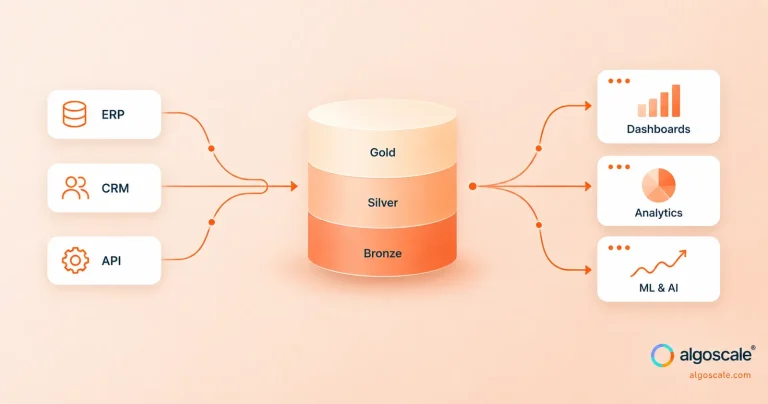
In a reasonably mature strategy, source systems feed both the streaming platform (for real-time needs) and the data lake (for at-rest storage and historical analysis), often through the same underlying ingestion pipelines. MDM golden records get published into the lake as a trusted reference dataset that other pipelines join against, rather than each pipeline independently reconciling entity identity. Data warehouses or warehouse-equivalent gold-layer tables get built from curated lake data for structured, high-performance reporting, and data marts derive from that layer for department-specific views. The catalog indexes all of this – lake, warehouse, marts, streaming topics – in one searchable place, and the governance program’s policies apply consistently across every piece rather than being reinvented separately for each system.

Where the Lakehouse Pattern Fits Into This
Lakehouse architecture blurs the traditional line between the data lake and data warehouse specifically, letting a single governed platform serve both roles. This simplifies part of the picture described above – you may not need a fully separate warehouse product – but it doesn’t eliminate the need for the other components. MDM, streaming integration, cataloging, and governance remain necessary regardless of whether your lake and warehouse are separate systems or unified through lakehouse capabilities. Our post on creating a single source of truth using data lakehouse architecture covers how this consolidation specifically supports the broader strategic goal of consistent, trustworthy data across an organization.
Common Strategic Mistakes
Treating the data lake as the entire strategy. Building an excellent data lake while leaving MDM, governance, and cataloging as afterthoughts produces a technically strong component sitting inside an incoherent broader system.
Buying tools before defining component roles. Acquiring a catalog product, an MDM tool, and a lakehouse platform without first deciding how they’re meant to work together tends to produce three separate, poorly-integrated systems rather than one coherent strategy.
Skipping MDM because it seems like a separate project. Without a master data strategy, even a well-architected data lake accumulates inconsistent representations of core business entities, undermining trust in exactly the way MDM is designed to prevent.
Assuming a lakehouse eliminates the need for the rest of the landscape. Lakehouse capabilities genuinely simplify the lake-versus-warehouse question, but streaming, MDM, cataloging, and governance remain necessary components regardless of that specific architectural choice.
Designing a Coherent Strategy, Not Just a Data Lake
A data lake built well in isolation, without a clear understanding of how it connects to the rest of an organization’s data landscape, delivers less value than one designed as a deliberate piece of a broader, coherent strategy. At Algoscale, our Data Lake Services team designs data lakes with this bigger picture in mind – understanding how the lake needs to connect to existing or planned warehouses, streaming platforms, MDM efforts, catalogs, and governance programs, rather than treating it as a standalone project.
To see the broader range of data engineering and analytics work we do beyond data lake architecture specifically, take a look at what Algoscale builds across the data stack.
Why Algoscale
A few things shape how we actually deliver on data lake and data engineering work, beyond the architecture and practices covered above:
● Pre-built accelerators. We don’t start every engagement from a blank slate – proprietary accelerators built from prior implementations speed up common data source integration and analytics patterns.
● Faster time to value. For a focused initial scope covering core data sources and first analytics use cases, our accelerators typically compress development timelines to around four weeks, rather than the several months a from-scratch build often takes.
● Built on a scalable framework. Our implementation approach follows a repeatable, scale-ready framework, so the architecture built for your first use case extends cleanly as data volume and teams grow, rather than requiring a redo.
● Microsoft Solution Partner for Data & AI. Algoscale holds Microsoft Solution Partner status for Data & AI, including specific expertise implementing Microsoft Fabric as a modern data warehouse.
Frequently Asked Questions
1. Do we need all of these components – data lake, warehouse, MDM, catalog, governance – from day one?
No. Most organizations build these incrementally, starting with the data lake and adding other components as specific needs emerge – MDM once entity inconsistency becomes a real problem, a formal catalog once discoverability becomes difficult, and so on. What matters is having a general sense of how these pieces will eventually connect, even if you’re not building all of them simultaneously.
2. Does adopting a lakehouse mean we don’t need a data warehouse at all?
Often, yes – lakehouse capabilities can serve the structured, high-performance reporting role a warehouse traditionally handled, through gold-layer tables. Some organizations still maintain a separate warehouse for specific reasons, but it’s no longer a strict requirement the way it once was.
3. Is MDM only necessary for large enterprises?
Entity inconsistency (multiple versions of the same customer or product) can happen at almost any organizational size once more than one system generates or modifies that data. Smaller organizations may handle this more informally, but the underlying problem MDM solves isn’t exclusive to large enterprises.
4. How does a data catalog differ from the metadata already built into a lakehouse’s table format?
A lakehouse table format’s metadata (schema, statistics, lineage within the table format itself) is technical and scoped to that specific system. A catalog spans across systems – the lake, a separate warehouse, streaming topics, other databases – providing unified discovery across the entire data landscape, not just within one component.
5. Should governance be a single centralized team, or distributed across each component’s owners?
Both models exist in practice, and many organizations use a hybrid – centralized policy and standards, with distributed responsibility for actually implementing and maintaining those standards within each specific system or domain.
6. What’s the first component worth adding once a data lake is established?
This depends on which specific pain is showing up first, but cataloging and basic governance tend to become necessary earliest, simply because data volume and team count both tend to grow faster than the informal, ad hoc processes that worked at a smaller scale.