


Every tool on this list will tell you it governs your data. Far fewer will tell you what it costs, and fewer still will enforce anything outside the platform it was built for. We checked both on 4 November 2026, before writing a word: of the six vendors here, exactly one publishes a dollar figure, and that figure does not buy the governance capability this post is about.
That gap is what this comparison of data governance tools is built around. A catalog that documents a policy and a platform that applies it at the source database are sold with the same vocabulary and cost different orders of magnitude. So each entry below answers two questions a vendor page will not: what does it enforce, and where does enforcement stop.
Seven entries, one of which is ours and is labelled as such. If you want the sequencing rather than the shortlist, meaning which phase of a governance programme needs which capability, that is our data governance strategy and roadmap, and this post is the buying decision inside it.
7 Best Data Governance Tools: Quick Comparison
| Tool | Best For | Public Reviews | The Catch | Starting Price | Access |
|---|---|---|---|---|---|
| 1Alation | Behaviour-led stewardship | G2 – 4.4 from 98 reviews; glossary lands, AI credits surprise people | Expensive, and AI credits add up | Not public | No trial; /pricing books a call |
| 2Collibra | Provable policy enforcement | G2 – 4.2 from 104 reviews; market leader, steep setup | Steep curve, and no published price | Not public | No trial; no pricing page |
| 3Algoscale | Building what you bought | No G2 listing – published case-study evidence only | A service: no trial, no rate card | Not public | Scoped per project |
| 4Informatica | An existing Informatica estate | G2 – 4.1 from 151 reviews; one place for policy, complex to navigate | Priced in IPUs, not in dollars | IPU credits, no dollar rate | Sales-qualified trial only |
| 5Microsoft Purview | A Microsoft-first estate | G2 – 4.7 from only 18 reviews, newest dated 2024 | The $12 seat excludes data governance | From $12/user/month, billed yearly | Needs an Azure subscription |
| 6Atlan | dbt and Snowflake stacks | G2 – 4.5 from 135 reviews; intuitive, advanced setup is clunky | Only as good as your tagging | Not public | No trial; /pricing is a form |
| 7BigID | Finding regulated data | PeerSpot – 4.1 from 15 reviews; strong discovery, buggy UI | Thin review corpus, discovery not stewardship | Not public | Quote scoped to your estate |
Not sure which of these fits your stack?
Tell us what you are running today and what you need it to do. We will tell you which of these we would pick, and why. We are not going to pitch you.
How We Researched These Data Governance Tools
The entry list came from the ten pages ranking for data governance tools, read for what each one ranks rather than what it mentions. That distinction cost us a round: our first pass counted vendors that appeared only in a rival’s navigation and footer, and treated a capabilities article as a product listicle. The corrected count put Alation and Collibra at six of ten sources each, Microsoft Purview and Informatica at five, and Atlan at four.
We overrode that frequency twice, and this paragraph exists to say so. Apache Atlas was cut because our data lineage comparison already ranks it and two other open-source projects, and a reader is better served by one honest post per question. IBM was cut at two mentions in favour of BigID, which was cited once, because a sixth catalog adds a row and no argument, while discovery-and-classification is a genuinely different answer to the same question.
Nothing here was trialled, and the heading says Researched for that reason. Five of the six vendors are sales-gated: there is no self-serve signup that does not ask for a work email and a call. Microsoft is the exception and only on paper, because Purview’s free trial needs an Azure subscription and a tenant with data in it before it governs anything. What this is built from instead is 17 primary sources (pricing pages, rate cards, product documentation) and 81 reviews across eight G2 and PeerSpot listings. Reddit was unreachable throughout, so no Reddit thread is quoted or paraphrased anywhere below.
Entries are ordered editorially, widest fit first: the two tools most buyers shortlist, then the implementation question that follows a purchase, then the three estate-specific platforms, then the discovery specialist. Every price, limit and quoted sentence was read at its own source on 4 November 2026 and linked.
Two caveats on the evidence, since the rest of this post is about reading the small print. Most G2 reviews in this category are vendor-solicited, and the badges say so: six of the eight G2 screenshots below carry an Incentivized chip, and one is marked AI Translated. We quote criticisms from them, which is the hardest thing for a vendor to solicit, and the two PeerSpot captures carry no such badge. Separately, the four questions in the FAQ come from this search result’s own People Also Ask box, with two adjustments: we restored the AI-governance question after cutting it as off-topic, and we answer the open-source question by pointing at our lineage comparison rather than re-ranking four projects we have already ranked.
What we weighed, heaviest first
- Can you see the price – the first thing a buyer needs, and the thing this category hides more thoroughly than any we have compared
- What it actually enforces, and where enforcement stops – publishing a policy and applying it in the warehouse are sold in the same sentence and cost different orders of magnitude
- Does it reach the estate you already run – a governance tool that covers one platform is a feature of that platform, not a governance programme
- How long to the first useful result – decides whether you can evaluate it at all before committing budget, and every tool here answers with a sales call
- What it costs to keep alive – an unmaintained catalog looks complete and is not, which reviewers raise more often than any missing feature
- What the review corpus actually says – read last because it is the least verifiable, and because two of these products have corpora too thin to lean on
Do You Need a Governance Tool, or Does Your Platform Already Govern?
Four of the eight entries on the rival ranking second for this term are not estate tools at all: Databricks Unity Catalog, AWS Lake Formation, Google’s catalog and Snowflake Horizon each govern the platform that sells them. They are genuinely good at it. If every regulated table you own lives in one of those platforms, the honest answer is that you may not need anything on this list.
The obvious objection is that Microsoft Purview is entry five and is equally vendor-native, so here is the distinction, which is documented rather than a matter of taste. Purview’s Data Map registers and scans Amazon S3, Amazon RDS, Redshift, Snowflake, BigQuery, Oracle, Teradata, SAP, Salesforce, Tableau, Looker, Qlik and more, with automatic classification on several of them. Snowflake Horizon governs Snowflake.
One caution on the fourth of those platform tools. Google Cloud Data Catalog is deprecated: its phased shutdown began on 1 June 2026, and the product was renamed Dataplex Universal Catalog and then Knowledge Catalog in April. A 2026-dated rival page still ranks it by the old name, which is a fair measure of how current this search result is.
| Where your regulated data lives | What to use | Why |
|---|---|---|
| All of it in Databricks | Unity Catalog | Native enforcement, already paid for |
| All of it in Snowflake | Snowflake Horizon | Same argument, inside the fence |
| Microsoft 365 plus two clouds | Purview | The Data Map scans well past Azure |
| Four platforms and a SaaS sprawl | A tool from this list | Nothing native crosses that boundary |
| Nobody knows where it lives | Discovery first, then a catalog | You cannot govern an unknown estate |
- AI governance is not data governance, and this search result conflates them: the third-ranking page is a list of model-governance tools. If that is what you are shopping for, none of the seven below is the right starting point.
- If your actual problem is tracing a number back to its source rather than controlling who sees it, read data lineage tools instead. It ranks the open-source options this post deliberately leaves out.
1. Alation: Best for Stewardship That Runs on How Analysts Already Behave

What it does: Alation is a data catalog that reads your database query logs and uses what people actually run to rank, attribute and document the data.
Who this is for: Enterprises with enough analyst query traffic for the behavioural signal to have something to read
Most catalogs rank data by who filled in a form. Alation reads the query logs instead. Its documentation is explicit: query log ingestion parses the logs, and from that data Alation calculates Top Users, Popularity and lineage, and extracts the filters and JOINs people actually use.
The honest limit is in the same documentation. Alation recommends at least a week of query history before the first run, and a minimum of three days on a database handling more than a million queries a day. It also says plainly that query logs are an essential but not the only input to those calculations.


Key Features
- Query log ingestion that derives Top Users, Popularity, lineage, joins and filters from the logs rather than from a form
- Term, table and column definitions a whole organisation reads from one place
- Scheduled or manual ingestion runs per data source
- Joins and filters extracted from real queries, so the catalog shows how tables are actually joined rather than how the diagram says they should be
Pros and Cons
Pros
- The ranking signal is behavioural: popularity comes out of parsed query history, not out of a curation backlog
- Reviewers single out the support team and the pace of releases
- Glossary work visibly lands: one reviewer’s gain is the whole organisation using the same term, table and column meanings
Cons
- Expensive, and reviewers say the AI credits are hard to forecast
- Getting context back out into other systems is a live complaint
- Query log ingestion needs history before it says anything useful: a week recommended, three days minimum on a busy database
- The pricing URL is not a pricing page. It redirects to a form that books a call
What Users Say
Rather expensive product. The ACU credits for AI product usage is a bit difficult to quantify expected usage of, and can quickly add up in costs.
Andrew L. on G2

Not being able to have our other systems integrate with Alation to access its context.
Karen B. on G2

Pricing
Not public, and not in the way you would expect. alation.com/pricing does not serve a pricing page at all. It returns an HTTP 307 redirect to a Start a Conversation booking form offering a 30-minute call. There is no tier, no per-user figure and no published floor anywhere on the site.
Budget for the licence and the AI credits separately. The credits are the part reviewers say they cannot forecast, and they are consumption-based rather than included.
Bottom Line
The strongest answer here if your problem is that nobody trusts the catalog, because Alation’s ranking comes from behaviour rather than from goodwill. Expect a sales cycle and a bill you cannot estimate in advance.
Buy Alation when you want the catalog ranked by what people actually query rather than by who had time to curate it, and your budget survives a quote plus AI credits.
2. Collibra: Best for Proving the Policy Was Enforced, Not Just Published
What it does: Collibra is a governance platform where policies are modelled, routed through BPMN workflows and then pushed down to the warehouse so the rule is enforced where the data sits.
Who this is for: Enterprises with a stewardship function that can absorb a BPMN-modelled approval process
Collibra Protect applies no-code policies at the source database level, with masking, redacting and hashing, on AWS Lake Formation, BigQuery, Databricks and Snowflake. The policy stops being a document and starts being something that happens to a query, which is what an audit actually tests.
Underneath it, approvals run on an industry-standard BPMN 2.0 engine, so stewardship is a modelled process rather than a checkbox and a shared inbox. That is also the cost: a process engine is only as good as the organisation willing to operate it, and reviewers say the configuration is where the time goes.

Key Features
- Collibra Protect: no-code data access rules that mask, redact or hash at the source
- BPMN 2.0 workflow engine for approvals and stewardship routing
- A fully customisable asset and operating model
- Masking, redacting and hashing applied at the source database from the Protect interface, rather than a ticket asking a DBA to do it
Pros and Cons
Pros
- The policy actually reaches the data: enforcement happens in Snowflake, Databricks, BigQuery and Lake Formation rather than stopping at a published document
- The asset model bends to the organisation instead of the other way round
- Reviewers describe one platform covering catalog, governance, lineage, quality and AI governance
Cons
- Expensive, which is the single most repeated word in its reviews
- Steep learning curve, especially setting up hierarchies and configuring lineage diagrams
- The flexibility cuts both ways: too many options becomes a headache for end users
- No published pricing at all, so there is no way to size it without a sales cycle
What Users Say
Its expensive tool but market leader in the DG space
Rafikul I. on G2

The learning curve is steep — especially when it comes to using the platform, setting up hierarchies, and configuring lineage diagrams.
Frank L. on G2

Pricing
Not public, and there is no pricing page to be not-public on: collibra.com/pricing returns a 404. That is rarer than it sounds. Most vendors here publish a page and leave the number off it.
Do not trust the aggregator figures circulating for Collibra. We checked three and they contradict each other on whether the number is per user or per platform licence, which makes all of them unusable. If you need a figure before a sales call, the AWS Marketplace listing and the US GSA schedule are the only primary-ish sources, and both are list prices for a specific term that must be quoted as such.
Bottom Line
The most complete enforcement story on this list, and priced like it. Choose it when the audit is real and the stewardship team exists; avoid it if you are hoping a tool will create the process for you.
Worth the licence and the headcount when an auditor will ask you to prove the rule was enforced rather than written down, because Protect applies it in the warehouse itself.
3. Algoscale: Best for Teams Whose Governance Gap Is the Pipelines, Not the Catalog
What it does: Algoscale is not a tool on this list. It is the data engineering team that implements them. We are including it here because the question that follows “which tool?” is usually “who is going to build this?”, and in most shortlists nobody answers it.
Who this is for: Regulated organisations with 5 to 10 scattered SaaS sources and no governed platform underneath them
The work is the part a licence does not buy. For an Ontario health professional regulatory body we delivered automated data catalog scanning with Microsoft Purview, column-level lineage and complete audit logging, with AES-256 encryption at rest across OneLake, credentials in Azure Key Vault, and every Azure source provisioned in the Canada Central region for residency.
Access was built against the actual org chart rather than a template: an RBAC framework for 61 named users across six defined roles, and Power BI row-level security using USERPRINCIPALNAME() matched against department fields. Alongside it, 131 KPI definitions documented with business owner sign-off, and analytics maturity assessed from 1.5 to 3.
Key Features
- Purview deployed and scanning, rather than licensed and empty
- RBAC and Power BI row-level security built against the actual org chart
- Data residency and encryption decided as part of the build rather than retro-fitted
- KPI definitions documented and signed off by a business owner
Pros and Cons
Pros
- The governance layer arrives attached to a working pipeline, which is the part a tool licence does not buy
- Delivered inside the client’s own cloud subscription, so nothing is hostage to a vendor tenancy
- Evidenced on regulated work under PHIPA and PIPEDA, with audit logging and residency as deliverables
Cons
- It is a services engagement, not a product: there is no trial, no self-serve tier and no rate card
- You still buy and run a governance tool underneath. We implemented Purview in both of the engagements cited in this post, we do not replace it
- Scope is per project, so comparing it with a per-seat licence is not like for like
What Users Say
automated data catalog scanning with Microsoft Purview, column-level lineage, complete audit logging
An Ontario health professional regulatory body on our published case study

Pricing
Not public, by the same standard as five of the six vendors in this list. Engagements are scoped per project rather than sold by seat, and we would rather say that plainly than leave the column blank and imply a figure exists.
If you want a number before a conversation, the useful comparison is not licence versus licence. It is what the licence costs while nobody is deploying it.
Bottom Line
Right when the gap between buying a governance tool and having governance is a quarter of engineering work nobody has. Wrong if you want software you can trial this afternoon.
Bring in Algoscale when the catalog is empty because the pipelines underneath it were never built. It implements governance inside your own cloud, on top of a tool you still license separately.
4. Informatica: Best for an Estate Already Running on Informatica
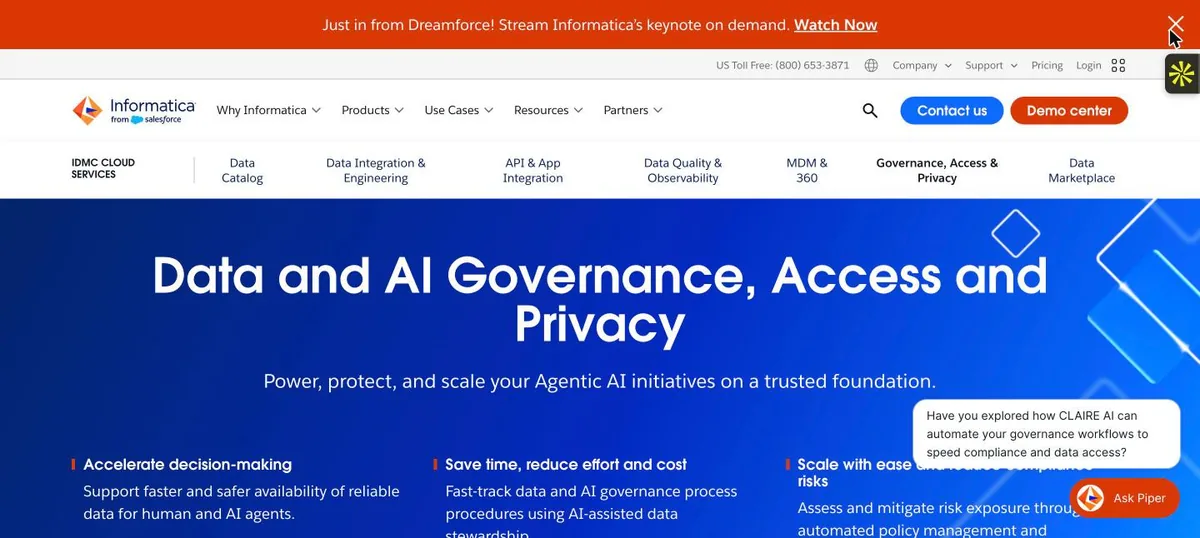
What it does: Cloud Data Governance and Catalog inside IDMC: policy, ownership, classification and lineage sold on the same metered platform as Informatica’s integration and quality products.
Who this is for: Organisations already consuming IDMC for integration or data quality, with procurement comfortable buying pre-paid consumption units
Consolidation is the argument here. Ownership and policy live in the same platform as the pipelines that move the data, which is worth real money if the estate is already Informatica and nothing if it is not. One reviewer puts the benefit plainly: the rules stop living only in a slide or a wiki page.
The argument against it is the bill. IDMC is sold in Informatica Processing Units, which are pre-paid credits drawn down per meter, and standard IPUs lapse monthly unless you are on the Flex plan, which carries them to the contract anniversary.

Key Features
- Policy and ownership recorded in the same platform as the pipelines that move the data
- Classification that surfaces which fields look sensitive
- Lineage used to answer where a number came from
- IPU metering with per-meter tiered rate cards and consumption alerts
Pros and Cons
Pros
- One vendor across integration, quality and governance, which is worth real money if the estate is already Informatica
- Reviewers value having ownership and policy in one place instead of in a slide nobody updates
- It publishes a rate card at all, tier by tier, which is more than most of this list manages
Cons
- You cannot price it without a contract: the rates are in IPUs and an IPU has no published dollar value
- Complex to navigate, and reviewers say the governance and privacy features take time to learn
- It degrades quietly if nobody maintains it: empty terms and old owners make the screen look complete when it is not
- Unused standard IPUs lapse monthly unless you are on the Flex plan
What Users Say
The tool only works if people keep the catalog alive. Empty terms and old owners make the screen look complete when it is not.
Sadahiro S. on G2

The platform can feel complex to navigate, and it can take time to understand all of the governance and privacy features.
Jay W. on G2

Pricing
No dollar figure is published anywhere, but, unusually for this list, real rates are. Informatica’s documentation carries sample rate cards denominated in IPUs: the Application Integration meter costs 1.38 IPUs per compute hour for the first 60 hours, 0.17 from 61 to 1,200, and 0.043 above that, so 5,000 hours comes to 440 IPUs.
Before you use those numbers, read the two caveats attached to them. Informatica’s own page says the sample rate cards “might not reflect the current IPU rates for your organization”, and the Cloud and Product Description Schedule attaches those particular tiers to subscriptions bought before 7 February 2025. Treat them as the shape of IPU pricing (tiered, per meter, resetting each billing period) rather than as what you would pay today. The dollar value of an IPU is set in your contract.
Bottom Line
A consolidation play. The case for it is the vendor you already have, not the product. If you are not already on IDMC, the metering is a tax on understanding your own bill.
Only sensible if Informatica already runs your pipelines, because one vendor for quality and policy is what you are buying, and IPU metering means you cannot forecast what it costs.
5. Microsoft Purview: Best for a Microsoft Estate That Needs Labels Everywhere
What it does: Microsoft’s governance estate: a Data Map that registers and scans sources well beyond Azure, with classification, sensitivity labels and compliance tooling attached to the Microsoft 365 security stack.
Who this is for: Microsoft-first enterprises already on M365 E5 with an Azure subscription to bill consumption against
Purview is more multi-cloud than its reputation suggests. The Data Map registers and scans Amazon S3, RDS, Redshift, Snowflake, BigQuery, Oracle, Teradata, SAP, Salesforce, Tableau, Looker and Qlik, with automatic classification on several of them, and sensitivity labels created in Information Protection extend to SharePoint, Teams, Power BI and SQL.
Where it stops is equally documented, and it is the thing to check before signing. In Microsoft’s own source table, the Can apply policies column reads No for every non-Microsoft source. Snowflake, Oracle, Redshift, BigQuery, SAP, all of them, with SQL Server on Azure Arc the single exception.


Key Features
- Data Map scanning across AWS, Google Cloud, SAP, Salesforce and the BI layer, not only Azure
- Automatic classification on S3, RDS, Oracle, Snowflake, Teradata and SQL Server
- Pay-as-you-go governance meters billed through an Azure subscription
- Sensitivity labels created in Information Protection extended to Power BI, SharePoint, Teams and SQL, with Data Map labelling itself still in preview
Pros and Cons
Pros
- Genuinely multi-cloud at the scanning layer, which is the thing most people assume it is not
- The only vendor here with a published per-seat price of any kind
- If the organisation already runs M365 E5, a large part of the compliance tooling is already paid for
Cons
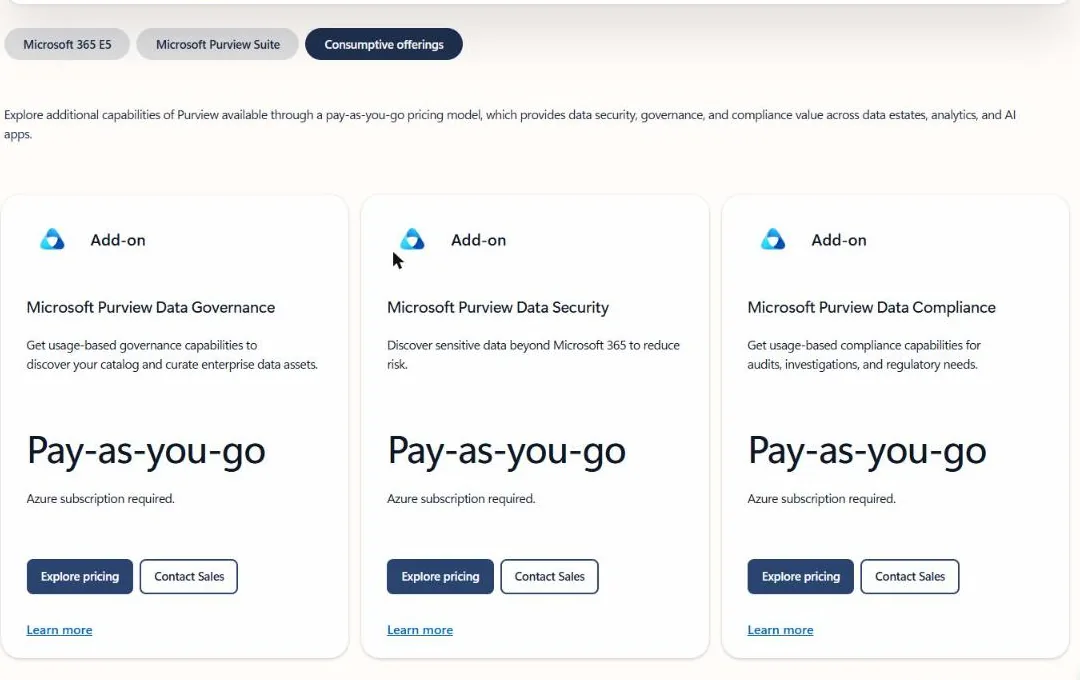
- The $12 seat is not the governance product: those meters are pay-as-you-go and unpriced on that page
- It scans far outside Microsoft but does not enforce far outside Microsoft: policy application is No for every non-Microsoft source bar one
- Reviewers have flagged connector coverage, especially for legacy and custom-built systems
- A thin and ageing review corpus for the governance SKU specifically: 18 reviews, newest dated 2024
What Users Say
limited connectivity-need more this could lead ,in comprehensive data discovery and governance, especially for legacy or custom-built systems
Niranjan L. on G2

The API needs some improvement when connecting to non-Microsoft API sources. This is a limiting factor.
Felipe A. on G2

Pricing
The only published figure on this list, and it comes with a trap. Microsoft Purview Suite is $12.00 per user per month, paid yearly, and requires Microsoft 365 E3 or Office 365 E3 plus Enterprise Mobility + Security E3. Microsoft 365 E5 is $60.00 and E5 without Teams is $51.45, on the same terms.
The trap is what that seat buys. Its feature list is data loss prevention, information protection, insider risk management, audit, eDiscovery and communication compliance. Data governance is not on it. Purview Data Governance, Data Security and Data Compliance are each separate pay-as-you-go add-ons requiring an Azure subscription, and the pricing page carries no figure for any of them. The Azure consumption page renders most rates as placeholders, though its worked examples do give real numbers: $100 for 200 governed assets over 30 days, and $30 for two Data Governance Processing Units.
Bottom Line
The sensible default for a Microsoft-first estate, and the one entry where the published price actively misleads. Price the meters before you price the seats.
Buy Purview if you are on Microsoft and need sensitivity labels to travel, but budget the pay-as-you-go governance meters separately, because the $12 seat does not include them.
6. Atlan: Best for Governance That Follows a Tag Instead of a Table
What it does: A metadata platform where access is scoped by tag rather than by table: personas group people, purposes group tagged assets, and policies follow the tag onto assets that do not exist yet.
Who this is for: Modern-stack data teams on dbt, Snowflake and Tableau, where the people in the catalog are the engineers building on it
The model is the reason to pick it. A purpose is built from tags, and Atlan treats every asset carrying any of those tags as part of it – including, in the documentation’s own words, any future assets that get the tag. A policy written once covers the table someone creates next month.
Denies are absolute and symmetric: a deny overrides grants from any other policy for the same users, across every purpose and persona they belong to. That is simpler to reason about than a precedence ladder, and it means an over-broad deny is as disruptive as an over-broad grant.


Key Features
- Purposes: tag-scoped access that applies automatically to assets created later
- Personas: access scoped by team
- Connections across the working stack (dbt, Snowflake, Tableau) with lineage in context
- Deny rules that override grants across every purpose and persona a user belongs to
Pros and Cons
Pros
- Tag-scoped policy is the one model here that does not rot the moment someone adds a table
- Reviewers consistently describe it as intuitive and quick to learn at the discovery layer
- It meets people in the tools they already use rather than in a governance portal
Cons
- Advanced features feel clunky to set up, and the learning curve for the full value is not trivial
- The surface area overwhelms newcomers to governance
- No published price at all: the pricing page is a redirect to sales
- The tag model only works if tagging is disciplined; untagged assets fall outside every purpose
What Users Say
One thing I don’t like about Atlan is that it can feel a bit overwhelming at first, especially if you’re new to data governance or catalog tools.
Akash A. on G2

the way it connects across your whole stack — dbt, Snowflake, Tableau, whatever you’re using — means you get lineage and context right where you need it
Verified User in Information Technology and Services on G2

Pricing
Not public. atlan.com/pricing 301-redirects to a talk-to-sales form. The pricing URL is itself the sales form, which is worth noticing when you are comparing vendors on transparency.
Reviewers feel it too. The same verified user who praises the lineage coverage calls the pricing and packaging “a bit opaque, which makes it hard to plan ahead when you’re trying to scale usage across a larger team”.
Bottom Line
The best fit for a stack that changes weekly, because the policy attaches to a tag rather than to today’s tables. Only as good as the tagging discipline behind it.
Buy Atlan when your stack is dbt and Snowflake and you want access rules that attach to tags, so tomorrow’s tables are governed without anyone revisiting the policy.
7. BigID: Best for Finding the Regulated Data Before You Catalog It
What it does: Discovery and classification first: BigID scans structured and unstructured sources to find regulated data, then hangs DSAR, privacy and security workflows off what it found.
Who this is for: Privacy, security and compliance teams facing GDPR, CCPA or DPDPA obligations across sprawling unstructured data
Everything above assumes you know what you have. BigID assumes you do not, and scans cloud and on-premises, structured and unstructured sources to find out. Reviewers describe building custom classifiers from regular expressions and writing custom connectors where none ships.
Two practical details raise it above a generic discovery pitch. Read-only access is enough to return accurate results, which lowers the security review it has to clear. Scans can also be scheduled for nights and weekends, so a busy production database is not scanned during its busy hours.

Key Features
- Discovery and classification across cloud, on-premises, structured and unstructured sources
- Custom classifiers built from regular expressions, and custom connectors where none ships
- Scheduled scans that can be pushed to nights and weekends
- A DSAR module with a customisable request page and request validation
Pros and Cons
Pros
- It answers the question the catalogs assume you already answered: where the regulated data is
- Read-only access is enough to scan, which lowers the security review it has to clear
- The DSAR workflow has a concrete, reviewer-reported payoff on GDPR response times
Cons
- No published price, and the tiers are described by scope rather than by anything countable
- The thinnest review corpus on this list, 16 reviews on G2 and 15 on PeerSpot, and one G2 entry is for a different product entirely
- It is a discovery and classification product, not a stewardship platform: the glossary and workflow story is weaker than Collibra’s or Alation’s
- Reviewers report a buggy UI and intermittent scan failures
What Users Say
I like BigID’s in-depth discovery and scanning capabilities, especially for unstructured data. This feature is a standout compared to competitors.
Ameya Mahale on PeerSpot

One area where BigID can be improved is the UI, which has a lot of bugs.
Aniruddha Nath on PeerSpot

One improvement I would suggest is addressing the intermittent failures of BigID scans, as there are times when some errors occur.
reviewer2789535 on PeerSpot

Pricing
Not public, and scoped rather than tiered. Three packages are named. Express for a focused first project, Business for several use cases, Enterprise for the whole estate at petabyte scale with air-gapped deployment available, with no figure against any of them. The quote is shaped by the sources and connectors in scope, the deployment model and the services tier.
One navigational note: bigid.com/pricing is a 404. The live page is on home.bigid.com.
Bottom Line
The right first purchase when discovery is the actual gap, and the wrong one if you already know where everything is and need to govern it. Judge it on a proof of concept rather than on its review corpus, which is too thin to lean on.
The right first purchase when the honest answer to “where is your regulated data” is nobody knows. It finds and classifies, and leaves the stewardship platform to someone else.
Which Data Governance Tool Should You Choose?
Choose Alation if:
- Your catalog exists and nobody trusts it
- You have enough analyst query traffic for popularity to mean something
- A quote plus consumption-based AI credits is a bill you can defend
Choose Collibra if:
- An auditor will ask you to prove enforcement, not intention
- Your regulated data is in Snowflake, Databricks, BigQuery or Lake Formation, where Protect can act on it
- You already have the stewardship people to run a modelled process
Choose Algoscale if:
- You have chosen the tool and have nobody to deploy it
- The governance gap is really a pipeline gap
- You need the build to happen inside your own cloud subscription
Choose Informatica if:
- IDMC already runs your integration or data quality
- One vendor across the stack is worth more than a forecastable bill
- Procurement is comfortable buying pre-paid consumption units
Choose Microsoft Purview if:
- You are Microsoft-first and already paying for E5
- You need one scanner across AWS, Google Cloud and SAP as well as Azure
- You accept that enforcement lands inside Microsoft and plan for the rest separately
Choose Atlan if:
- Your stack is dbt, Snowflake and a BI tool
- Your schema changes faster than anyone can rewrite policies
- Tagging discipline is something your team will actually sustain
Choose BigID if:
- Nobody can say where the regulated data lives
- A GDPR, CCPA or DPDPA deadline is driving the project
- Most of the risk is in unstructured data rather than in warehouse tables
Skip this category entirely if:
- Every regulated table you own lives in one platform. Unity Catalog, Lake Formation, Knowledge Catalog and Snowflake Horizon govern their own estates well, and you are already paying for one of them.
- What you actually need is model governance: evaluation logs, model cards, an EU AI Act register. That is a different category, however often this search result mixes the two.
- Your problem is tracing a number to its source rather than controlling who sees it. Start with lineage instead.
What’s the Best Data Governance Tool in 2026?
There is no single answer here, and the reason is worth a paragraph. Collibra enforces most completely, Alation documents most convincingly, Purview reaches furthest across an estate for the least incremental money, Atlan survives change best, and BigID answers a question the other four assume you have already answered. Those are five different purchases, which is why the post has no winner and no score.
What the comparison does settle is the price question, and it is the one thing every data governance software buyer asks first. Six of the seven entries here publish no usable figure, and the one that does, Microsoft at $12 per user per month, sells a seat whose feature list does not include data governance. Informatica publishes real rates in units whose dollar value is set in your contract. Collibra publishes no pricing page at all. If a vendor tells you the category is transparent, this list is the counter-example.
So choose on enforcement boundaries rather than on feature grids. Ask where the policy is applied, which systems it reaches, and what happens to the table created next Tuesday. Every tool here answers those three questions differently, and the answers are more stable than the feature lists, which change with each release.
Getting a Governance Tool into Production
The decision this post helps with is the smaller half of the problem. A governance platform scans what it is pointed at, enforces what it is configured to enforce, and documents what someone takes the time to document. All three of those are engineering work, and they are the work that stalls after the purchase order clears.
Algoscale builds that layer. For a US field services and fleet operator we unified NetSuite, Fleetio, Samsara, KPA Flex and ADP into one governed Azure warehouse in fourteen weeks from kickoff to go-live, with Microsoft Purview holding the business glossary, auto-generated lineage and sensitivity labels on PII and finance data, and Entra-backed RBAC scoping access by role. The Ontario regulatory engagement in entry 3 is the same shape under PHIPA and PIPEDA, with residency and audit logging as named deliverables.
Both of those used a tool from this list rather than replacing it. The licence is the cheap part, and the gap between a licence and a governed estate is a quarter of pipeline work, access modelling and definition-chasing. That gap is what our data engineering team closes. If you have picked a tool and the deployment has not moved in a month, it is where you are stuck.
- Pipelines first, because the catalog is empty until something governed is flowing into it
- Access modelled against your actual org chart, not a vendor template
- Residency, encryption and audit logging decided during the build rather than retro-fitted
- KPI and term definitions documented with a named business owner who signed them off
- Delivered in your own cloud subscription, with handover to your team
Ready to put this into production?
Algoscale’s data engineers have built and migrated data platforms for retail, fintech and manufacturing teams. Book a free consultation and we will scope yours with you.
Frequently Asked Questions
What is the difference between a data catalog and a data governance tool?
A catalog documents what data exists; a governance tool controls what happens to it. The practical test is whether the product can change the result of a query. Collibra Protect, for example, applies masking, redacting and hashing at the source database on Snowflake, Databricks, BigQuery and AWS Lake Formation. A catalog records that a column is sensitive and relies on someone else to act on it. Most products here do both, in different proportions, which is why the enforcement boundary matters more than the category label.
What is AI and data governance?
They are two different disciplines that this search result keeps merging. Data governance controls who can see and change data, and proves it to an auditor. AI governance covers models rather than tables: model inventories, evaluation logs, bias testing and regulatory registers under frameworks like the EU AI Act. The overlap is real, because a model trained on ungoverned data inherits every problem that data has, but the tooling is distinct: none of the seven products compared here is a model-governance platform.
Are there open source data governance tools?
Yes, and the four worth knowing are OpenMetadata, DataHub, Apache Atlas and Egeria, which are the ones that appear on this search result, and they are genuine alternatives if you have the engineering capacity to run them. We have deliberately not ranked them here, because our data lineage tools comparison already covers three of them in depth and a reader is better served by one honest post per question than by the same four projects ranked twice.
What are the three pillars of data governance?
People, process and technology, and the order matters more than the list. The tools compared here are the third pillar only. Informatica’s own reviewers make the point best: the catalog “only works if people keep the catalog alive”, and empty terms make the screen look complete when it is not. If you need the people and process half, our data governance strategy and roadmap sets out the five phases and which capability each one needs.