



The most recommended alternative to dbt is SQLMesh. Fivetran bought the company behind it, Tobiko Data, in September 2025. Fivetran then completed its merger with dbt Labs on 1 June 2026. The tool and the thing it was built to replace now have the same owner, and one page-one result for this search is bylined “Tobiko – a Fivetran company”.
The other thing worth knowing before you shop: most of these dbt alternatives are not replacements for dbt. They replace dbt Cloud’s scheduler, or the semantic layer, or the invoice. Only one of them replaces the engine.
Five options, each with the job it actually does, the price read off the vendor’s page this week, and who owns it now.
5 Best dbt Alternatives: Quick Comparison
| Tool | Best For | Public Reviews | The Catch | Starting Price | Access |
|---|---|---|---|---|---|
| 1SQLMesh | Rebuilds that have got out of hand | HN: discussed mostly through the Fivetran acquisition | Owned by Fivetran, which also owns dbt Labs | Free, Apache-2.0 | Open source |
| 2dbt Core | Teams unhappy with the invoice | HN: dbt Cloud’s model-based billing drew real complaints | You supply the scheduler, CI and hosting | Free; dbt Cloud $100/user/mo | Open source |
| Algoscale | Model graphs nobody understands | Case study: a VP of Finance on answering what the group billed | Not a product, a scoped engagement | Not public | Consulting |
| 3Dataform | BigQuery shops | HN: chosen over dbt for architectural coherence | BigQuery only | Free; BigQuery bills the queries | In Google Cloud |
| 4Dagster | Running dbt on different rails | HN: a $500 bill for 13k executions over the credit limit | Credits on top, and Prefect owns it now | $10/mo Solo, $100/mo Starter | 30-day trial |
| 5Cube | Arguments about metric definitions | HN: semantic layers beat pointing an LLM at the warehouse | Replaces the semantic layer, not the models | Free tier, then $40/developer | Free forever tier |
Scroll the table sideways for public reviews, price and access.
Not sure which of these fits your stack?
Tell us what you are running today and what you need it to do. We will tell you which of these we would pick, and why. We are not going to pitch you.
How We Compared These dbt Alternatives
Nothing here was installed for this post. dbt Core, SQLMesh, Dagster and Cube Core are all free to run, and a hands-on comparison would be more useful than this one. It is not what we did, and we are not going to imply otherwise.
What we did was open every pricing page on 28 October 2026 and screenshot it, including the one that 404s; pull stars, open issues and last-push dates from the GitHub API, following the redirects both SQLMesh and dbt Core now have; read eleven Hacker News comments and link each one; and take the acquisition dates from the companies’ own announcements. Two of those commenters have a product in this space and the post says so under the quote.
What we weighed, heaviest first
- Which job it replaces – three different products are sold under one search term
- Who owns it this year – two of the five changed hands in the last fourteen months
- What the paid tier charges for – seats, models built and credits all bill differently
- What you give up by leaving – dbt’s community is still the biggest asset in the category
dbt Core vs dbt Cloud: Which One Are You Replacing?
dbt Core is the open-source command-line tool: models, tests, docs, macros, Apache-2.0, 14,091 GitHub stars. dbt Cloud is the hosted product around it, with a browser IDE, a scheduler, CI, a catalog and a semantic layer, priced by seats and by models built. Almost every complaint that sends people searching is about the second one.
That matters because the three answers are different. Unhappy with the invoice? dbt Core plus an orchestrator you already run costs nothing in licence terms. Unhappy with the scheduler? Dagster keeps your models and replaces the runner. If rebuild times and blast radius hurt, SQLMesh is the only entry here that changes how builds work. Coalesce, which also ranks for this search, is a fourth answer: a GUI-first transformation tool at $150 per user a month billed annually, which we have not given an entry because the only public commentary we could find was its own hiring posts.
And if the argument is really about metric definitions, neither a framework nor a scheduler helps. That is a semantic layer question. If the pipelines feeding your models are the weak point, we compared orchestration tools and ingestion tools separately.
| Your situation | What to reach for | Why |
|---|---|---|
| The dbt Cloud invoice | dbt Core | Same framework, no seats, no model counting |
| Builds take all night | SQLMesh | Column-level impact and state-aware backfills |
| The scheduler and the lineage | Dagster | dbt models become assets next to everything else |
| We are on BigQuery and want one less vendor | Dataform | Free, and native to the console |
| Two dashboards disagree about revenue | Cube | Metrics defined once and served everywhere |

1. SQLMesh: Best for Teams Whose Rebuilds Have Got Out of Hand
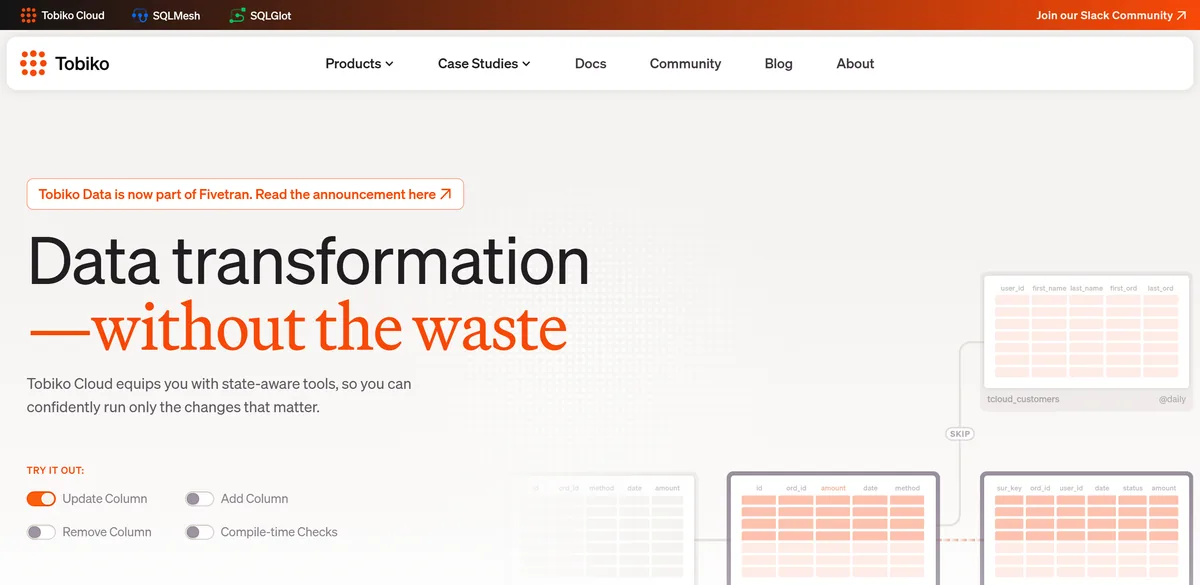
What it does: An open-source Python transformation framework that understands your SQL, builds virtual environments without copying data, and backfills only what changed.
Who this is for: Teams whose dbt pain is rebuild cost and blast radius: long backfills, and no way to know what a model change breaks.
SQLMesh parses your SQL instead of templating it, and the rest follows from that: column-level impact analysis before you merge, development environments that copy no data, and backfills limited to the intervals actually missing. For teams whose dbt build has become an overnight job, that is the pitch.

Key Features
- SQL understanding rather than string templating
- Virtual data environments, so a dev environment costs no storage
- State-aware backfills that only rebuild what changed
- Apache-2.0 with 3,335 GitHub stars
Pros and Cons
Pros
- The only entry here that changes how rebuilds work, not just who runs them
- Column-level impact analysis before you merge
- Free and Apache-2.0, whatever happens commercially
Cons
- Owned by Fivetran, which also owns dbt Labs since June 2026
- Tobiko’s pricing page is a 404, so the commercial path is unclear
- 3,335 stars against dbt’s 14,091: a much smaller community to ask
What Users Say
Last month Fivetran also acquired Tobiko, maker of SQLMesh, a dbt alternative. Looks like they are going all in.
ayhanfuat on Hacker News
consolidation in the space has been coming for quite some time now and this merger only confirms what us, along with many others, have been saying: the data tooling is in a miserable state…
karakanb on Hacker NewsThe commenter opens by disclosing he co-founded Bruin, another dbt alternative.
Pricing
The framework is free under Apache-2.0. Tobiko’s own pricing page returns a 404 reading ‘We’ll be back soon!’, so there is no published price for the commercial product.
Bottom Line
Run it against one slow model set and watch the backfill. That is the whole evaluation.
Worth adopting if overnight rebuilds are your daily tax, with the caveat that Fivetran now owns it and dbt Labs too.
2. dbt Core: Best for Teams Whose Only Problem Is the Invoice
What it does: The open-source command-line tool underneath dbt Cloud: the same models, tests and documentation, run by your own scheduler.
Who this is for: Teams whose complaint is the dbt Cloud invoice rather than the framework.
Most people searching for dbt alternatives are not unhappy with dbt. They are unhappy with the bill, and the bill comes from dbt Cloud. dbt Core is the same framework with your own scheduler in front of it, free under Apache-2.0 with 14,091 stars. You give up the browser IDE, the catalog, the semantic layer and managed CI.

Key Features
- The same models, tests, docs and macros as dbt Cloud
- Free under Apache-2.0, 14,091 GitHub stars
- Runs under any orchestrator you already have
- The largest community of anything in this comparison
Pros and Cons
Pros
- No migration: it is the tool your team already knows
- Removes the per-seat and per-model bill entirely
- Every error message you will hit has been answered somewhere
Cons
- You supply the scheduler, the CI and the hosting
- No catalog, semantic layer or governed metrics from the paid tiers
- Now developed inside Fivetran, which bought a competing engine in 2025
What Users Say
This change will cause data team into the bad pattern of trying to cram as much into a model as possible rather then splitting them up into sub models that can be used for multiple use cases.
roeja on Hacker NewsAbout dbt Cloud’s move to billing by models built, from 2023.
Dagster (orchestration tool) is complementary to dbt core (open source CLI tool for defining data transformation jobs) but competitive to dbt cloud (SaaS, orchestrates dbt jobs).
jnac on Hacker News
Pricing
dbt Core is free under Apache-2.0. dbt Cloud has a Developer tier that is free with one developer seat, 3,000 successful models built a month and one project; Starter is $100 per user a month with five seats, 15,000 models and 5,000 queried metrics; Enterprise and Enterprise+ are custom, with 100,000 models and 30 or unlimited projects.
Bottom Line
Price your dbt Cloud seats against a week of engineering time. That comparison usually ends the discussion.
If the bill is the problem and the framework is not, this is the whole answer.
Algoscale: Best for Model Graphs Nobody Understands Any More
What it does: The data engineering team that builds and runs the transformation layer, whichever framework it is written in.
Who this is for: Teams with a model graph nobody fully understands, where the build takes longer every month.
A lot of transformation pain is not framework pain. It is 900 models where 300 are read, a build that takes longer every month, and nobody left who knows why a staging layer exists. We rebuild the modelling layer around what the business reads, then run it, as on an AWS warehouse modernisation covering 14+ ERP instances.

Key Features
- Modelling layers rebuilt around what the business reads
- Metadata-driven ETL on AWS Glue and Step Functions
- Quality checks and lineage tracking embedded in the build
- Continuous observability and cloud FinOps after go-live
Pros and Cons
Pros
- Framework-agnostic: we sell none of the five here
- Published case studies with figures and a named client role
- Addresses the model sprawl a new framework will inherit
Cons
- Not a product: no download and no free tier
- Scoped work costs more than a licence
- Unnecessary if your project is thirty models and healthy
What Users Say
We had grown to 14 companies and still couldn’t answer a simple question, what did we bill last month across the whole business? Algoscale gave us that answer, plus 20 dashboards we didn’t even know we needed.
VP of Finance & Business Intelligence on Case studyA named role rather than a named person, quoted from the published case study.
Pricing
Not public – scoped per engagement.
Bottom Line
Worth a call when the build time is growing and nobody can say which models matter.
For teams whose transformation problem is the model graph, not the framework.
3. Dataform: Best for BigQuery Shops Who Want Nothing New to Buy
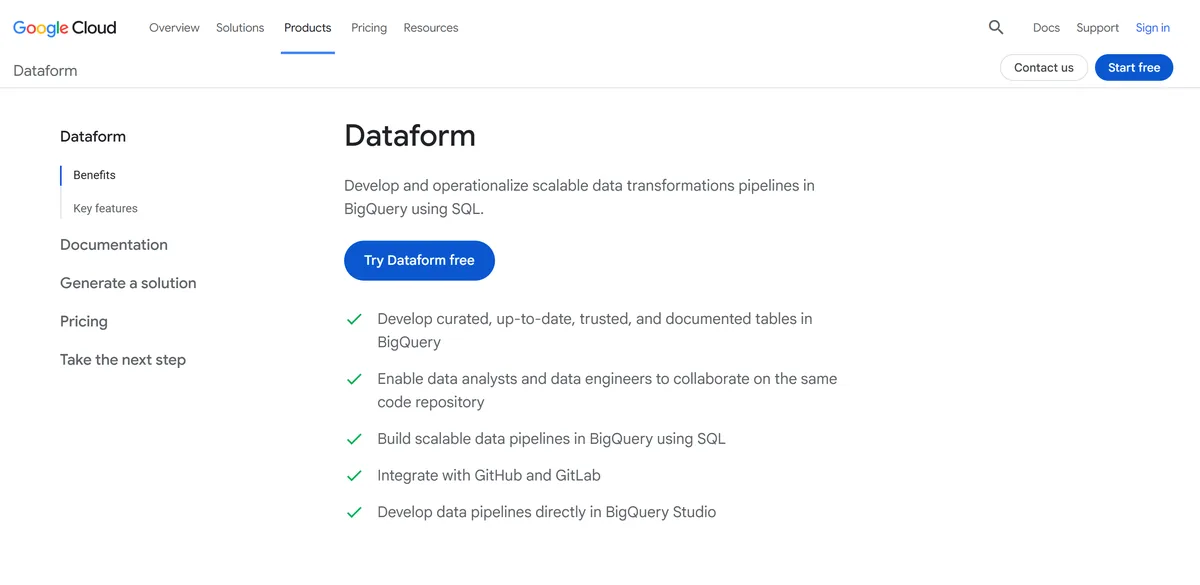
What it does: Google Cloud’s SQL transformation tool for BigQuery, free as a service with the query cost billed through BigQuery.
Who this is for: BigQuery shops who want dependency management and testing without another vendor relationship.
If you are on BigQuery, Dataform is free and already in your console. Google’s pricing page says so plainly: a free service, with BigQuery billing the queries it runs. No seats, no model counts, no new vendor to approve. The catch is reach, since it runs its queries in BigQuery and one practitioner calls it virtually unknown.

Key Features
- SQL workflows with dependencies, testing and documentation
- Free as a service: you pay only for BigQuery
- Native to the Google Cloud console and IAM
- Version control through your own repository
Pros and Cons
Pros
- No licence cost and no new vendor to approve
- Practitioners describe preferring it to dbt on BigQuery
- One less system to authenticate and secure
Cons
- BigQuery only: it is not an option on Snowflake or Databricks
- Little known outside BigQuery, and its community is a fraction of dbt’s
- Your transformation layer becomes a Google Cloud dependency
What Users Say
The addition of Dataform into our stack has completely changed the game, allowing us to maintain one source of objective truth
mike_lee_28 on Hacker NewsFrom 2019, before Google acquired Dataform.
Dataform is a bit better but virtually unknown and was greatly hindered by the Google acquisition.
forgetfulness on Hacker NewsThe same commenter later described choosing Dataform over dbt on a BigQuery project.
Pricing
$0. Google documents Dataform as a free service, with the queries it runs charged through BigQuery.
Bottom Line
On BigQuery, try it before you buy anything. Off BigQuery, ignore it.
On BigQuery it is the obvious choice. Anywhere else it does not exist.
4. Dagster: Best for Running dbt on Different Rails
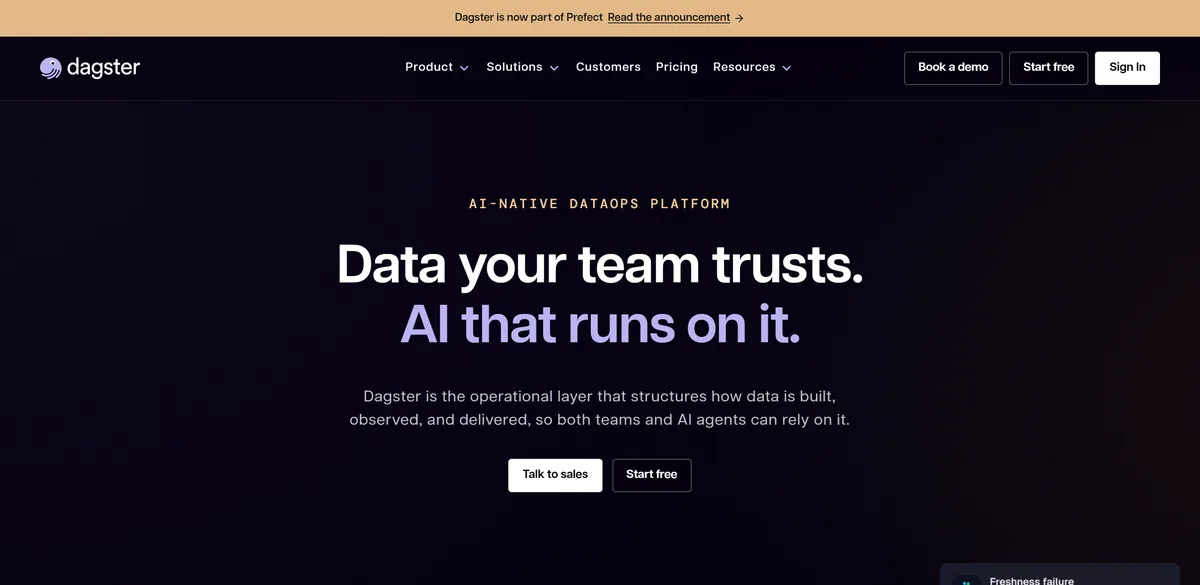
What it does: An asset-centric orchestrator that loads dbt models as individual assets, so you run dbt on different rails instead of replacing it.
Who this is for: Teams who like dbt but want their models scheduled alongside everything else, with lineage across the whole stack.
Dagster is here because of what people often mean by the question. When the models are fine and the scheduling hurts, a new transformation framework solves nothing. Dagster loads dbt models as individual assets and runs them beside everything else, with lineage across the lot, from $10 a month.

Key Features
- dbt models loaded as individual software-defined assets
- Lineage across dbt and everything else you run
- Published prices: $10 Solo, $100 Starter
- Apache-2.0 with 16,344 GitHub stars
Pros and Cons
Pros
- Keeps your dbt project and removes the dbt Cloud scheduler
- Prices published, with a trial you can start alone
- Asset-level lineage that covers more than the warehouse
Cons
- Credits on top of the plan make a month hard to forecast
- Owned by Prefect since July 2026, another consolidation
- Learning an orchestrator is a bigger ask than learning a scheduler
What Users Say
Then you realize that their cloud pricing is absolutely bonkers if you go over the paltry 30k credits… unless you sign up for a meaty annual enterprise contract. Got a $500 bill for something like 13k executions over the limit.
jscheel on Hacker News
Add a “last updated” note, since this space changes often (see the prefect/dagster situation that just happened)
otter-in-a-suit on Hacker NewsPosted days after Prefect announced the acquisition.
Pricing
Solo is $10 a month and Starter $100 a month, both with a 30-day trial; Pro is a conversation. Credits are billed on top at $0.040 on Solo and $0.035 on Starter, plus $0.010 a minute of serverless compute.
Bottom Line
Model your real credit usage before committing. The plan price is the smaller half of the bill.
Pick this when the scheduler is what hurts and the models are fine.
5. Cube: Best for Teams Arguing About Metric Definitions
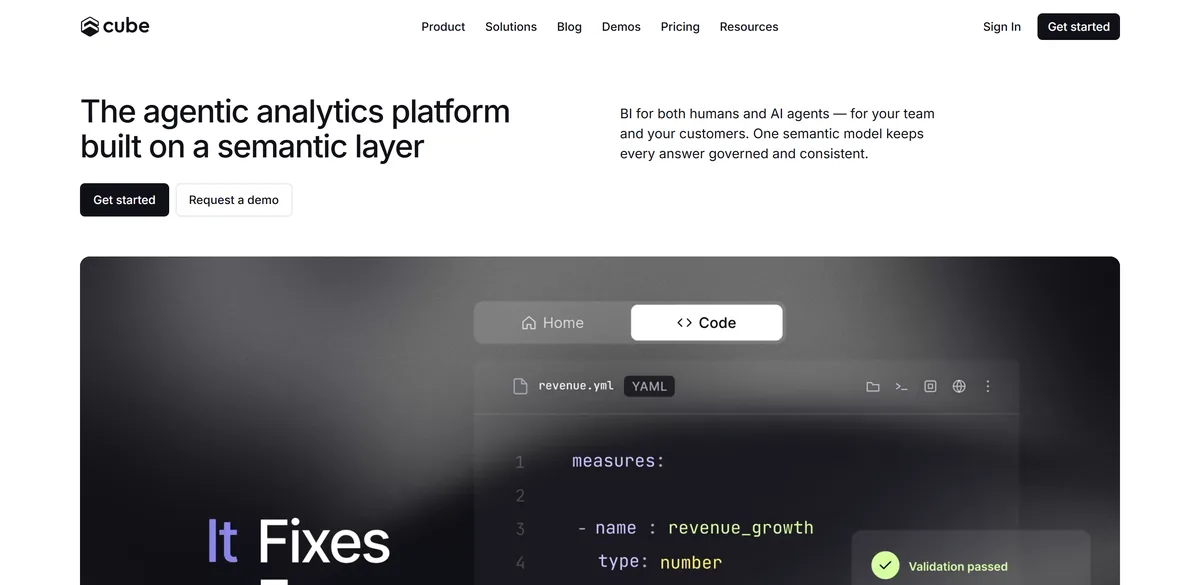
What it does: A semantic layer that defines metrics once and serves them to BI tools and AI agents, in place of the dbt Semantic Layer.
Who this is for: Teams whose actual complaint is governed metrics, not model builds.
Sometimes the fight is not about models at all. It is about whether revenue means the same thing in three dashboards. Cube answers that whether or not you keep dbt, starting free and then $40 per developer a month. Reading your dbt models directly sits on the Premium tier at $80, which is worth knowing before you budget.

Key Features
- Metrics defined once and served to BI tools and agents
- dbt integration from the Premium tier at $80 per developer
- Free forever tier, then $40 per developer a month
- 21,106 GitHub stars
Pros and Cons
Pros
- Separates the metrics problem from the transformation problem
- Published per-seat and per-hour pricing
- Consistency for LLM and agent queries, which text-to-SQL does not give you
Cons
- Not a dbt replacement: your models still have to be built by something
- Reading your dbt models needs the Premium tier, not the $40 one
- Another layer to operate and keep in sync with the warehouse
What Users Say
we (Delphi) find semantic layers way better for this kind of work than just going straight to a database/data warehouse. One thing you really need with LLMs is consistency. Text-to-SQL kind of lets the LLM do whatever it wants
mjirv on Hacker NewsThe commenter names his own company, Delphi, which builds in this space.
Spark/PySpark/polars/dbt/sqlmesh are all data engineering frameworks for data transformation… If you don’t have a data warehouse / OLAP system you are generally not in the niche for those tools.
OoooooooO on Hacker NewsQuoted for the boundary it draws, not as a comment on Cube.
Pricing
A Free forever tier, then $40 per developer a month and $80 per developer on the tier above, with compute billed from $0.15 an hour up to $1.20.
Bottom Line
If two dashboards disagree about a number today, start here rather than with a framework.
The right tool if the argument in your company is about metric definitions.
Which dbt Alternative Should You Choose?
Choose SQLMesh if:
- Rebuild cost or blast radius is the daily pain
- You can live with Fivetran owning it
Choose dbt Core if:
- The framework is fine and the bill is not
- You already run an orchestrator and CI
Choose Dataform if:
- Everything you have is in BigQuery
- You want no new vendor relationship at all
Choose Dagster if:
- Your dbt models need to run beside other work
- You want asset-level lineage across the stack
Choose Cube if:
- Metric definitions are the thing people argue about
- BI tools and agents need one consistent answer
Skip this category entirely if:
- You came looking for open source dbt alternatives and already run dbt Core. You are there: the open-source part is the part you have.
- Your project is under a hundred models and the build is quick. The framework is not your bottleneck.
- You are on the dbt Cloud free tier. One seat and 3,000 models a month is a real allowance.
- Nobody can say which models are read. A migration will carry the dead ones across.
What’s the Best dbt Alternative in 2026?
For most teams it is dbt Core, which is a strange sentence to write in a post about alternatives. The framework is rarely the complaint; the hosted product’s pricing is, and dropping it costs nothing but the scheduler you have to supply.
SQLMesh is the one genuine engine alternative, and it is technically the more interesting design. Weigh that against who owns it, and against a community roughly a quarter the size.
Dataform if you live in BigQuery, Dagster if the scheduler is what hurts, Cube if the real argument is about what a metric means. Two of the five changed owners in the last fourteen months, so whatever you choose, check who owns it before you sign.
Before You Migrate: The Models Come With You
A migration carries your modelling decisions into the new tool unchanged. If the build is slow because there are 900 models and 300 of them are read, every framework on this list will build 900 models for you, some of them faster.
Algoscale’s data engineering team rebuilds the transformation layer around what the business reads, with quality checks and lineage tracking embedded, then hands it over. We sell none of the five tools above.
On a recent AWS warehouse modernisation, 14+ ERP instances plus a CRM, an HRMS and a planning tool went into one governed lake with twice-daily refreshes. The client’s VP of Finance described the problem beforehand as not being able to say what the group billed last month.
- An audit of which models are actually read, and by whom
- Modelling layers rebuilt around the questions the business asks
- Quality checks and lineage tracking embedded in the build
- Handover, so the next migration is not a rescue
Ready to put this into production?
Algoscale’s data engineers have built and migrated data platforms for retail, fintech and manufacturing teams. Book a free consultation and we will scope yours with you.
Frequently Asked Questions
What is the best alternative to dbt?
It depends which part you are replacing. If the dbt Cloud bill is the problem, dbt Core is free under Apache-2.0 and is the same framework. If overnight rebuilds are the problem, SQLMesh is the only option here that changes how builds work, with column-level impact analysis and state-aware backfills. On BigQuery, Dataform is free and native. For scheduling, Dagster runs dbt models as assets from $10 a month.
Is dbt Core free?
Yes. dbt Core is Apache-2.0 with 14,091 GitHub stars and was last pushed on 28 October 2026. You run it yourself, with your own scheduler, CI and hosting. dbt Cloud is the paid product: a free tier with one developer seat and 3,000 models built a month, Starter at $100 per user a month for five seats and 15,000 models, and a custom Enterprise tier.
What is the difference between dbt Core and dbt Cloud?
The framework is identical. dbt Cloud adds a browser IDE, job scheduling and monitoring, CI checks on GitHub and GitLab, the dbt Catalog for lineage and the Semantic Layer for metrics, and bills for seats and successful models built. Teams that already run an orchestrator and CI are usually paying for things they have.
Is SQLMesh better than dbt?
It is a different design with real advantages on rebuilds. SQLMesh understands your SQL instead of templating it, so it can do column-level impact analysis and backfill only what changed, and its virtual environments avoid copying data. Against that: a community roughly a quarter the size of dbt’s, and Fivetran has owned it since September 2025 while also owning dbt Labs since June 2026.