

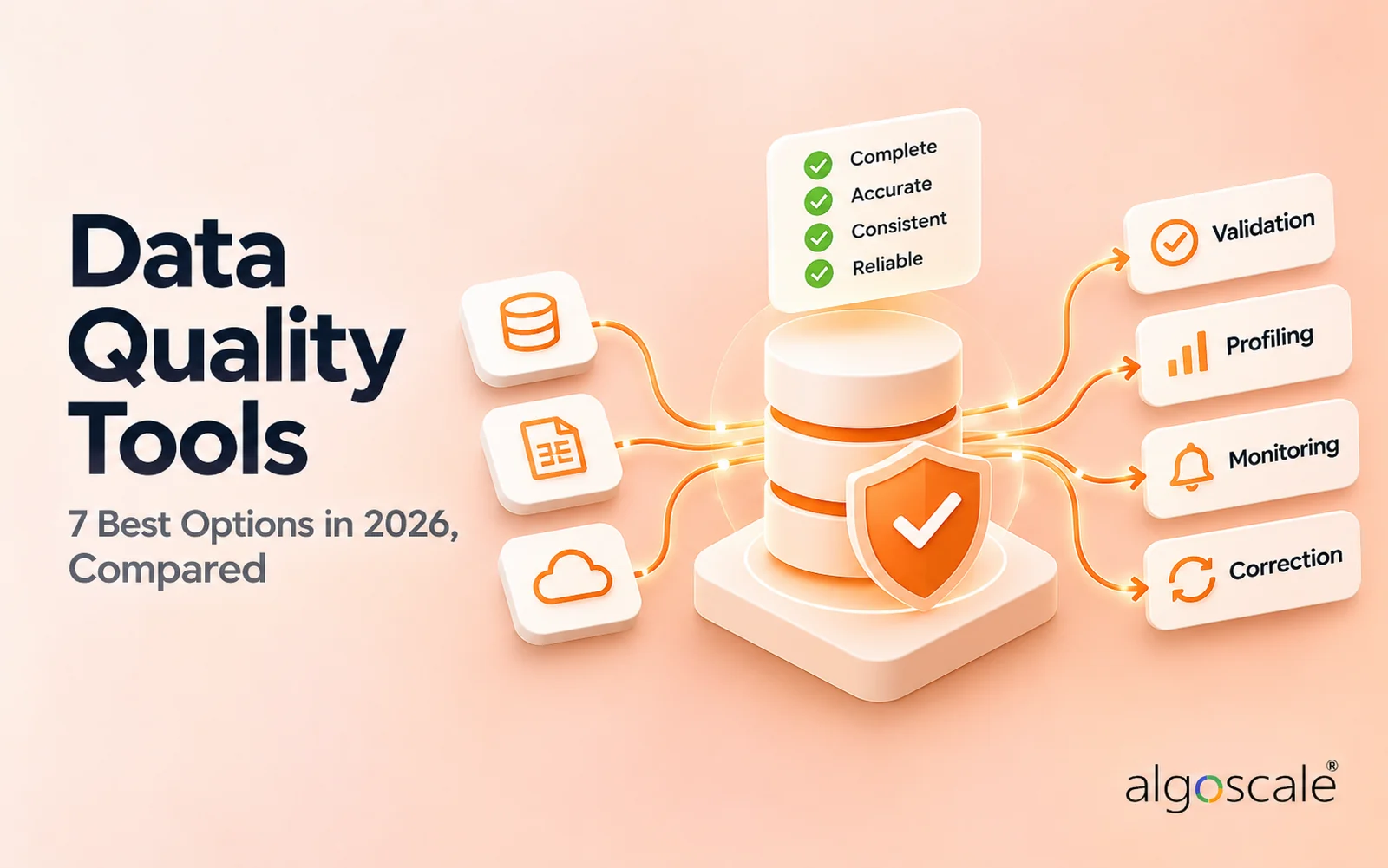

There are two kinds of data quality tools and most comparisons mix them together. In one, the test lives with the transformation, in version control, written by the person who wrote the model. In the other, the rule lives in a platform, written once so it outlives whoever wrote it.
Both are legitimate and they fail in opposite directions. Code-native tools only catch what somebody remembered to declare. Enterprise suites catch more, cost more, and publish less: of the three enterprise suites here, not one prints a price.
Every figure below was read on the vendor’s own pricing page on 5 November 2026. Nothing was trialled and no account was created. Three of the seven entries have a free open-source core with a separate commercial product, and this post never quotes one’s price against the other’s licence.
7 Best Data Quality Tools: Quick Comparison
| Tool | Best For | Public Reviews | The Catch | Starting Price | Access |
|---|---|---|---|---|---|
| 1dbt | Testing what is already modelled in the warehouse | G2 – 4.7 from 210 reviews; praised for lineage, criticised for a cluttered UI | Tests only what you declare; lineage starts at $100 a seat | Core free; Cloud $0 / $100 user / custom | Open source, or a free Cloud seat |
| 2Soda | Checks an engineer and an analyst can both read | G2 – 4.4 from 55 reviews; praised for YAML checks, criticised for community support delays | Nothing between free and $750 a month | $0 / $750 mo / custom | Open source, or a free account |
| 3Algoscale | Writing the checks when nobody owns the rules | Our own case study – dbt tests and validation matrices built with the models | A services engagement, not a product | Scoped per project | Talk to us |
| 4Great Expectations | Validation that doubles as documentation | G2 – 4.5 from 11 reviews, one of which never mentions the software | Free Cloud tier is 3 users and 5 validated assets a month | GX Core free; Cloud free / custom / custom | Open source, or a free Cloud tier |
| 5Informatica Cloud Data Quality | Rules that outlive the people who wrote them | TrustRadius – 6.9 from 40 ratings; praised for profiling, called a hardware monster | Priced in consumption units with no published figure | Not published | Get quote |
| 6Qlik Talend | Integration and quality on one contract | G2 – the open-source edition was retired, which its reviewers still mind | Data quality starts on the third of four tiers | Not published | Contact Us on every tier |
| 7Ataccama ONE | Quality, governance and MDM as one programme | G2 – 4.2 from 12 reviews; praised for permissions, criticised for a hard on-prem setup | Tiered on users, objects and active checks, with no figure | Not published | Request pricing |
Not sure which of these fits your stack?
Tell us what you are running today and what you need it to do. We will tell you which of these we would pick, and why. We are not going to pitch you.
How We Researched These Data Quality Tools
We attempted ten pages ranking for this term and opened nine; the tenth is a Reddit thread we cannot read, and we will not work around the site’s bot protection to get at it. Of the nine, four rank any product at all, and three of those four rank only enterprise master-data and address-cleansing suites. That is why a head-term search here returns a category with the code-native half missing.
Nothing was trialled and no account was created. Every price, limit and feature below was read on the vendor’s own pricing or documentation page on 5 November 2026. There is no dashboard screenshot and no hands-on narrative anywhere in this post.
Three entries have a free open-source core and a separate commercial product, and the distinction decides whether a price means anything. dbt Core is free and self-hosted; every figure in the dbt row is dbt Cloud’s. Soda Core is free and open source; the $750 is Soda’s hosted platform. GX Core is the free library; the tiers under Great Expectations are GX Cloud’s. Quoting one against the other is the most common error in this category and we have not made it.
Reviews come from G2 for four entries and TrustRadius for Informatica, with the Qlik Talend quote carried over from our data integration comparison, where the same listing was read. Review corpora in this category are thin and uneven – 210 reviews for dbt against 11 for Great Expectations – so the star ratings are reported but not compared.
Four things decided the order:
- What it actually catches – a declared test catches what you thought of; profiling and semantic typing catch what you did not
- Can you see the price – two of the six vendors here publish a paid figure and four refuse, which changes how long an evaluation takes before anyone can approve it
- Where the rule lives – in a repository it goes through review like code; in a platform it survives the person who wrote it
- What it costs to publish results widely – a quality programme nobody can see is a quality programme nobody acts on, and seat pricing decides that
Code-Native or Enterprise Suite: Which Half Is Yours?
The fork in this list is not open source against commercial. It is where the rule lives and who is expected to maintain it.
Read down the left column. If your sentence is in the top half, the first three entries are your shortlist. If it is in the bottom half, start at entry five.
| What is going wrong | Which half | Why |
|---|---|---|
| A model changed and a downstream dashboard broke silently | Code-native | dbt tests the models you already wrote, in the same repository and the same pull request |
| The checks need to be readable by the analyst who owns the metric, not only the engineer | Code-native | Soda’s check language is YAML a non-developer can read and write |
| Bad rows arrive from a source you do not control, before anything is modelled | Code-native | Great Expectations validates data at ingest and publishes the results as documentation |
| Nobody has profiled this source in years and nobody knows what is in it | Enterprise suite | Informatica and Qlik Talend profile automatically and recognise semantic types without rules being written first |
| Customer records are duplicated and addresses are wrong across several systems | Enterprise suite | Cleansing, standardisation and address validation are what the enterprise suites are actually for |
| Quality, governance and master data are one budget line and one programme | Enterprise suite | Ataccama sells all three as one platform rather than three products |
- If the answer is both halves, buy the code-native tool first. It is cheaper, it starts this week, and it will tell you how bad the problem is before you size the platform.
- Monitoring is a third category and not this one. Freshness, volume and anomaly detection belong to data observability tools, where Monte Carlo, Anomalo and Acceldata sit and where Soda and Algoscale both appear again – Soda judged there on what it watches and here on what you declare.
1. dbt: Best for Testing What Is Already in the Warehouse

What it does: Transformation in SQL with tests declared next to the models, so a data quality check is part of the build rather than a separate tool.
Who this is for: Analytics engineering teams running SQL transformations who want tests in version control
Two things are true about dbt and the comparison depends on keeping them apart. dbt Core is open source, free and self-hosted, with no seat or model limit. dbt Cloud is the commercial product, and every figure in this row is dbt Cloud’s.
The second thing: dbt Labs has merged with Fivetran. The banner runs across the top of dbt’s own pricing page, and no ranking rival on this term mentions it. If you are planning a stack around either company, that is the news.


Key Features
- Tests declared in YAML beside the model they test, versioned in the same repository
- dbt Core: free, self-hosted, with no seat or model limit
- dbt Cloud: browser IDE, job scheduling, CI checks on GitHub and GitLab
- Lineage with dbt Catalog and the semantic layer on the paid tiers
Pros and Cons
Pros
- The quality check lives with the code, so it goes through review like any other change
- dbt Core costs nothing and runs anywhere you can run Python
- The largest and most current review corpus of the open-source options here
Cons
- It tests what you declare: there is no anomaly detection, and nothing watches data you did not write a test for
- dbt Cloud’s free tier is one seat and 3,000 models a month, which a real team passes quickly
- Lineage, the feature most teams want next, starts at $100 a user a month
What Users Say
The UI could use a bit of improvement. After opening different models, it starts to look a little messy and cluttered.
Anish G. on G2Consultant at an enterprise, 21 June 2026, rated 5 out of 5 overall. This is the dislike half of the review; the praise half is that SQL is all you need and that it has lineage.

It solves many problems related to data transformations, data quality, and data lineage.
Akash M. on G2Senior Data Engineer in Information Technology and Services, 3 May 2026, rated 5 out of 5. Badged Incentivized and sourced from a G2 invite. The same review asks for errors to surface before compile time.
Pricing
dbt Core: free, open source, self-hosted. No seat limit, no model limit, no vendor.
dbt Cloud Developer: free. One developer seat, 3,000 successful models built a month, one project, browser IDE, job scheduling and CI checks on GitHub and GitLab.
dbt Cloud Starter: $100 per user a month. Five developer seats, 15,000 models a month, 5,000 queried metrics, one project. This is the first tier with lineage via dbt Catalog and the semantic layer.
dbt Cloud Enterprise: custom. 100,000 models a month, 20,000 queried metrics, 30 projects, column-level lineage, dbt Mesh, SSO, RBAC and SCIM.
The meter is successful models built and queried metrics per month – not rows, not compute.
Bottom Line
The default if your transformations are already SQL. Budget for Starter the moment you want lineage, and remember dbt Core alone tests only what you remember to declare.
Start here. It is the cheapest way to find out how bad your data quality problem actually is.
2. Soda: Best for Checks Both Sides of the Team Can Read
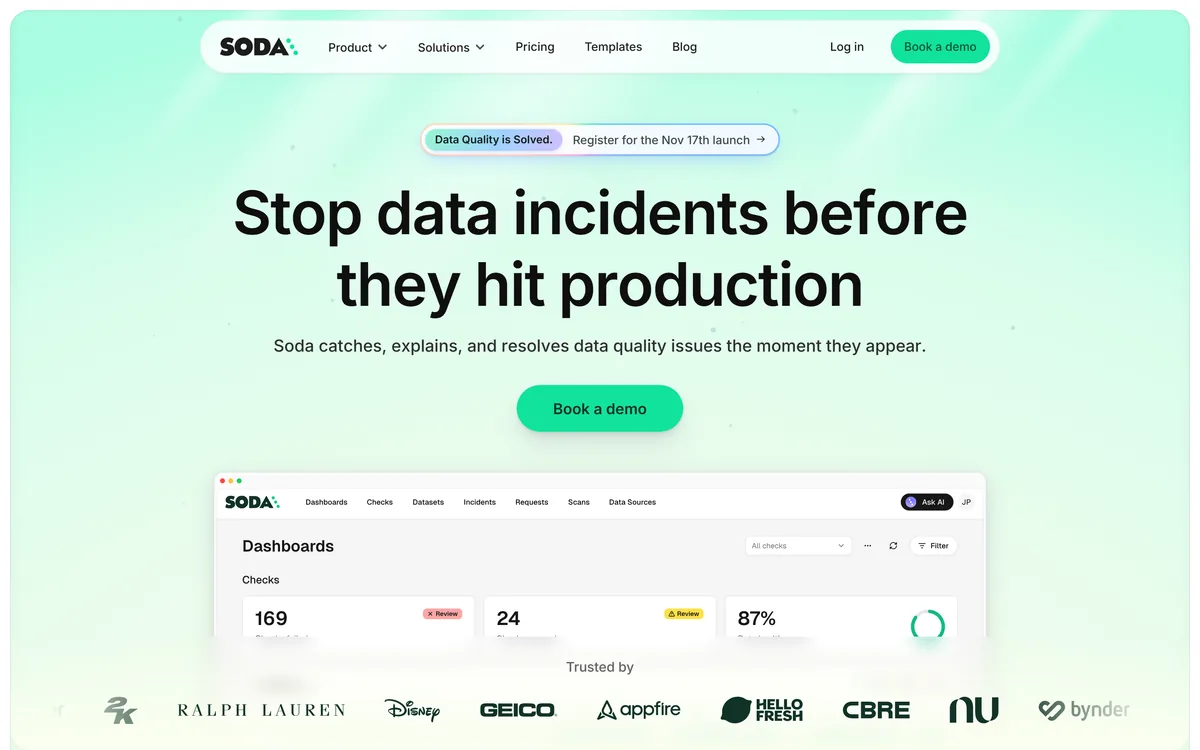
What it does: Data quality testing written as checks in YAML, run inside the pipeline, with alerting and anomaly detection on top.
Who this is for: Data teams who want quality checks inside the pipeline and owned by the people who own the data
Soda’s argument is who writes the check. SodaCL is YAML, which means the analyst who owns the metric can read the rule that guards it and, more importantly, can tell when it is wrong. Soda Core is free and open source and runs inside an orchestrator you already have.
The paid shape is unusually honest and unusually steep. Free is $0 with unlimited users and pay-as-you-go processing units. Team is a flat $750 a month. There is nothing in between, so the upgrade is a decision rather than a drift.


Key Features
- Checks written in SodaCL, a YAML check language a non-developer can read
- Soda Core open source, running inside an existing orchestrator such as Airflow
- Data contracts between producers and consumers, on the Team tier
- Built-in anomaly detection alongside the declared checks
Pros and Cons
Pros
- A published paid price, which four of the six vendors here refuse
- Unlimited users on the free tier, so a pilot is not rationed by seat
- Checks are readable by the people who own the data, not only by engineers
Cons
- $750 a month is a real step up from free, with nothing in between
- Metered in Soda Processing Units, so the cost depends on a unit you have to model first
- Support on the open-source side runs through a community Slack channel, where its own reviewers report delays
What Users Say
It is very easy to write Soda data contracts & quality tests in YAML format. This will be a significant productivity booster, especially for non-developers.
Rahul S. on G2Principal Data Engineer at a mid-market company, 27 August 2024, rated 5 out of 5. The same review records running Soda Core inside Airflow with alerts through PagerDuty.
Nothing as of now, sometime there is slight delay in support over slack community `soda-core` channel
Gaurav M. on G2Data Engineer at an enterprise, 7 August 2024, rated 3.5 out of 5. Badged Incentivized and sourced from a seller invite. Quoted as published.

Pricing
Soda Core: free, open source, self-hosted, run inside an orchestrator you already have.
Free: $0 a month. Free Soda Processing Units, pipeline testing, metrics observability, and alerting and ticketing integrations. No credit card.
Team: $750 a month. Collaborative data contracts, a no-code interface, audit logs, custom roles and RBAC, private deployment, SSO and premium support.
Enterprise: custom.
Additional capacity on the free plan is pay-as-you-go in Soda Processing Units, so model your check volume before you commit.
Bottom Line
The middle ground: open source to start, a readable check language, and a published price when you outgrow it.
The one to pick when the people who care about the data are not the people who write Python.
3. Algoscale: Best for Writing the Checks Nobody Owns
What it does: The team that writes and owns the checks these tools run, and the models they are written against.
Who this is for: Teams who have bought a data quality tool and have nobody to write and own the rules it runs
Algoscale is not a tool on this list – it is the data engineering team that implements them. We are including it here because the question that follows “which tool?” is usually “who is going to build this?”, and in most shortlists nobody answers it.
Every product above runs the checks you give it. On a paid-media analytics rebuild, our case study lists what we brought: “Emphasis on data quality, transparency, and reproducibility through dbt tests and validation matrices.” The tests were written with the models, not after them.


Key Features
- The test suite written with the models, in the same repository and the same review process
- Reconciliation against the system being replaced, at the grain the business actually reports on
- Layered modelling – L1 staging, L2 core metrics, L3 unified marts, L4 BI-ready views – so a failing test points at a layer
- Separated dev and prod targets with controlled promotion, so a new check cannot break production first
Pros and Cons
Pros
- Answers the question every tool on this list assumes somebody else answered: what should the checks be
- The work is published as a case study on our own site, not asserted as a capability
- No per-seat, per-asset or per-check meter, so publishing more checks does not raise the bill
Cons
- A services engagement, not a product: no free tier, no trial, no rate card
- Overkill if the checks are already written and somebody owns them – run dbt Core or buy Soda and stop
- You still license the tool underneath; this is the layer that decides what it tests, not a replacement for it
Pricing
Scoped per project. No rate card – the same answer Informatica, Qlik Talend and Ataccama give, and the opposite of Soda’s published $750.
No per-seat, per-asset or per-check meter, so publishing quality results across the business does not add licences.
The engagement is the models, the tests and the reconciliation. The tool that runs them is still yours to license.
The same engagement reconciled the old warehouse against the new one at the grain of date by platform by device by conversion name, and corrected the transformation gaps that comparison exposed.
Bottom Line
Bring us in when the tool is installed and the checks still are not written – the part every product on this list leaves to you.
The right call when the rules are the gap, not the software.
4. Great Expectations: Best for Validation That Documents Itself
What it does: Declared expectations about data, validated on a schedule or in a pipeline, with the results published as documentation.
Who this is for: Teams who need the validation rules to be legible to people who did not write them
GX Core is the open-source library and it is free with no caps. GX Cloud is the hosted product, and its free Developer tier is smaller than it first looks: three users, five validated data assets a month, and limited AI recommendations. Unlimited expectations and validations start on Team.
What makes it worth the work is the artefact. Validation results publish as readable documentation, so the rules become the description of what the data is supposed to be. That is the thing a new joiner can actually read.


Key Features
- Expectations declared in Python and validated against a batch of data
- Data Docs: the validation results published as readable documentation
- GX Core open source with no limits, self-hosted
- Role-based access control on every GX Cloud tier, including the free one
Pros and Cons
Pros
- The validation suite doubles as the documentation of what the data is supposed to be
- GX Core is genuinely free and has no asset cap
- Role-based access control is on every tier, including the free one, which the paid-only RBAC elsewhere in this category is not
Cons
- No published price above free, so the upgrade starts with a sales call
- Three users and five validated data assets a month, with expectations and validations limited until you pay – the free Cloud tier is an evaluation, not a working allowance
- An 11-review corpus is not a basis for a rating comparison, and one of those five-star reviews never mentions the software at all
What Users Say
Ease of Use and the features that are provided on the platform to handle different challenges associated with data quality.
ramesh R. on G2Principal Consultant at a small business, 19 April 2023, rated 4.5 out of 5. Badged Incentivized and sourced from a G2 invite. Username in the lower case G2 shows.
Great Expectations is a brilliant evocation of a time and place.
Sunil K. on G2A five-star review, badged Incentivized, whose entire praise is that sentence and which says nothing about the software. It is one of the eleven reviews behind the 4.5 rating.

Pricing
GX Core: free, open source, self-hosted, no caps.
GX Cloud Developer: free. Up to 3 users and 5 validated data assets a month, with role-based access control and limited AI recommendations.
GX Cloud Team: custom. Up to 10 users, and the first tier with unlimited expectations and validations, full AI recommendations and one year of audit retention.
GX Cloud Enterprise: contact sales. Multiple workspaces, agent deployment, SSO, a 99.5% uptime SLA, life-of-term audit retention and 5 hours of professional services annually.
G2’s listing says the same thing in its own words: pricing details for this product are not currently available.
Bottom Line
Take GX Core for the documentation it produces. Treat the Cloud free tier as an evaluation, and treat the star rating as noise.
Worth it if somebody will read the docs it produces. Otherwise you have bought a second test runner.
5. Informatica Cloud Data Quality: Best for Rules That Outlive Their Authors

What it does: Enterprise data quality – profiling, cleansing, address validation, stewardship – inside Informatica’s Intelligent Data Management Cloud.
Who this is for: Enterprises cleansing and standardising customer data, usually next to an MDM programme
This is where the list stops publishing numbers. Informatica prices on consumption in Informatica Processing Units, and the pricing page carries Get quote and no figure for any product. Both product-level pricing URLs we held render a page headed File Not Found.
What you buy for that unknown price is the work the code-native half does not attempt: profiling that surfaces anomalies before anybody writes a rule, agents that automate cleansing and standardisation, and address verification.


Key Features
- Continuous data profiling to surface patterns, anomalies and quality risks
- Data Quality Agents that automate cleansing, standardisation and validation
- Address verification and content filtering, by its own reviewers’ account
- One IPU capacity pool spent across data quality, integration and the platform’s other services
- Informatica appears in three of our comparisons and each is a different product: IDMC moves the data, the governance module enforces policy, and Cloud Data Quality, the entry here, writes and runs the rules
Pros and Cons
Pros
- Covers the enterprise cases the open-source tools do not attempt, address validation above all
- One capacity pool spent across data quality, integration and governance
- Business users can run profiling without a developer, by its reviewers’ account
Cons
- No published price at any level, and the product-level pricing URLs are dead
- Consumption pricing in a unit you cannot model before buying
- Its own reviewers call it a hardware monster: the more data you profile, the more memory and CPU it needs
What Users Say
Informatica Data Quality is a tool that supports business users (non-technical) and developers(technical) in an equal way. However, the more data you profile, the more memory and CPU it needs.
Gurcan Orhan on TrustRadiusData Quality Management Software Development Manager at a bank, 10,001+ employees, 12 April 2019, rated 9 out of 10 and badged Incentivized. Quoted as published. The review’s first listed con is “A hardware monster.”

Data reviewing is not fully encompassed by Informatica Data Quality, which would validate the database.
Angel Caroline on TrustRadiusIT Consultant at an insurance group, 25 December 2021, rated 10 out of 10 and badged Incentivized. This is the first of two cons in a positive review; the praise half credits the cleansing and address verification.
Pricing
Not published. Consumption pricing in Informatica Processing Units, with Get quote in place of any figure, for every product.
One IPU pool is spent across the platform’s services, which Informatica presents as the benefit: “Only pay for the services you require now, swap for new services as needed and track usage to maximize ROI.”
The pricing page leads with 413% average ROI and seven figures of claimed savings, attributed to a Nucleus Research guidebook. That is a third-party study published by the vendor on its own pricing page, not a benchmark a buyer went looking for.
Both product-level pricing URLs – for cloud data management and cloud data integration – render a page headed File Not Found.
Bottom Line
The enterprise answer for cleansing and stewardship. Expect a quote, a consumption unit and a procurement cycle before you see a number.
Right product, opaque purchase. Budget the evaluation time, not just the licence.
6. Qlik Talend: Best for Integration and Quality on One Contract
What it does: Data integration with data quality, profiling and stewardship bundled into the upper tiers of one platform.
Who this is for: Organisations that want integration, CDC and data quality from one vendor, including SAP and mainframe sources
Read the tier table before you shortlist this one. All four Qlik Talend Cloud tiers carry Contact Us and no figure, and data quality does not appear until Premium, the third of the four. Starter and Standard are integration and change data capture only.
Premium is worth the climb if you need it: profiling based on automatically recognised semantic types, stewardship workflows for review and remediation, and the Qlik Talend Trust Score as a single readiness measure. Enterprise adds SAP and mainframe sources.


Key Features
- Data quality, profiling and stewardship on the Premium tier and above
- The Qlik Talend Trust Score as a single readiness measure across the estate
- Change data capture and real-time synchronisation from the Standard tier
- SAP and mainframe connectivity on Enterprise
Pros and Cons
Pros
- Integration and quality on one contract, with one vendor to call
- Semantic-type recognition means profiling starts without writing rules first
- Covers sources the rest of this list does not reach, SAP and mainframe included
Cons
- No published price at any tier
- Data quality starts at the third of four tiers, so the entry plans do not do the job this post is about
- The open-source edition was retired, which removed the free path its own reviewers used to take
What Users Say
We use can use drag and drop methodology in talend and connection between source database and the target database using talend studio which is used yo ingest the data to target from source
uday t. on G2Consultant at a small business, 5 July 2023, rated 5 out of 5. Organic, not incentivised. Typos as published. From the Talend Data Fabric listing, which predates the Qlik rebrand.

They retired the open source product, only commercial version available Talend does not have good support for third-party data sources especially cloud based sources
Yassiem D. on G2IT consultant at a small business, 26 October 2023, rated 1 out of 5. Organic, not incentivised. Published with no sentence punctuation and under a positive review title. Also from the Talend Data Fabric listing, before the rebrand.
Pricing
Not published. Starter, Standard, Premium and Enterprise all carry Contact Us and no figure.
Starter is pre-built SaaS and database connectivity, managed pipelines, a catalog and field-level profiling.
Standard adds log-based change data capture, hybrid deployment and Qlik Open Lakehouse.
Premium is the first tier with data quality and profiling on automatically recognised semantic types, stewardship for review and remediation, and the Trust Score.
Enterprise adds comprehensive SAP application and mainframe connectivity.
Bottom Line
Shortlist it when integration and quality have to be one contract. Price Premium, not Starter, because that is where the quality features begin.
A fair deal if you are buying the whole platform, and a poor one if you only want the checks.
7. Ataccama ONE: Best for Quality, Governance and MDM as One Programme
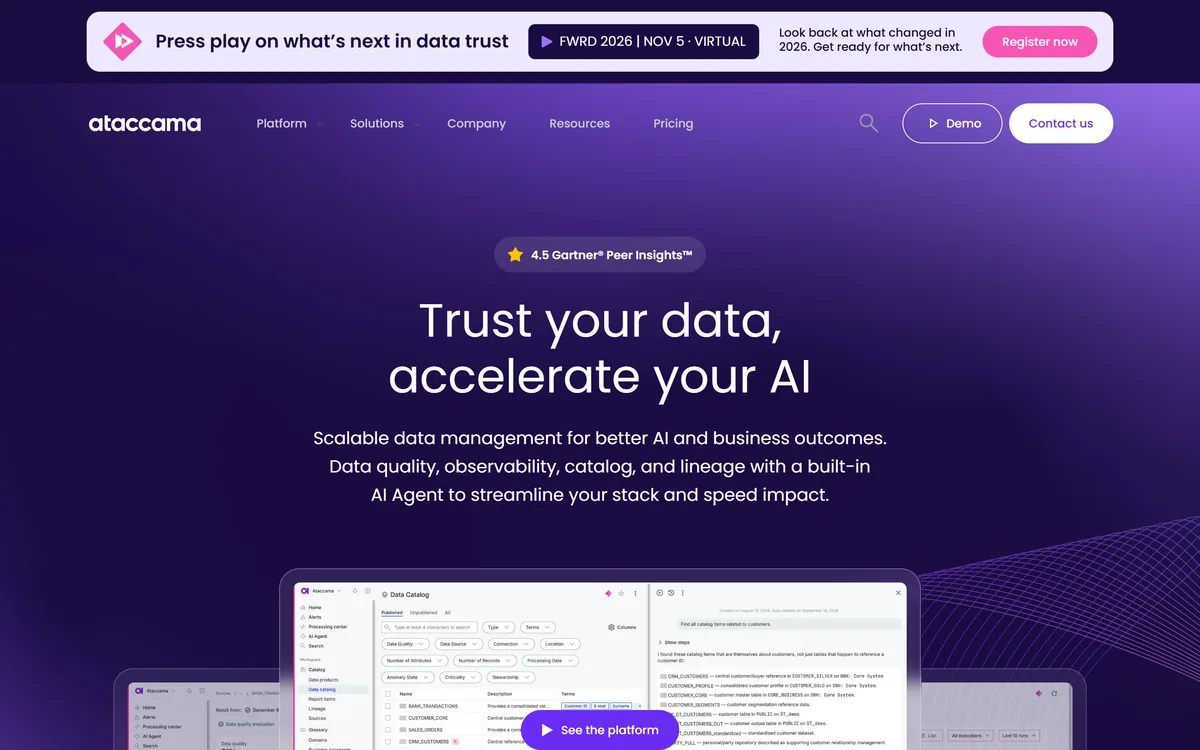
What it does: A unified data trust platform: quality, observability, governance and master data management in one product.
Who this is for: Enterprises running quality, governance and MDM as one programme
Ataccama publishes its pricing model without publishing a price, which is more than Informatica or Qlik Talend manage. Three dimensions set the tier: named users with full platform access, data objects managed, and active data quality configurations – checks that have run at least once in the past 90 days.
Two details in that model are worth copying whoever you buy from. Inactive configurations do not count, so retired rules stop costing money. And consumer users with view permissions are unlimited at every tier, so publishing results across a business does not add licences.


Key Features
- Quality, observability, governance and MDM in one platform rather than four
- Unlimited view-only consumer users at every tier
- Tiering on active checks, so retired rules stop costing money
- Folder-level permissions and monitoring project views, by its reviewers’ account
Pros and Cons
Pros
- The pricing model is published even though the price is not, which is more than Informatica or Qlik Talend offer
- Unlimited read-only users, so publishing quality results across a business does not add licences
- One platform covers the governance and MDM work the testing tools here do not touch
Cons
- No figure anywhere: every evaluation starts with Request pricing
- Reviewers describe the desktop application as complicated and the on-premise setup as hard
- A 12-review corpus, which is too thin to read a rating from
What Users Say
The initial setup was very hard with the on-prem installation, but now they brought it to the cloud, so it’s seamless.
Siva M. on G2Lead Member Of Technical Staff at an enterprise, 20 May 2026, rated 4.5 out of 5. The same review praises folder-level permissions and the monitoring project view, and asks for machine-learning rule suggestions.

Ataccama desktop is very complicated. Need a learning experience for this
Karthika S. on G2Senior Data Governance Analyst at an enterprise, 1 November 2024, rated 5 out of 5. Quoted as published. The same review rates the UI easy to use and the support good.
Pricing
Not published. The pricing page is Request pricing.
Three dimensions set the tier: named users with full platform access, data objects managed – tables, views, pipelines, BI reports – and active data quality configurations.
An active configuration is a check executed at least once in the past 90 days. Inactive configurations do not count.
Consumer users with view permissions are unlimited at every tier, and Ataccama states that exceeding a threshold “will never disrupt your operations or result in retroactive charges”.
The 348% three-year ROI on the page comes from a commissioned Forrester Total Economic Impact report, published by the vendor.
Bottom Line
The broadest platform here and the least priced. Worth the call if quality, governance and MDM are one budget line.
Buy the programme, not the checks. If you only need checks, you are two entries too far down this list.
Which Data Quality Tool Should You Choose?
Choose dbt if:
- Your transformations are already SQL and already in git
- You want the test to go through code review like the model does
- dbt Core’s licence is free and that is the whole budget for now
Choose Soda if:
- The person who owns the metric is not the person who writes Python
- You want checks inside the pipeline, not a separate monitoring product
- $750 a month is a step you can take in one go rather than by drift
Choose Algoscale if:
- The tool is installed and the rules still are not written
- The models and the tests need building together, not one after the other
- The new warehouse has to be reconciled against the one it replaces
Choose Great Expectations if:
- Bad rows arrive before anything is modelled
- The validation rules need to be readable as documentation
- GX Core self-hosted covers you, because the Cloud free tier is three users
Choose Informatica Cloud Data Quality if:
- Customer records need cleansing, standardising and address validation
- The rules have to outlive the people who wrote them
- A quote and a procurement cycle are a normal way for you to buy
Choose Qlik Talend if:
- Integration and quality have to come from one vendor
- Nobody has profiled the source in years and semantic typing would help
- SAP or a mainframe is in scope
Choose Ataccama ONE if:
- Quality, governance and MDM are one programme and one budget
- Results need publishing to people who will never log in to write a rule
- You would rather buy one platform than integrate three
Skip this category entirely if:
- One pipeline is the whole problem. dbt Core or Soda Core costs nothing and will tell you how bad it is before you size anything bigger.
- The question is “does the new table match the old one” after a migration. That is reconciliation rather than data quality, and Datafold is the product category built for it.
- You are validating Spark or pandas frames at ingest in Python. Pandera is the lighter data quality testing tool when Great Expectations would be more machinery than the job needs.
What’s the Best Data Quality Tool in 2026?
dbt, for most teams reading this – because the transformations are probably already SQL, dbt Core is free, and a test that lives in the same pull request as the model is a test that gets maintained. The honest caveat is the one its own design implies: it catches what you declared and nothing else.
Soda if the checks need to be readable by the business. It is one of only two entries here that publish a paid price, and the only one where that price is a flat monthly figure rather than a per-seat multiplication. Great Expectations if the validation has to double as documentation, on GX Core rather than the three-user Cloud tier.
Informatica, Qlik Talend or Ataccama are the answer when the rules have to outlive their authors. Cleansing, address validation, stewardship and MDM are real work the code-native half does not attempt. All three cost a procurement cycle before they cost money, and none of the three will tell you what that money is.
And if the honest answer is that the tool is already installed and nobody has written the rules, no entry on this list fixes that. That is the row we are in, at number three.
How Algoscale Writes the Checks These Tools Run
Every tool above runs the rules you give it. The failure we are called in for is almost never that the tool is wrong – it is that nobody decided what good data looks like, so the suite is three freshness checks and a row count.
On a paid-media analytics rebuild, our data engineering team built the models and the tests together, in four declared layers, with dev and prod targets separated and controlled promotion between them. The case study lists the capability as emphasis on data quality, transparency and reproducibility through dbt tests and validation matrices.
The part that is hardest to buy as a product is the reconciliation: comparing the new warehouse against the one it replaces, at the grain the business actually reports on, and fixing what that comparison exposes.
- Test suites written with the models, in the same repository and the same review process
- Reconciliation against the system being replaced, at the grain the business reports on
- Layered modelling so a failing test points at a layer rather than at the whole warehouse
- Separated dev and prod targets with controlled promotion, so a new check cannot break production first
- No per-seat, per-asset or per-check meter, so publishing more checks does not raise the bill
Ready to put this into production?
Algoscale’s data engineers have built and migrated data platforms for retail, fintech and manufacturing teams. Book a free consultation and we will scope yours with you.
Frequently Asked Questions
What are the best open source data quality tools?
Three of the seven entries here have a free open-source core. dbt Core is free and self-hosted with no seat or model limit, and tests the models you have already written. Soda Core is free and open source and runs inside an orchestrator you already have, with checks written in YAML. GX Core, the Great Expectations library, is free with no asset cap and publishes its validation results as documentation. Each has a separate commercial product – dbt Cloud, Soda’s paid tiers and GX Cloud – and the prices in this post belong to those, not to the open source projects.
What is the difference between data quality and data observability?
Data quality tools check what you declare: this column is never null, this total matches that one, this value is in this set. Data observability tools watch what you did not think to declare: freshness, volume, schema drift and statistical anomalies. The practical difference is who writes the rule. Quality needs someone to decide what good looks like; observability infers it from history and tells you when today is unusual. Most teams need both, and we cover the second in a separate comparison of data observability tools.
How much do data quality tools cost?
It splits three ways. Free and open source: dbt Core, Soda Core and GX Core all cost nothing to run yourself. Published paid prices: Soda at a flat $750 a month for Team, and dbt Cloud at $100 per user a month for Starter. Not published at all: Informatica, Qlik Talend and Ataccama, plus the Team and Enterprise tiers of GX Cloud. Four of the six vendors on this list will not print a number, which is worth knowing before you plan an evaluation.
Can dbt tests replace a data quality tool?
For a lot of teams, yes – and that is the cheapest honest answer in this category. If your data is already modelled in the warehouse and the problems you have are broken joins, unexpected nulls and totals that stop matching, dbt tests catch them, in version control, for free. What they do not do is notice a problem nobody anticipated. There is no anomaly detection and nothing watches a table you did not write a test for, so the suite is exactly as good as the thinking behind it.