

Digital transformation has become one of the most overused phrases in enterprise technology, often serving as a catch-all for any initiative involving cloud migration, mobile applications, or workflow automation. Underneath the marketing language, digital transformation has a concrete meaning: the ability of an organization to sense changes in its environment, process relevant data, and respond faster and more intelligently than it could before. The organizations that are actually succeeding at digital transformation consistently share one infrastructure characteristic. They modernized their data foundation first.
A cloud-native data lakehouse is increasingly the infrastructure at the center of successful digital transformation programs. Unlike legacy data warehouses that require costly capacity planning and struggle with growing data volumes, or first-generation data lakes that accumulate data without enabling reliable analytics, the modern data lakehouse delivers scalability, governance, and analytics capability in a form that can accelerate every layer of a digital transformation initiative. This piece examines why the data lakehouse has become the platform of choice for digitally transforming organizations and what the cloud-native design specifically makes possible that earlier architectures could not.
What Cloud-Native Actually Means for a Data Lakehouse
The term cloud-native has a specific meaning in data infrastructure that goes beyond simply running software on cloud hardware. A cloud-native data lakehouse is one designed around the fundamental characteristics of cloud computing: elastic scalability, separation of storage and compute, pay-per-use economics, and managed operational responsibility. Storage is held in cloud object storage such as Amazon S3 or Azure Data Lake Storage, where durability is eleven nines and cost per gigabyte continues to decline. Compute engines are decoupled from storage and can scale to zero when not in use or to thousands of processing cores on demand when workloads require it.
This design has profound implications for digital transformation initiatives. Business units no longer need to wait weeks for central IT to provision additional server capacity before launching a new analytics use case. A new data product can be built by pointing a query engine at an existing S3 bucket, defining a schema through the catalog, and making it available to downstream consumers within hours rather than weeks. The speed of iteration that cloud-native infrastructure enables directly translates to faster business decision-making, more frequent experimentation, and faster response to market changes, which are the operational behaviors that define a digitally transformed organization.
Breaking Down the Data Silos That Stall Transformation
Most digital transformation initiatives eventually encounter the same obstacle: data silos. Customer data lives in a CRM system. Transaction data lives in an ERP. Operational metrics live in departmental spreadsheets. Web analytics live in a SaaS platform that exports to CSV. When decision-makers need a unified view of the business to make transformation decisions, the data they need is scattered across systems that do not connect, maintained by different teams with different field definitions, and often duplicated in inconsistent ways that make reconciliation more art than science.
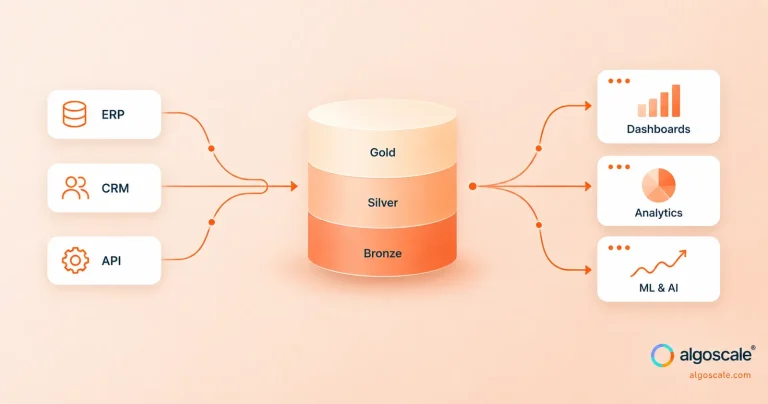
A data lakehouse architecture addresses this by creating a single unified storage layer, a cloud data lake, into which data from all source systems is ingested, cataloged, and governed. AWS data lakehouse implementations using Glue and Lake Formation connect to hundreds of source systems through native connectors and publish all ingested data through a centralized catalog that enforces consistent naming, definitions, and access controls. Azure data lakehouse environments using Azure Data Factory and Microsoft Purview accomplish the same integration across the Microsoft ecosystem and beyond. Once data is unified in the lakehouse, business units can build the cross-functional analytical products that were previously impossible because the data they needed existed in systems that could not be joined at any scale.
Enabling Real-Time Decision-Making Where It Matters Most
Traditional data warehouses operate on a batch model where yesterday’s data is available today and this week’s summary is available next Monday. Digital transformation requires organizations to respond to events as they happen: detecting fraud within milliseconds of a transaction, personalizing the next customer interaction based on the current session behavior, rerouting supply chain logistics in response to a disruption that occurred an hour ago. This real-time requirement cannot be satisfied by a batch-oriented warehouse architecture regardless of how fast the underlying query engine runs.
A cloud-native data lakehouse supports real-time data ingestion through streaming pipelines built on Apache Kafka, Amazon Kinesis, or Azure Event Hubs. Open table formats like Apache Iceberg and Hudi enable streaming writes to the lakehouse with ACID guarantees, making data available for analytical queries within seconds of generation. Query engines such as Amazon Athena, Trino, or Azure Synapse Serverless serve near-real-time analytical dashboards and operational applications over this continuously updated dataset without requiring separate real-time serving infrastructure that must be maintained independently of the batch analytical environment.
Traditional Data Architecture vs. Cloud-Native Data Lakehouse Digital Transformation Impact
| Capability Dimension | Traditional Data Architecture | Cloud-Native Data Lakehouse | Business Impact of the Difference |
| Data Availability Latency | Hours to days after generation | Seconds to minutes after generation | Real-time operational decisions become viable |
| Infrastructure Scaling Speed | Weeks for hardware procurement | Minutes via cloud auto-scaling | New use cases launch without infrastructure delay |
| Storage Cost Trajectory | Increases with hardware lifecycle | Declines as cloud prices fall over time | More data retained at lower cost over time |
| Time to Launch New Use Case | Months for schema design and ETL | Days to weeks with catalog and query | Faster experimentation and business agility |
| AI and ML Workload Readiness | Low due to schema and format constraints | High with open formats and native Spark | Accelerated AI program delivery |
| Data Science Team Autonomy | Low, dependent on central DBA team | High with self-serve catalog and query | Faster model development and iteration |
| Cross-Domain Analytics | Limited by system and team silos | Unified through shared lakehouse catalog | Better-informed cross-functional decisions |
| Disaster Recovery and Resilience | Complex, expensive, often manual | Built-in via cloud multi-region replication | Higher resilience with lower operational cost |
Accelerating the AI Layer of Digital Transformation
Artificial intelligence sits at the center of most enterprise digital transformation programs, whether expressed as predictive maintenance for industrial assets, recommendation engines for digital commerce, fraud detection for financial services, or clinical decision support for healthcare. AI programs need large volumes of high-quality, well-governed training data. A cloud-native data lakehouse is the most natural foundation for these workloads because it stores data in open formats that Python data science tools and ML frameworks can read directly, maintains the versioning and lineage controls that AI governance requires, and scales storage cost-effectively to the volumes that serious ML programs demand.
Organizations that attempt to build AI capabilities on top of a traditional data warehouse consistently encounter the same constraints. The warehouse cannot serve the large-scale unstructured and semi-structured data that many AI workloads require. Organizations that build AI on an ungoverned cloud data lake face reproducibility and audit challenges that undermine compliance in regulated sectors. A well-designed lakehouse architecture resolves both constraints simultaneously, enabling data science teams to iterate rapidly on models while governance controls keep the program defensible as it scales and regulatory scrutiny increases.
Supporting Multi-Cloud and Hybrid Modernization Strategies
Large enterprises rarely operate on a single cloud provider, and almost none have migrated all workloads from on-premises infrastructure to the cloud. A cloud-native data lakehouse built on open table formats is well-positioned to serve as the data layer in a multi-cloud or hybrid modernization strategy because the underlying data is stored in vendor-neutral open formats that any cloud provider’s tools can read without data movement. An Iceberg table stored in Amazon S3 can be queried by Snowflake, Google BigQuery Omni, or Azure Synapse without copying the underlying Parquet files. A Delta Lake table on Azure ADLS Gen2 can be read by Databricks clusters running on AWS or GCP.
This cross-cloud portability means your organization is not locked into any single provider’s compute ecosystem even while taking advantage of each cloud’s managed services for specific workloads. For CIOs managing cloud vendor relationships as part of a broader commercial or risk management strategy, the open data layer that a lakehouse architecture provides is a significant strategic asset. It ensures that the data itself remains portable and accessible regardless of future compute platform decisions, which is the most important dimension of avoiding lock-in in a multi-cloud data strategy.
Digital Transformation Capability Enablement Through Cloud-Native Lakehouse Features
| Transformation Use Case | Enabling Lakehouse Capability | Illustrative Platform Configuration |
| Real-time customer behavior analytics | Streaming ingestion with Iceberg commits | Kafka and Flink and Iceberg on AWS data lakehouse |
| 360-degree customer view | Unified cloud data lake with governed catalog | ADLS Gen2 and Purview on Azure data lakehouse |
| AI-driven product recommendation | ML-ready open formats with feature store | S3 and Iceberg and SageMaker integrated |
| Supply chain real-time visibility | High-frequency CDC via Hudi or Iceberg | Debezium and Hudi and EMR on AWS |
| Automated regulatory reporting | Governed lakehouse with full audit logging | Lake Formation and CloudTrail and Athena |
| Self-serve analytics for business teams | Governed catalog with serverless SQL engine | Athena and Glue Catalog and QuickSight |
| Unified operational and analytical data | Multi-source ingestion to shared lakehouse | ADF and Synapse and Power BI on Azure |
| Data cost optimization at petabyte scale | Tiered object storage with open table format | S3 Intelligent-Tiering and Iceberg lifecycle |
Governance That Enables Rather Than Restricts
A persistent misconception about data governance is that it creates friction and slows analytical teams down. In a poorly designed architecture, this is sometimes true because access controls are implemented as manual processes that create bottlenecks. In a well-designed cloud-native data lakehouse, governance is what makes self-service analytics possible at scale. AWS Lake Formation and Microsoft Purview allow organizations to grant granular access to specific tables, columns, or row subsets without requiring the central data team to mediate every request. Business analysts and data scientists can discover available datasets through the catalog, review their quality and lineage documentation, and request access through automated approval workflows rather than filing tickets and waiting in queues.
This self-service governance model is what separates a genuinely transforming organization from one that is still managing data as a centralized function that other teams depend on and wait for. When business teams can access the data they need quickly and with confidence in its quality, they iterate faster, test more hypotheses, and make better decisions. The cloud-native data lakehouse makes this organizational behavior change possible by combining open, elastic storage with the governance controls that allow organizations to say yes to data access requests rather than defaulting to no in the name of security and control.
Measuring the Return on Lakehouse Infrastructure Investment
Digital transformation programs are notoriously difficult to measure in terms of infrastructure return on investment. The relationship between infrastructure investment and business outcome is rarely direct or immediate. However, organizations that have built cloud-native data lakehouse platforms consistently report measurable improvements across the metrics that matter to transformation programs. Data engineering teams report significant reductions in the time required to onboard new data sources after moving to a governed lakehouse with a centralized catalog. Data scientists report faster feature iteration cycles when working directly with lakehouse data versus waiting for warehouse exports. Business teams report access to cross-functional analytical capabilities that were previously impossible due to data silos between source systems.
Infrastructure cost improvements are measurable and often compelling. Organizations moving analytical workloads from provisioned warehouse clusters to serverless lakehouse query engines report meaningful cost reductions for workloads with variable or unpredictable query patterns, because they pay only for queries actually executed rather than maintaining capacity for peak demand. Storage cost improvements from moving to open Parquet files in S3 or ADLS from proprietary warehouse formats are often substantial at petabyte scale. These savings compound over time and fund the additional data engineering investment needed to expand the lakehouse’s coverage to more business domains, creating a virtuous cycle of data-driven investment and organizational capability building.
How AlgoScale Helps Organizations Build Cloud-Native Data Lakehouses
Building a cloud-native data lakehouse requires more than selecting the right technology. Organizations need a well-planned architecture, secure data governance, scalable data pipelines, and a migration strategy that supports long-term business growth.
AlgoScale helps enterprises design and implement modern data lakehouse platforms on AWS and Azure using industry-leading services and open data architectures. From data ingestion and pipeline development to governance, real-time analytics, and AI-ready data foundations, our team delivers scalable solutions tailored to your business requirements.
Whether you’re modernizing a legacy data warehouse, consolidating fragmented data sources, or planning a new cloud-native analytics platform, AlgoScale provides the technical expertise to help you build a secure, high-performance, and future-ready data ecosystem.