

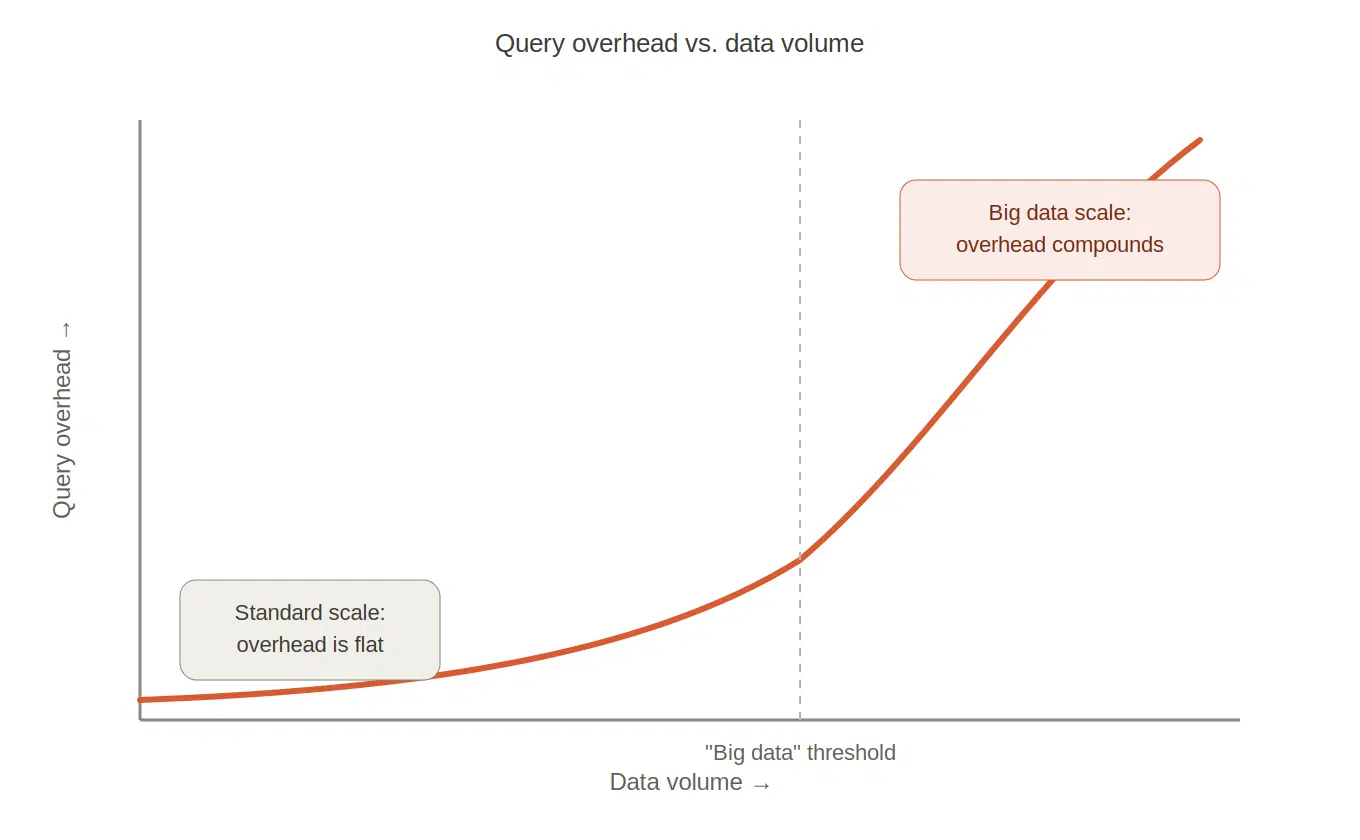

A data lake architecture that works beautifully at a few hundred gigabytes doesn’t automatically work the same way at fifty terabytes, and often breaks down entirely somewhere past a petabyte. This isn’t a knock against the original design – most of the practices that work fine at modest scale genuinely do work fine at that scale. The problem is that volume changes the physics of the system in ways that aren’t visible until you actually cross certain thresholds.
This post is about those thresholds: what specifically changes as a data lake grows from “standard” scale into genuine big data territory, and what needs to change in your architecture and practices to keep up. If your data lake is starting to show cracks as it grows, our Data Lake Services team at Algoscale has worked through exactly these scaling problems across client architectures.
For the organizational side of scale – governance, team structure, multi-domain ownership – our companion post on enterprise data lake architecture and best practices at scale covers that ground in more depth.
Why “Big Data Lake” Isn’t Just a Marketing Term
It’s tempting to treat “big data” as a vague buzzword, but at the engineering level, there are real, identifiable thresholds where the behavior of a data lake changes qualitatively, not just quantitatively. A query that scans a thousand files behaves differently than one scanning ten million files – not just slower, but differently, in ways that require different architectural choices to manage well.
The Technical Shifts
The Small Files Problem Becomes Real
At modest data volumes, having somewhat inefficient file sizes barely matters – scanning a few thousand small files is fast regardless. At large volumes, especially with frequent streaming or micro-batch writes, file counts can grow into the millions, and the overhead of opening, reading metadata from, and closing each file starts to dominate query time more than the actual data scanning does. What was a non-issue becomes one of the most common performance problems in large-scale lakes.
Partitioning Strategy Stops Being Optional
At a small scale, a reasonable but imperfect partitioning scheme rarely causes real pain – even a full table scan finishes quickly enough. At large volume, partition design directly determines whether a query scans megabytes or petabytes to answer the same question. Partitioning that seemed “good enough” at gigabyte scale can become the single biggest cost and performance driver once a table crosses into terabyte or petabyte territory.
Query Planning and Metadata Overhead Grows
Every query needs to plan which files to read before it reads them. At small scale, this planning phase is nearly instantaneous. At large scale, with millions of files and complex partition structures, metadata operations themselves – figuring out what to read – can become a meaningful fraction of total query time, sometimes even the dominant cost for certain query patterns.
Compute Scaling Patterns Change
Small-scale workloads often run comfortably on a fixed, modestly-sized cluster. At large volume, static cluster sizing becomes either wasteful (over-provisioned for average workloads) or inadequate (under-provisioned for peak ones). Autoscaling, workload-aware cluster sizing, and separating compute by job type become necessary rather than optional optimizations.
Ingestion Throughput Becomes a Bottleneck
A batch job that comfortably ingests a few gigabytes overnight doesn’t scale linearly to terabytes without hitting real throughput limits – network bandwidth, write concurrency limits, and downstream processing capacity all start to matter in ways they didn’t before. Ingestion architecture that was an afterthought at small scale often needs to become a first-class design concern at volume.
Cost Curves Bend Differently
Storage cost scales roughly linearly with volume, but compute cost often doesn’t – inefficient queries that were cheap to run occasionally at small scale become expensive when run repeatedly against petabyte-scale tables. The cost of not optimizing (partitioning, file sizing, query patterns) grows disproportionately as volume increases, which is why practices that felt like premature optimization at small scale become essential cost controls at large scale.
Where the “Standard” Playbook Breaks Down
Several practices that work fine at modest scale actively cause problems once volume grows significantly:
Writing many small files per batch. Fine at low volume; a serious performance drag once file counts climb into the millions.
Loose or absent partitioning. Tolerable when a full scan is fast anyway; a major cost and performance problem once a full scan means reading petabytes.
Fixed-size compute clusters. Reasonable when workload is predictable and small; wasteful or inadequate once workload variability grows with data volume.
Ad hoc, unmonitored query patterns. Harmless when queries are cheap; a real budget risk once each inefficient query costs meaningfully more to run.
Signs Your Data Lake Has Crossed Into Big Data Territory
Queries that used to return in seconds now take minutes, without any change to the query logic itself. Your cloud storage or computer bill has grown faster than your actual data volume would suggest it should. Data engineers start avoiding certain tables because “queries against that one are always slow.” Simple operations like listing a directory or running a crawler start taking noticeably longer than they used to. You’re seeing the small-files problem show up explicitly in query engine warnings or performance diagnostics.
If several of these are showing up, the architecture decisions that were reasonable at your original scale are worth revisiting now, before they become significantly more expensive to fix.
Best Practices for Big Data Lakes at Volume
Actively manage file sizes, not just file counts. Regular compaction jobs that merge small files into appropriately-sized ones (typically in the hundreds of megabytes to low gigabytes range, depending on your query engine) meaningfully improve both query performance and metadata overhead.
Design partitioning around actual query patterns, not convenience. Partition by the columns your queries actually filter on most often – usually date, and sometimes a secondary dimension like region or source – rather than whatever happens to be easiest to implement.
Separate compute by workload type and let it scale independently. ETL, ad hoc querying, and BI reporting have very different resource profiles at volume, and isolating them prevents one workload from degrading performance for the others.
Invest in ingestion architecture proportional to your actual throughput needs. If you’re ingesting at genuinely high volume, batch-oriented ingestion patterns that worked at a smaller scale may need to shift toward streaming or micro-batch architectures designed for sustained throughput.
Monitor query cost and performance actively, not reactively. At volume, a handful of inefficient recurring queries can represent a meaningful fraction of total spend – visibility into which queries are expensive is what lets you actually address it before the bill arrives.
For a look at how consistent access patterns and shared standards help at this scale specifically, our post on creating a single source of truth using data lakehouse architecture covers the governance side of managing this well as data grows.
How Open Table Formats Help at Scale
This is one area where adopting an open table format (Delta Lake, Apache Iceberg, Apache Hudi) genuinely earns its keep at volume, beyond the reliability benefits that matter at any scale. These formats maintain rich metadata that enables efficient file pruning – skipping irrelevant files without scanning them – which matters enormously once file counts grow large. Apache Iceberg in particular was designed with very large-scale tables specifically in mind, supporting partition evolution (changing your partitioning scheme without rewriting the entire table) and metadata structures built to stay efficient even at millions of files. If volume growth is a real concern for your architecture, this is a strong argument for adopting a table format early, rather than waiting until scale forces the issue.
Ingestion Patterns Worth Reconsidering at Volume
As data volume grows, the choice between transforming data before or after loading it starts to matter more directly for cost and throughput, not just convenience. Our comparison of ETL vs. ELT: which architecture is better in 2026 is worth revisiting specifically through a volume lens if you haven’t reconsidered this decision since your data was meaningfully smaller.
Planning for Scale Before You’re Forced To
The most expensive way to address volume-related problems is reactively, after query performance has already degraded and costs have already crept up. At Algoscale, our Data Lake Services team helps organizations proactively assess whether their current architecture will hold up as volume grows, and re-architect the specific pieces – partitioning, file management, compute strategy – that actually need to change, rather than rebuilding everything.
To see the broader range of data engineering and analytics work we do beyond scale-specific architecture, take a look at what Algoscale builds across the data stack.
Why Algoscale
● Pre-built accelerators. We don’t start every engagement from a blank slate – proprietary accelerators built from prior implementations speed up common data source integration and analytics patterns.
● Faster time to value. For a focused initial scope covering core data sources and first analytics use cases, our accelerators typically compress development timelines to around four weeks, rather than the several months a from-scratch build often takes.
● Built on a scalable framework. Our implementation approach follows a repeatable, scale-ready framework, so the architecture built for your first use case extends cleanly as data volume and teams grow, rather than requiring a redo.
● Microsoft Solution Partner for Data & AI. Algoscale holds Microsoft Solution Partner status for Data & AI, including specific expertise implementing Microsoft Fabric as a modern data warehouse.
Frequently Asked Questions
1. Is there a specific data volume where a data lake officially becomes “big data”?
Not a precise threshold – it depends more on file counts, query complexity, and workload patterns than raw terabyte counts alone. A table with a few large files at ten terabytes can perform better than a table with millions of small files at one terabyte. Volume is a strong proxy for these problems, but not the only cause.
2. Do these performance problems appear gradually, or suddenly?
Often gradually at first – slightly slower queries, slightly higher costs – but the small-files and metadata-overhead problems in particular can compound in a way that feels sudden once certain thresholds are crossed, since query planning time can grow faster than data volume itself past a certain point.
3. Can we fix these problems without a full re-architecture?
Usually yes. Compaction, improved partitioning, and adopting an open table format can often be applied to an existing lake incrementally, starting with the highest-impact, most expensive tables rather than requiring a full rebuild.
4. How does adopting Delta Lake or Iceberg specifically help with volume problems?
These formats maintain metadata that lets query engines skip irrelevant files efficiently, support safer schema and partition changes without full rewrites, and are specifically engineered to remain performant even with very large numbers of files – addressing several of the core volume-related problems directly.
5. Should we over-invest in scalability now, even if we’re not at big-data volume yet?
Not necessarily to an extreme degree, but designing reasonable partitioning and avoiding obviously poor file-size practices from the start costs very little and avoids a much more expensive retrofit later, if your data volume does grow significantly.
6. How do we know if our current cloud spend is being driven by volume-related inefficiency rather than just genuine growth?
Compare cost growth to data volume growth over time – if cost is climbing meaningfully faster than data volume, that’s a strong signal that inefficient queries, poor file management, or suboptimal partitioning are driving cost independent of actual data growth.