

Every organization that has invested in a data warehouse knows the value of reliable, structured data. But as data volumes grow, as machine learning becomes a standard part of analytics, and as the types of data being collected expand far beyond rows and columns, traditional warehouses start to show their limits. The shift toward a data lakehouse is no longer just an industry trend. It is a practical response to the way modern data teams actually work, and more importantly, how they need to work in the next three to five years.
At AlgoScale, we have guided dozens of organizations through this transition, and the concern we hear most often is not about technology. It is about continuity. Teams want to migrate without breaking the dashboards that executives check every morning, without disrupting the ETL pipelines that run every night, and without putting data quality at risk during the move. This guide walks through how to do exactly that, step by step, with the guardrails that make the process safe.
Why the Data Warehouse Alone Is No Longer Enough
Data warehouses were designed for a specific era. They excel at serving structured, well-governed data to business intelligence tools, and they do that job extremely well. But they were not built for the volume and variety of data that companies now collect: clickstreams, IoT sensor readings, video metadata, document stores, unstructured text, and real-time event streams.
The typical response to this challenge was to build a data lake alongside the warehouse storing raw data cheaply in object storage while keeping clean, curated data in the warehouse. The problem with this approach? Two separate systems meant duplicated ingestion pipelines, inconsistent data definitions, fragmented governance, and operational overhead that grew with every new data source.
A data lakehouse solves this by combining the low-cost, flexible storage of a cloud data lake with the performance, governance, and reliability features that were previously exclusive to data warehouses. With open table formats like Apache Iceberg, Apache Hudi, and Delta Lake, teams can now run SQL queries directly on object storage with full ACID transaction support, schema enforcement, time travel, and partition management all without proprietary formats or vendor lock-in.
Data Warehouse vs. Data Lakehouse: A Direct Comparison
Before committing to a migration, it helps to understand exactly what changes and what stays the same. The table below covers the most important dimensions.
| Feature | Data Warehouse | Data Lakehouse |
| Data Types Supported | Structured (SQL tables) only | Structured, semi-structured, and unstructured |
| Storage Model | Tightly coupled with compute; proprietary formats | Decoupled object storage; open formats (Parquet, ORC, Avro) |
| Storage Cost | High managed block or SSD storage | Low commodity cloud object storage (S3, ADLS) |
| Schema Enforcement | Schema-on-write; rigid structure required upfront | Schema-on-read with optional schema enforcement |
| ML / AI Workloads | Not supported natively; separate infrastructure needed | Native support same data used for SQL, Spark, and ML |
| Query Performance | Excellent for structured BI queries | Comparable for SQL; superior for large-scale batch and ML |
| Scalability | Vertical; limited and expensive to scale | Horizontal; near-unlimited at low cost |
| Streaming Support | Limited; batch processing dominant | Native streaming with Spark Structured Streaming, Flink |
| Vendor Lock-in | High proprietary file formats and SQL dialect | Low open formats portable across AWS, Azure, GCP |
| Governance Maturity | Mature row/column-level security built in | Rapidly maturing Unity Catalog, Lake Formation, Purview |
| Transaction Support | Full ACID support natively | Full ACID via Delta Lake, Apache Iceberg, Apache Hudi |
| Typical Cost Model | License + storage + compute (bundled) | Storage + compute (pay-per-use; decoupled) |
Understanding Lakehouse Architecture Before You Migrate
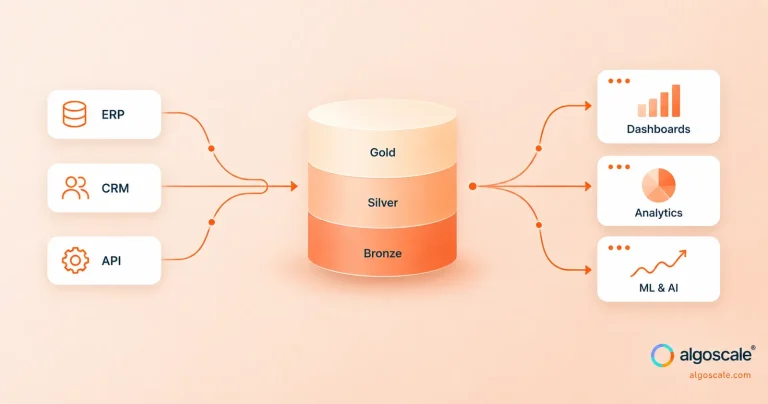
A clear mental model of lakehouse architecture makes the migration path easier to reason about. The most fundamental shift is the separation of storage from computers. In a data warehouse, these two concerns are tightly coupled. The engine that stores your data is the same engine that queries it. In a lakehouse, storage lives independently in object storage, and multiple compute engines can read from it simultaneously.
The key components of a well-designed lakehouse are:
Storage Layer : Object storage holds raw and processed data in open formats. There are no proprietary file formats locking data to a single vendor, which means the data you store today can be queried by any engine your team chooses tomorrow.
Open Table Format : Formats like Delta Lake, Apache Iceberg, and Apache Hudl add a metadata and transaction layer on top of object storage. This is what enables ACID transactions, schema evolution, time travel queries, and partition management without the need for a traditional database engine.
Query and Processing Layer: Engines like Apache Spark, Trino, Presto, and Flink read from the open table format. Multiple engines can query the same data simultaneously, which removes the one-engine-per-workload constraint that limits traditional warehouses.
Governance and Catalog Layer : Tools like Unity Catalog, AWS Lake Formation, and Microsoft Purview handle access control, data discovery, lineage tracking, and classification. In a mature lakehouse, governance policies apply uniformly across all engines and all workloads.
Serving Layer : BI tools, machine learning pipelines, streaming applications, and data science notebooks all connect to the same unified data store. There is no need to copy data between systems before running a different type of workload.
Mapping Out the Migration Without Disrupting Operations
The most common mistake in a warehouse-to-lakehouse migration is trying to execute the entire move in a single cutover weekend. Cutting over everything at once might seem operationally efficient, but it eliminates the safety net of running both systems in parallel and makes rollback virtually impossible when something does not match.
The approach that works consistently and that AlgoScale uses for every client engagement is a phased migration with explicit validation gates between each stage.
Phase 1: Inventory and Assessment
Before any data moves, you need a complete picture of what you have. Document every table, every pipeline, every data mart, and every downstream consumer from executive dashboards to automated nightly reports. Classify workloads by business criticality and query pattern. Pipelines that feed financial reporting or real-time operational systems should be among the last to move, not the first. This phase also includes a data quality assessment, because a migration is not the time to discover that a critical dimension table carries years of duplicate records.
Phase 2: Build the Lakehouse Foundation in Parallel
Stand up the lakehouse infrastructure while the warehouse continues running normally. This means provisioning your object storage layer, configuring your chosen open table format, setting up your compute engines, and establishing governance policies before any production data flows through the new system. The warehouse keeps running uninterrupted, and teams can begin experimenting with the new environment without any operational stakes.
Phase 3: Historical Data Migration
Start with historical data that is effectively read-only archive tables, quarterly snapshots, reporting datasets that do not change after the fact. This carries the lowest operational risk. Move it to the lakehouse, validate row counts and data types, run reconciliation scripts, and let analysts start using the lakehouse for read operations while the warehouse remains the authoritative system for writes and active data.
Phase 4: Dual-Write Configuration
This is the step that most teams underestimate. Before cutting over any active pipelines, configure them to write to both the warehouse and the lakehouse simultaneously. This creates a reconciliation window typically two to four weeks during which you can compare outputs field by field, catch discrepancies, and build genuine confidence in the lakehouse data quality. This is also when you begin migrating transformation logic, rewriting stored procedures as dbt models or Spark jobs.
Phases 5 and 6: Consumer Redirect and Decommission
Once the lakehouse data consistently matches the warehouse output across your full reconciliation window, redirect consumers gradually. Start with low-traffic internal reports, then move progressively to higher-criticality tools. After running in full lakehouse mode for at least 30 days without incidents, place the warehouse in read-only mode for a final 30-day buffer, then decommission it cleanly.
Choosing the Right Cloud Platform for Your Lakehouse
Whether you are building an AWS data lakehouse or an azure data lakehouse, the architectural principles remain the same. Both platforms offer managed services that remove a significant portion of the infrastructure complexity. The decision usually comes down to where your existing infrastructure already lives and which ecosystem your team is most productive in.
| Capability | AWS Data Lakehouse | Azure Data Lakehouse |
| Primary Platform | AWS Lake Formation + Amazon S3 | Azure Synapse Analytics + ADLS Gen2 |
| Object Storage | Amazon S3 (virtually unlimited scale) | Azure Data Lake Storage Gen2 (hierarchical namespace) |
| Open Table Format | Apache Iceberg (native), Delta Lake via AWS Glue | Delta Lake (native via Databricks / Synapse) |
| SQL Query Engine | Amazon Athena, Redshift Spectrum | Azure Synapse Serverless SQL Pool |
| Spark / ML Engine | Amazon EMR, AWS Glue Spark | Azure Databricks, Synapse Spark Pools |
| Data Catalog | AWS Glue Data Catalog | Microsoft Purview / Synapse Catalog |
| Governance & Security | AWS Lake Formation (column + row-level security) | Microsoft Purview + Azure RBAC + Defender |
| BI Integration | Amazon QuickSight | Microsoft Power BI (native integration) |
| Streaming Ingestion | Amazon Kinesis Data Streams / Firehose | Azure Event Hubs + Stream Analytics |
| ETL / Orchestration | AWS Glue, AWS Step Functions, MWAA | Azure Data Factory, Synapse Pipelines |
| Cost Model | Pay-per-query (Athena) + S3 storage cost | Pay-per-use DWU + ADLS storage cost |
| Best Fit For | Teams already on AWS with diverse open-source tooling needs | Organizations with Microsoft ecosystem (Azure AD, Power BI, Office 365) |
For organizations that want portability across clouds, the cloud data lake pattern built on Apache Iceberg gives the most flexibility. Iceberg is supported natively across AWS, Azure, and GCP, which means your table format is not bound to any single cloud vendor. Teams can run Athena on top of the same Iceberg tables that Azure Databricks reads, without any data duplication.
What Governance Looks Like in a Lakehouse
One of the most common concerns during migration is governance continuity. In a traditional data warehouse, access control is well understood: roles, schemas, and column-level permissions are all managed within the database engine. In a data lakehouse, governance spans object storage, the open table format layer, and multiple compute engines simultaneously.
Modern lakehouse governance platforms have closed this gap significantly. AWS Lake Formation applies column-level and row-level security directly on top of Amazon S3, so queries from Athena, Redshift Spectrum, and Amazon EMR all respect the same access policies. Microsoft Purview does the equivalent for the Azure data lakehouse, with automated data classification and policy propagation across Synapse Analytics and Azure Databricks workspaces.
The safest approach during migration is to operate your lakehouse governance in shadow mode for the first several weeks. Apply all the same access policies from your warehouse to the lakehouse layer, run access audits, and compare them against your baseline. Only after that shadow period is complete and all policy discrepancies are resolved should production consumers be switched over. This approach ensures that security posture does not regress during the transition.
Data lineage is another governance concern that deserves explicit attention. The best time to instrument lineage tracking is during the migration itself, when your understanding of data flows is freshest. Tools like AWS Glue Data Catalog, Unity Catalog in Databricks, and Microsoft Purview all provide lineage capture that integrates with Spark, dbt, and SQL-based transformations.
Common Pitfalls to Avoid
Teams that have gone through this migration consistently report a set of challenges that are predictable and preventable:
● Schema mismatches are the number one source of data quality failures during migration. Warehouse schemas are often enforced implicitly by the ETL layer, not by the table definition itself. Moving to a lakehouse and enabling explicit schema enforcement frequently surfaces silent data quality issues that have been accepted as normal for years. Treat schema definition as a first-class migration deliverable.
● Compute sizing surprises teams migrating from tightly coupled warehouse architectures. In a warehouse, the query engine knows the physical data layout intimately. In a lakehouse, your compute layer must be configured to match your workload patterns. Without proper partition pruning strategies and file size optimization, query costs can spike in the early weeks.
● Data catalog sprawl is a risk in large organizations where multiple teams set up their own metadata registries. Decide on a single catalog authority early and enforce it as a policy before migration begins. Whether that is Unity Catalog, AWS Glue Data Catalog, or Microsoft Purview, having one source of truth prevents inconsistencies that become expensive to resolve later.
● Transformation logic debt tends to surface during migration. If your current stack relies heavily on stored procedures or database-specific SQL functions, plan additional time to rewrite these as portable Spark jobs or dbt models. This work is an investment in future portability, but it requires realistic timeline planning.
How AlgoScale Supports Your Lakehouse Migration
At AlgoScale, our data lakehouse services are built around a single principle: your operations should never feel the migration happening. We handle the infrastructure provisioning, the dual-write pipeline configuration, the transformation logic rewrite, and the consumer cutover on a timeline calibrated to your team’s capacity and your organization’s risk tolerance.
Our engineering team has delivered lakehouse migrations across both AWS data lakehouse and azure data lakehouse environments, and we bring pre-built migration accelerators that compress the assessment phase from several weeks to just a few days. We have developed proprietary reconciliation tooling that automates the dual-write comparison, flagging row-level discrepancies in near real time so your team can focus on resolution rather than discovery.
Whether you are starting from a legacy on-premises warehouse, a managed cloud warehouse service, or a hybrid architecture with parts of each, the path to a unified lakehouse architecture built on an open cloud data lake foundation is a journey we have completed many times over. The technology is ready, the migration patterns are proven, and with the right partner managing the transition, your teams can keep shipping analytics while the infrastructure beneath them evolves.
If you are evaluating your migration options or want a no-obligation assessment of your current data warehouse environment, the AlgoScale team is ready to start the conversation at algoscale.com