

Every company that works with data eventually runs into the same wall. The data warehouse handles reports well but was never built to store raw video, log files, or sensor data. The data lake stores everything cheaply, but without structure it slowly turns into a swamp that nobody trusts. This is exactly the gap a data lakehouse was built to close, and it’s why so many engineering teams at Algoscale get asked to design one for their clients this year.
A data lakehouse brings the low cost and flexible storage of a data lake together with the reliability, structure, and performance people expect from a data warehouse. Instead of running two separate systems and copying data back and forth between them, teams get one platform that handles raw files, structured tables, streaming events, and machine learning workloads side by side. For a US-based data lakehouse service provider like Algoscale, this is the architecture we recommend most often, because it removes duplicate infrastructure while still keeping data clean enough for finance, operations, and analytics teams to depend on every day.
Companies moving to a cloud data lake setup are often surprised by how much manual reconciliation work disappears once governance and storage live in the same place. Analysts stop waiting on nightly batch jobs to see fresh numbers, engineers stop maintaining two copies of the same pipeline, and finance teams stop finding small discrepancies between the lake and the warehouse right before a board meeting. None of that is a coincidence. It is the direct result of collapsing two systems into one and giving every team a single, governed version of the truth to work from.
This blog walks through what a data lakehouse actually looks like, how it compares to older approaches, and the ten benefits that make lakehouse architecture worth the switch for growing companies.
What Is a Data Lakehouse?
A data lakehouse is a data management architecture that combines the storage flexibility of a data lake with the transaction support, schema enforcement, and governance features of a data warehouse. It sits on top of low-cost cloud object storage such as Amazon S3 or Azure Data Lake Storage, and adds an open table format layer, such as Delta Lake, Apache Iceberg, or Apache Hudi, to bring reliable metadata and ACID transactions to that storage.
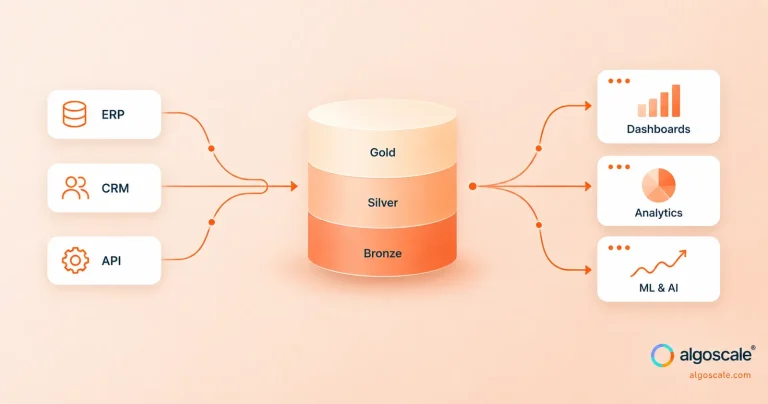
Below the surface, a typical data lakehouse has five layers. The first is the source layer, where data arrives from applications, databases, IoT devices, and streaming systems. The second is the unified storage layer, where all of that data lands in its raw or lightly processed form. The third is the metadata and governance layer, which tracks schema, applies access rules, and keeps a version history of every table. The fourth is the processing layer, where SQL engines, Spark jobs, and machine learning pipelines run against that data. The fifth is the consumption layer, where dashboards, applications, and data science notebooks pull the finished results.
This layered setup is what allows a single data lakehouse to support a finance analyst running a monthly report and a data scientist training a model, without either one waiting on the other or working from a different copy of the data.
Adoption has picked up over the past few years mainly because open table formats matured to the point where they can handle production workloads at scale. Early data lakes were fine for archiving files but were never designed for the kind of concurrent updates and strict schema checks that a finance or operations team expects from a system of record. Once tools like Delta Lake and Apache Iceberg closed that gap, a data lakehouse stopped being an experimental idea and became the default recommendation for new cloud data platforms.
Data Lakehouse vs Data Warehouse vs Data Lake
Before looking at the benefits, it helps to see where a data lakehouse sits compared to the two architectures it replaces.
| Aspect | Data Lake | Data Warehouse | Data Lakehouse |
| Data types supported | Structured, semi-structured, unstructured | Mostly structured | Structured, semi-structured, unstructured |
| Storage cost | Low | High | Low |
| Schema | Schema-on-read | Schema-on-write | Schema enforced, flexible on read |
| ACID transactions | Limited or none | Yes | Yes |
| Machine learning support | Good | Limited | Good |
| BI and reporting support | Weak without extra tools | Strong | Strong |
| Governance | Weak by default | Strong | Strong |
| Best fit | Raw data archiving | Reporting and BI | Unified analytics and ML |
As the table shows, a data lakehouse is not simply a data lake with a new name. It borrows the governance and reliability that warehouses were built for, while keeping the low storage cost and flexibility people already like about a cloud data lake. That combination is really what the rest of this list comes down to: fewer trade-offs, because the architecture no longer forces a team to pick reliability over flexibility or cost over structure.
Top 10 Benefits of Implementing a Data Lakehouse Architecture
The advantages below show up in different ways depending on team size and industry, but most companies that make the switch notice all ten to some degree within the first year.
1. Unified Storage for All Data Types
A data lakehouse stores structured tables, semi-structured JSON, images, video, and streaming events in one place. Teams no longer need separate systems for raw and processed data, which cuts down on duplicate pipelines and makes it far easier to point to a single source of truth when someone asks where a number came from. This matters most for companies that have grown through acquisitions or added new product lines, since those situations tend to leave data scattered across formats that used to require several different tools just to combine.
2. Lower Storage and Infrastructure Costs
Because a data lakehouse runs on cheap cloud object storage instead of proprietary warehouse storage, companies typically see a noticeable drop in their storage bill within the first few months. There is also no need to pay for two systems, a lake for raw data and a warehouse for reporting, since one platform now covers both jobs. For teams already paying for a large cloud data lake footprint, adding lakehouse capabilities on the same storage is usually cheaper than standing up a parallel warehouse.
3. Faster, Real-Time Analytics
With streaming ingestion and modern query engines, a data lakehouse can serve near real-time dashboards alongside historical reporting from the same tables. Retailers checking inventory levels, logistics teams tracking shipments, or fraud teams scanning transactions all benefit directly from this shorter gap between an event happening and a business user actually seeing it on a screen.
4. Stronger Data Governance and Security
Open table formats bring schema enforcement, versioning, and audit history to data that used to live as loose files in a lake. Combined with catalog tools like AWS Lake Formation or Microsoft Purview, a data lakehouse gives administrators fine-grained control over who can see or change which rows and columns, which makes compliance audits far less painful than they used to be under a plain data lake setup.
5. Support for Both BI and Machine Learning Workloads
Data scientists need raw, granular data for training models, while business analysts need clean, aggregated tables for dashboards. A data lakehouse serves both groups from the same underlying storage, so machine learning pipelines and BI tools query consistent data without waiting on a separate export process or a nightly copy job that might already be a day out of date.
6. Elimination of Data Silos
When every department dumps data into disconnected systems, nobody has the full picture and every quarterly review starts with an argument about whose numbers are correct. A data lakehouse pulls data from CRMs, transactional databases, IoT devices, and third-party feeds into a single governed layer, so sales, marketing, and operations teams are finally looking at the same figures instead of three slightly different spreadsheets.
7. ACID Transactions and Reliable Data
Traditional data lakes struggled with partial writes and inconsistent reads, especially when multiple jobs touched the same files at the same time. Table formats such as Delta Lake and Apache Iceberg bring ACID transactions to lakehouse architecture, so concurrent reads and writes no longer corrupt tables, produce duplicate rows, or leave a report showing half-written data mid-refresh.
8. Flexibility Across Cloud Providers
An AWS data lakehouse built on S3, Glue, and Redshift Spectrum, or an Azure data lakehouse built on ADLS Gen2, Synapse, and Databricks, both follow the same open architecture principles. Companies are not locked into one vendor’s proprietary storage format, which keeps the door open for multi-cloud strategies, easier vendor negotiations, or a future migration without a full data rebuild.
9. Simplified Architecture and Easier Maintenance
Running a separate lake and warehouse means maintaining two ingestion pipelines, two sets of access controls, and often two teams of specialists who barely talk to each other. A data lakehouse consolidates this into one architecture, which reduces the engineering hours spent on pipeline maintenance and cuts down on the chance of data drifting out of sync between systems over time.
10. Better Collaboration Between Data Teams
Because everyone, from data engineers to analysts to data scientists, works against the same governed tables, handoffs between teams get much simpler. A model built by a data science team can be validated against the exact same data an analyst used in a quarterly report, which removes a lot of the back-and-forth that used to happen when the numbers on two different desks didn’t match.
AWS Data Lakehouse vs Azure Data Lakehouse
Two of the most common ways companies stand up a data lakehouse today are on AWS and on Azure. Both follow the same layered pattern, storage at the bottom, governance in the middle, compute and consumption on top, but the specific services differ.

An AWS data lakehouse typically uses Amazon S3 for storage, AWS Glue and Lake Formation for cataloging and governance, and Redshift Spectrum, Athena, or EMR for processing, with QuickSight and SageMaker on the consumption side.

An Azure data lakehouse follows a similar pattern using Azure Data Lake Storage Gen2 for storage, Microsoft Purview or Unity Catalog for governance, Synapse Analytics or Databricks for processing, and Power BI or Azure Machine Learning for consumption.
| Capability | AWS Data Lakehouse | Azure Data Lakehouse |
| Core storage | Amazon S3 | Azure Data Lake Storage Gen2 |
| Table format support | Delta Lake, Apache Iceberg, Apache Hudi | Delta Lake, Apache Iceberg |
| Data catalog | AWS Glue Data Catalog | Microsoft Purview / Unity Catalog |
| Governance and access control | AWS Lake Formation | Microsoft Purview, Azure RBAC |
| Query and processing engines | Redshift Spectrum, Athena, EMR | Synapse Analytics, Databricks |
| Streaming ingestion | Kinesis, Managed Streaming for Kafka | Event Hubs, Azure Stream Analytics |
| BI and consumption | Amazon QuickSight | Power BI |
| Machine learning | Amazon SageMaker | Azure Machine Learning |
Both an AWS data lakehouse and an Azure data lakehouse can be built with open table formats, so the choice usually comes down to which cloud a company already runs on, existing team skills, and pricing for compute and storage rather than any real difference in what a lakehousea architecture can do.
Where Algoscale Fits In
Algoscale works with US companies to design and manage cloud data lake and lakehouse environments on both AWS and Azure, from the first architecture diagram through ongoing pipeline support and monitoring. Our teams have set up lakehouses for companies moving off legacy on-premise warehouses, startups that outgrew a basic data lake, and larger organizations trying to bring machine learning and BI teams onto the same governed data for the first time.
Whether the goal is replacing an aging warehouse, consolidating scattered data sources, or getting machine learning teams access to cleaner data faster, a well-planned data lakehouse tends to solve more of the underlying problem than adding another point tool ever does. Teams still weighing a data lake against a data warehouse are usually better served by asking a different question: does a lakehouse architecture let them stop choosing between the two altogether. For most of the companies Algoscale works with, the answer has been yes, and the migration pays for itself well before the first year is out.