


The advertised price of a CRM is not the price of a forecast. HubSpot sells seats from $7 and puts forecasting on the $90 tier. Salesforce starts at $25 and puts it at $100. Pipedrive starts at $14 and puts it at $24. Every comparison you will read quotes the first number.
The dedicated tier is worse: Gong, Aviso and Clari Forecast publish no figure at all. And the best-known name in the category is not a company you can buy from any more – Clari is a module inside Salesloft, which most lists ranking it still have not noticed.
So this sales forecasting software comparison carries a column no rival page has: the first tier that actually includes a forecast, with its per-seat price and any one-time fee in the same cell. Every figure was read on the vendor’s own page on 5 and 8 November 2026, with no trial and no account anywhere.
7 Best Sales Forecasting Software Tools: Quick Comparison
| Tool | Best For | Public Reviews | The Catch | Starting Price | First Tier With Forecasting | Access |
|---|---|---|---|---|---|---|
| 1HubSpot Sales Hub | A first real CRM and a first forecast together | TrustRadius – 8.9 from 584 ratings; praised for pipeline visibility, criticised for thin lower tiers | Forecasting starts at Professional, plus a required $1,500 onboarding fee | Free / $7 seat / $90 seat / $150 seat | Professional, $90 a seat plus $1,500 onboarding | Free tier for 2 users, no card |
| 2Pipedrive | The smallest team that still needs a defensible number | TrustRadius – 8.6 from 521 ratings; praised for value, criticised for reporting depth at scale | Forecast reports start on Growth, not Lite | $14 / $24 / $49 / $69 per seat, billed annually | Growth, $24 a seat a month | 14-day trial, no card |
| 3Algoscale | When the forecast has to read from more than one CRM | Our own case study – two CRMs unified, 997K leads consolidated, 127K orders synced | A services engagement, not a product | Scoped per project | Not a tier – we build the layer the tiers read from | Talk to us |
| 4Salesforce | Sales Cloud incumbents who should upgrade a tier, not add a vendor | TrustRadius – 8.8 from 3,472 ratings; the largest corpus here, criticised for complexity | Revenue Intelligence is another $220 a user on top | $25 / $100 / $195 per user a month | Pro Suite, $100 a user a month | Free trial |
| 5Clari Forecast | Forecast accuracy as a managed process, not a report | TrustRadius – 8.2 from 119 ratings, under the title Clari (legacy product) | Not an independent product: it is a Salesloft module | Not published | Not published | Talk to sales |
| 6Gong | Forecasting from the call, when the CRM cannot be trusted | TrustRadius – 9.1 from 1,190 ratings, the highest score here; criticised on cost | A platform fee sits on top of per-user licences | Not published | Not published | Book a demo |
| 7Aviso | Enterprise teams replacing a spreadsheet forecast with a model | G2 – 4.3 from 994 reviews; praised for the forecast tab, criticised for implementation | Implementation is the recurring theme in its own worst reviews | Not published | Not published | Request a proposal |
Not sure which of these fits your stack?
Tell us what you are running today and what you need it to do. We will tell you which of these we would pick, and why. We are not going to pitch you.
How We Researched These Sales Forecasting Tools
Ten sources were attempted for this term, eight opened and five rank any product at all. Two could not be read: one page 404s and one is a Reddit thread the site blocks us from, which we will not work around. Four of the five that do rank are built the same way – a list of CRMs with forecasting mentioned as a feature – and not one prints the tier the forecast sits on.
Nothing was trialled and no account was created. Every price, tier and limit below was read on the vendor’s own pricing or documentation page on 5 or 8 November 2026. HubSpot and Salesforce price in local currency by default; the figures here are the US dollar view.
Review sites have stopped serving automated readers. TrustRadius returns a bot challenge and G2 returns a 403, so every rating and quote here was read in a browser and the listing headers are on file. Nine of the twelve third-party quotes are older than four months, which is what a thin category looks like – each one carries its date so you can weigh it.
One finding changed the shape of the list. Clari, the name most buyers start with, is a module inside Salesloft: its own login menu says so, and TrustRadius files it as a legacy product. Two of the ten sources still sell it as an independent purchase. The four questions at the foot of this post come from revenue.io’s own published buying-criteria block and from Google’s related searches for this term – there is no people-also-ask block for it, and nothing here was invented to fill one.
Four things decided the order:
- What the forecast tier actually costs – three vendors publish a complete ladder, three publish nothing, and in every published case the forecast sits above the advertised entry price
- What the forecast is built from – deal stages a rep typed, conversations a tool recorded, or data from more than one system are three different foundations and they fail differently
- Whether you are buying a product or a programme – the dedicated tier sells implementation alongside the licence, and its own reviewers say the implementation is the hard part
- Who you are actually buying from – one of the best-known names in this category has not been an independent company for some time, and most comparisons have not caught up
Do You Need Forecasting Software, or a Better CRM Tier?
Revenue forecasting software splits three ways and the split decides your budget before any feature does.
Read down the left column until you find your sentence.
| What is wrong with your forecast | What to buy | Why |
|---|---|---|
| The pipeline is in one CRM and nobody has turned the forecast on | CRM-native | HubSpot, Pipedrive and Salesforce all have one; the question is which tier, and it is never the cheapest |
| Reps update deal stages optimistically and everyone knows it | Dedicated revenue intelligence | Gong builds the forecast from recorded conversations rather than self-reported stages |
| The forecast is a spreadsheet one person maintains and nobody else can check | Dedicated revenue intelligence | Aviso and Clari Forecast exist to replace that spreadsheet with a model and an inspection process |
| The pipeline is split across two systems and the numbers disagree | Build the layer underneath | The join between the two systems has to exist before any forecast can read it – this is the row we are in |
| The forecast is fine; the close dates are fiction | None of the above | That is a management problem and no tool on this list fixes it |
| The forecast is one input to a company-wide plan with headcount and budget in it | Enterprise planning, not this list | Anaplan and IBM Planning Analytics do that job, and they are a different department’s purchase |
- If you are in the first row, stop reading comparisons and open your own CRM’s pricing page at the forecast tier.
- If you are in the last row but one, buying software will not make the close dates true.
1. HubSpot Sales Hub: Best for a First CRM and a First Forecast Together
What it does: A CRM whose forecast is a view over the deals already in it, so the pipeline and the forecast are maintained by the same people.
Who this is for: Sales teams already running HubSpot whose forecast should not be a second system
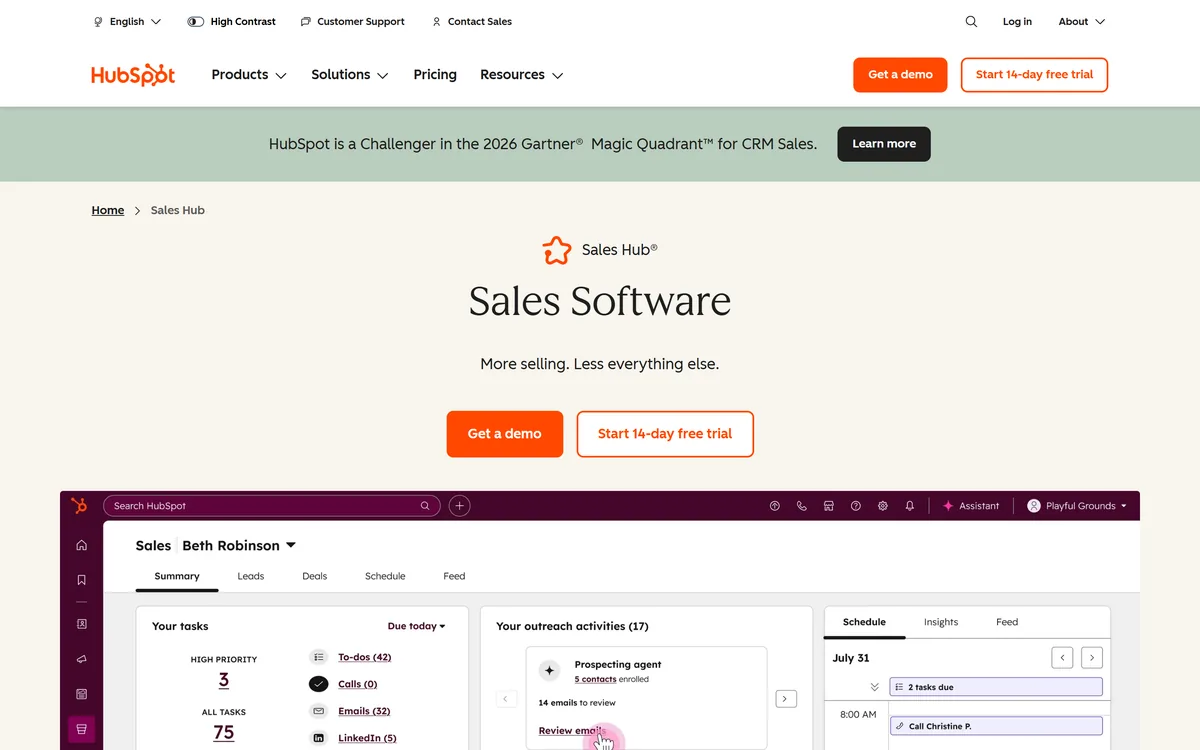
HubSpot is where most teams in this category start, and where the gap this post is about is widest. The page advertises seats from $7. Forecasting is not on that tier. It appears on Professional, at $90 a seat a month.
Underneath that card is a footnote worth more than the discount above it: a required one-time onboarding fee of $1,500 on Professional, $3,500 on Enterprise. It is not optional and it is not in the monthly figure.


Key Features
- A forecast built from the deal stages already in the CRM, with no second system to reconcile
- Free tier for two users, so the pipeline exists before anyone pays
- Published prices at every tier, which three of the six vendors on this list do not have
- Custom forecast submission over the top of the calculated projection
Pros and Cons
Pros
- The forecast and the pipeline are maintained by the same people, in the same tool
- A published price at every tier
- A real free tier, so the CRM can be running before the forecast is bought
Cons
- Forecasting starts at Professional: the real entry price is $90 a seat, not $7
- A required one-time onboarding fee of $1,500 on Professional and $3,500 on Enterprise sits outside the monthly figure
- The forecast inherits the pipeline’s hygiene – it does not correct optimistic close dates
What Users Say
HubSpot is well suited for sales prospecting, lead liming, dashboard reporting and data tracking.
Eddien Laroya on TrustRadiusBusiness Development Executive in Marketing at Ripeconcepts, 501-1000 employees. Badged Incentivized. Quoted as published, typo included. The same review’s cons are cold-calling features and no LinkedIn message sync.

Room for improvement is connecting scoring to activities on lower tiers.
Grant Carlile on TrustRadiusManaging Director at Mountains, 11-50 employees, rated 10 out of 10 overall. One of three cons in a positive review, and the one that matches this post: the lower tiers are where the features thin out.
Pricing
Free for up to 2 users, no card.
Starter: $7 per seat a month in the annual billing state, over a struck-through $20. The page’s only qualifier is a footnote: discounts available for new customers only.
Professional: $90 per seat a month, over a struck-through $100. This is the first tier with the forecast tool. Plus a required one-time $1,500 onboarding fee.
Enterprise: $150 per seat a month. Plus a required one-time $3,500 onboarding fee.
HubSpot’s documentation describes the mechanism: the forecast uses deal stages and each deal’s likelihood to close, with a custom forecast submittable for the month or quarter.
Bottom Line
The sane default when the CRM is already HubSpot. Add the onboarding fee to the seat price before you compare it with anything here.
Buy the tier that has the forecast, or do not count the forecast as bought.
2. Pipedrive: Best for the Smallest Team That Still Needs a Number
What it does: A pipeline-first CRM with revenue forecast reports, priced per seat and cheap enough that a small team keeps the pipeline current.
Who this is for: Small sales teams who need a forecast report and not a revenue platform
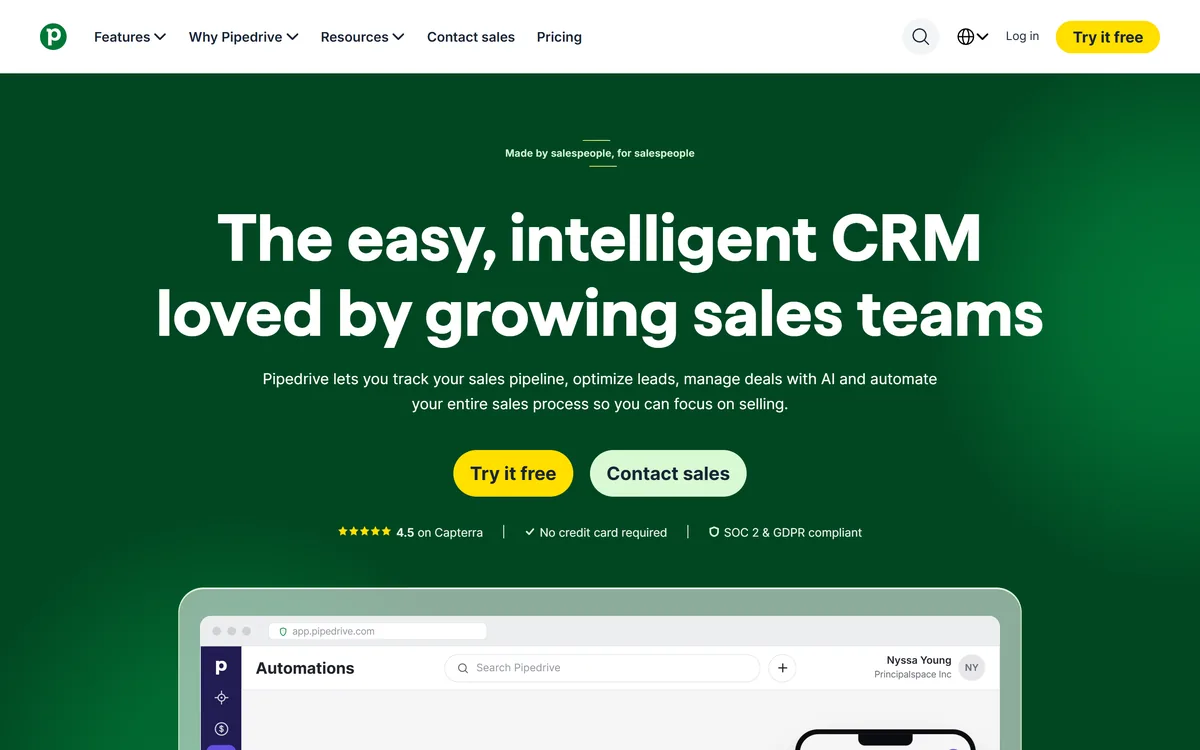
At $24 a seat a month, Pipedrive has the cheapest published forecast on this list – and it is the only entry you can evaluate today without talking to anyone, on a 14-day trial that needs no card.
The same trap applies in miniature. Lite at $14 does not carry forecast reports; the feature row sits under Growth. The gap is smaller than HubSpot’s, which is the honest reason this is entry two rather than entry one.


Key Features
- Revenue forecast reports from the Growth tier
- A free 14-day trial on every tier, with no credit card
- Per-seat pricing published in full
- Deal and activity tracking built around a visual pipeline
Pros and Cons
Pros
- The cheapest published forecast here, at $24 a seat a month
- A trial you can start today without a sales call
- Simple enough that a small team keeps the pipeline current, which is what makes a forecast worth reading
Cons
- Reporting and dashboards thin out as the team grows, by its own reviewers’ account
- The forecast is a report over the pipeline, not a model – no scoring, no risk analysis
- Billed annually at every tier, so the entry cost is a year rather than a month
What Users Say
Pipedrive is really valuable for startups who need a less costly and easy to implement sales CRM. As companies mature, they may need more of the functionality that comes with something like Hubspot.
Aviva Rosman on TrustRadiusCo-Founder and COO at BallotReady, 11-50 employees, 13 March 2025. Badged Incentivized and verified on LinkedIn. The same review’s cons are weaker marketing lead tracking and less automation than HubSpot.

I think as the company scales Pipedrive could do a bit better with reporting and dashboarding to pull analytics together for the Sales & Ops folks.
Adam Tuchscherer on TrustRadiusSales and Finance executive at Capitalize Consulting, 51-200 employees. Badged Incentivized. The same review says he uses Pipedrive to forecast deals.
Pricing
Lite: US$14 per seat a month, billed annually. No forecast reports.
Growth: US$24 per seat a month, billed annually. The first tier with subscriptions and forecast reports.
Premium: US$49 and Ultimate: US$69 per seat a month, billed annually.
Every tier carries a free 14-day trial with no credit card.
The page prints the monthly figure and the billing basis; annual totals are that figure times twelve rather than numbers Pipedrive publishes.
Bottom Line
The cheapest honest answer here. Start the trial, and budget Growth rather than Lite if the forecast is the point.
The one entry on this list you can test this afternoon.
3. Algoscale: Best When the Forecast Spans Two CRMs
What it does: The data engineering team that builds the forecast outside the CRMs, so a pipeline split across more than one system can be read as one.
Who this is for: Sales organisations whose pipeline is split across more than one CRM
Algoscale is not a tool on this list – it is the data engineering team that implements them. We are including it here because the question that follows “which tool?” is usually “who is going to build this?”, and in most shortlists nobody answers it.
A US health and wellness testing provider ran two CRMs, NetSuite and Close.io. We unified both and built the forecasting engine on BigQuery rather than inside either one. Our case study records 997K leads consolidated and 127K orders synced.


Key Features
- Two CRM platforms unified and synchronised in real time, with duplicate leads resolved rather than counted twice
- A forecasting engine built on BigQuery, outside either CRM, so it can read both pipelines at once
- Duplicate leads resolved in the data, not netted off in the model – the 997K figure is what that produced
- Outputs that trigger an action, not only a quarterly number
Pros and Cons
Pros
- Builds the forecast where every source can be read at once, which is the problem when the pipeline is split across two CRMs
- The duplicate-lead problem is solved in the data, not papered over in the model
- The forecast is built outside both CRMs, so it is not limited to what either licence can see
Cons
- A services engagement, not a product: no free tier, no trial, no rate card
- Overkill when the whole pipeline already lives in one CRM – buy the tier that includes forecasting and stop
- You still license the CRM; this is the layer that reconciles what it holds, not a replacement for it
From Our Case Study
Two CRM platforms unified, synchronised in real time, and a forecasting engine on BigQuery that tells the sales team when to reach out rather than guessing.
Algoscale case study – a US health and wellness testing providerFrom our own published case study for this engagement, not a third-party review.

Pricing
Scoped per project. No rate card – the same answer Gong, Aviso and Clari Forecast give, and the opposite of Pipedrive’s published $24.
No per-seat licence on the output, so the forecast is not rationed to the people who already have a CRM seat.
The engagement is the unification, the reconciliation and the forecasting layer. The CRM is still yours to license.
The published outcome of that engagement, in the case study’s own words: an 11% increase in sales, credited to improved customer engagement through timely purchase reminders, backed by accurate forecasts.
Bottom Line
Bring us in when the pipeline lives in two systems and the forecast has to see both – and when the duplicate records between them are why the number is wrong.
The answer when the problem is the data, not the dashboard.
4. Salesforce: Best for Sales Cloud Incumbents Who Should Upgrade, Not Add
What it does: The CRM most large sales organisations already run, with forecasting at the second edition and revenue analytics sold separately on top.
Who this is for: Enterprises already standardised on Salesforce, where the forecast has to live on the system of record
If you already run Salesforce, the forecast you need is probably an edition upgrade rather than a new vendor. Starter Suite is $25 a user. Pro Suite at $100 is the first edition that lists Sales Quoting and Forecasting.
The part that looks most like forecasting software is priced separately again: Revenue Intelligence is an add-on from $220 per user a month, on top of the edition. Both numbers belong in the comparison, not just the edition price.


Key Features
- Forecasting and quoting from the Pro Suite edition
- Revenue Intelligence as a separate add-on from $220 per user a month
- Published per-user prices on every edition and add-on
- The deepest customisation and the largest partner ecosystem here
Pros and Cons
Pros
- Published prices at every edition, including the add-ons
- The forecast sits on the system of record most enterprises already run
- Depth and customisation nothing else on this list matches
Cons
- The forecast starts at $100 per user a month, four times the advertised entry price
- Revenue Intelligence is another $220 per user a month
- Customisation is a project: its own reviewers describe a system that needs administrators
What Users Say
I personally feel that the interface can feel confusing for new users. There are too many options and features makes navigation difficult. Small businesses may find it difficult to afford.
Tripti Kashaudhan on TrustRadiusSoftware development engineer at KSOLVES, 501-1000 employees. Badged Incentivized and verified on LinkedIn. Quoted as published from the review’s cons. The same review names clear visibility into sales performance and forecasting as one of its four use cases. TrustRadius serves this listing under the name Agentforce Sales.

Because our clients are mostly from the transportation department, so they need all the emails and everything on time. So it’ll be really helpful for us.
Puneet Khubchandani on TrustRadiusSenior Developer at AnavClouds Software, 11-50 employees, 5 November 2025, rated 10 out of 10 and badged Incentivized. The review is transcribed speech and is quoted as published.
Pricing
Starter Suite: $25 per user a month, billed monthly or annually. No forecasting.
Pro Suite: $100 per user a month, billed annually. The first edition listing Sales Quoting and Forecasting.
Core: $195 per user a month. Higher editions exist above it.
Revenue Intelligence: from $220 per user a month, as an add-on rather than an edition. Agentforce for Sales is another, from $125.
TrustRadius now serves the Sales Cloud listing under the name Agentforce Sales, which is worth knowing if you are comparing review counts.
Bottom Line
The right answer if you already run Salesforce. The edition upgrade is the purchase; the add-on is a second one.
Upgrade the edition before you add a sixth vendor to the stack.
5. Clari Forecast: Best Known, and No Longer Its Own Company
What it does: Forecasting and revenue inspection, now a module of the Salesloft platform rather than a standalone product.
Who this is for: RevOps teams evaluating forecast inspection, who need to know it is now part of Salesloft
Start with the thing most comparisons have not caught up with. Clari is not an independent product you can buy. Salesloft’s own login menu lists it – Log in to Salesloft, Log in to Clari Forecast, Log in to Conversations, Drift, Groove – and TrustRadius files it as a legacy product.
What you are evaluating is the Salesloft platform with Clari Forecast inside it. Two of the ten sources we pulled for this term still present it as a company you can buy from, and neither mentions Salesloft at all.


Key Features
- Forecast roll-ups and inspection across the pipeline
- Conversation intelligence alongside the forecast – transcription, summaries and coaching
- Automated CRM updates from what was said on the call
- Sold inside the Salesloft platform rather than as a product of its own
Pros and Cons
Pros
- The forecast inspection the category was built on, now with a wider platform behind it
- A mature review corpus from its standalone years – 119 ratings at 8.2 out of 10
- Conversation intelligence and forecasting on one contract rather than two
Cons
- Not a standalone purchase any more: you are buying the Salesloft platform
- No published price
- Most comparisons you will read describe a company that no longer sells this on its own
What Users Say
Before we bought Clari, we did our forecast in Google sheets which broke often and could not track the week over week insights we wanted. Clari has simplified our forecasting process.
Verified User, Manager on TrustRadiusA manager at a 1001-5000 employee company, one year with the product, rating it 2 out of 5 overall and badged Incentivized. The praise above sits beside its cons: “Implementation – a very messy experience” and a forecast tab that is hard to navigate. TrustRadius shows no name.

Clari has an excellent conversation intelligence system. It is well-suited for any organisation that is looking to improve its sales process and customer service.
Nyjil Nazeer on TrustRadiusTalent and Technology Strategist at Rapidor, 51-200 employees. Badged Incentivized. The review lists revenue forecasting and automated CRM updates among the features used, which is the half of the product this post is about.
Pricing
Not published. Salesloft routes pricing through a sales conversation.
The first question is not what it costs but who you are buying from: clari.com redirects to salesloft.com, and clari.com/pricing lands on Salesloft’s own see-it-live page.
TrustRadius lists the product as Clari (legacy product), scoring 8.2 out of 10 from 119 reviews and ratings.
Bottom Line
Check who you are actually buying from before you shortlist it.
A good product inside a different company’s platform. Evaluate the platform.
6. Gong: Best When You Do Not Trust Your Own Pipeline Data
What it does: Revenue intelligence software that builds the forecast from recorded customer conversations, which is what most people mean by AI sales forecasting.
Who this is for: Sales organisations whose forecast is wrong because the pipeline is self-reported
Every CRM-native forecast on this list inherits whatever the reps typed. Gong’s argument is that its own does not: the forecast is built from recorded conversations, which it describes as grounded in reality, not opinion.
It publishes no price, but it does publish the shape of the bill, which is more than Aviso or Clari manage: per-user licences, plus a platform fee that scales with the number of users supported, plus free integrations.


Key Features
- Call recording and transcription as the data source for the forecast
- Deal and pipeline review built on what was said on the call
- Per-user licences plus a platform fee that scales with users supported
- Free integrations with the existing stack
Pros and Cons
Pros
- The highest-rated product here, on a corpus of more than a thousand ratings
- The forecast does not depend on reps updating deal stages honestly
- Publishes the structure of the bill even though it publishes no figure
Cons
- No price at all: the pricing page is a form
- A platform fee sits on top of per-user licences, which a per-seat comparison will miss
- It records customer conversations, which is a legal and cultural decision before it is a purchase
What Users Say
Allows me to use 100% of my brain on a call instead of dedicating some portion to notetaking responsibilities.
Caleb Woodford on TrustRadiusProduct Sales at Trimble, 10,001+ employees. Badged Incentivized. The same review describes going back to a timestamped source months later.
Cost is always a concern especially with AI token usage but that’s pretty standard with a tool like this.
Verified User, Director in Sales on TrustRadiusA sales director at a 51-200 employee company, six years with the product. Badged Incentivized. TrustRadius shows no name. The same review’s other cons are onboarding depth and an implementation that takes longer than expected.

Pricing
Not published. The pricing page is a form that asks how big your team is.
What it does state, in three lines: licences are priced per user, there is a platform fee based on the number of users supported, and you can integrate your existing stack for free.
Gong claims its forecast uses 300+ signals to predict deal outcomes with 20% more precision than algorithms based on CRM data. That is Gong’s own figure on Gong’s own page.
TrustRadius shows 1,190 ratings in the header and 676 written reviews in the search box – the first number includes ratings left without a review.
Bottom Line
Buy it when the forecast’s problem is the data going in. Expect a per-user licence and a platform fee, neither published.
The most convincing argument here, behind the least convincing pricing page.
7. Aviso: Best for Replacing a Spreadsheet Forecast With a Model

What it does: AI revenue intelligence and forecasting, sold to enterprise sales organisations and priced entirely by proposal.
Who this is for: Enterprise revenue teams moving a forecast off spreadsheets, who can absorb a multi-module rollout
Aviso’s users describe the switch this post’s readers are usually contemplating: moving the forecast off a spreadsheet and onto a model. Its pricing page offers to buy out your current vendor contract, pay for migration and run the onboarding.
It publishes no figure and no tier, and the offers beside the form – a contract buy-out, free migration – carry no price and no end date either. The complaint in its own worst review is not the forecast but the rollout.


Key Features
- Forecast roll-ups with a view on period-over-period movement
- Conversation data used alongside CRM data to score deal health
- Migration and onboarding offered as part of the deal
- Sold by proposal to enterprise revenue teams
Pros and Cons
Pros
- A large review corpus for a product this specialised – 994 reviews on G2
- Its users describe moving a forecast off spreadsheets and onto a model
- The vendor will buy out an incumbent contract, which shortens a switch
Cons
- No published price of any kind
- Implementation is the complaint in its own worst review: a multi-module rollout with no project management support from the vendor
- The 98+% accuracy figure is Aviso’s own, on Aviso’s own page
What Users Say
I like the forecast tab because it helps me move from Excel models to a better AI-integrated source.
Tushar P. on G2Senior Sales Operations Analyst at an enterprise. Badged Current User, Validated Reviewer, Incentivized, Source: Seller invite. The same review asks for week-on-week and year-on-year change views before he can stop using Excel entirely.

The multi-module implementation process was a nightmare with no project management support from Aviso, and all self-serve capabilities within admin settings were locked off.
Verified User in Computer Software on G2Mid-market, 51-1000 employees. G2 shows no name for this reviewer. The same review praises the forecast predictability and the call summaries, and rates the product 0 out of 5 overall – both halves are worth carrying.
Pricing
Not published. The pricing page is headed Flexible Pricing Plans and carries a proposal request form, with no figure and no named tier.
What it advertises instead tells you the deal size: a buy-out of your current vendor contract, free migration, and white-glove onboarding and implementation. The page attaches no price and no end date to any of the three.
Aviso’s own page claims 98+% revenue forecast accuracy. That is a vendor figure on a vendor page, not an independent benchmark.
Bottom Line
Shortlist it when the forecast has to be a model rather than a report. Budget for the implementation, which is what its own reviewers complain about.
Strong product, and the rollout is the part to negotiate.
Which Sales Forecasting Software Should You Choose?
Choose HubSpot Sales Hub if:
- HubSpot is already your CRM and the forecast should not be a second system
- You can price Professional at $90 a seat plus $1,500 of onboarding
- Your pipeline hygiene is good enough that a stage-based forecast means something
Choose Pipedrive if:
- The team is small and the budget is real
- You want to test the forecast this week rather than next quarter
- A report over the pipeline is enough – you do not need deal scoring
Choose Algoscale if:
- The pipeline lives in more than one CRM and the two disagree
- Duplicate records are why nobody trusts the number
- The forecast has to read from systems that do not share a licence
Choose Salesforce if:
- Salesforce is already the system of record
- You can price Pro Suite and, if you need the analytics, Revenue Intelligence on top
- You have administrators, because this is configured rather than switched on
Choose Clari Forecast if:
- You want forecast inspection run as a weekly process rather than a report
- Buying the wider Salesloft platform is acceptable, because that is what you are buying
- A sales conversation before a price is normal for you
Choose Gong if:
- You suspect the deal stages in your CRM are fiction
- Recording customer conversations is already settled, legally and culturally
- A platform fee on top of per-user licences will survive your finance review
Choose Aviso if:
- The forecast is a spreadsheet today and it has to become a model
- You are switching from an incumbent and a contract buy-out matters
- You have the people to run a multi-module implementation
Skip this category entirely if:
- Your close dates are optimistic and everybody knows it. No tool here fixes that, and the better-formatted version will cost you $90 a seat.
- You have fewer than five reps and one pipeline. A spreadsheet and a Monday meeting is a defensible forecast at that size.
- You are only shopping because the forecast was wrong last quarter. Find out why it was wrong first – if the answer is bad data, no licence on this list repairs it.
What’s the Best Sales Forecasting Software in 2026?
Whichever one your CRM already is – and the thing to check is the tier, not the brand. HubSpot at $90 a seat, Salesforce at $100 a user, Pipedrive at $24. All three advertise a cheaper number that does not include a forecast.
Pipedrive if the budget is the constraint and the team is small enough that the pipeline stays current. It is the cheapest published forecast here and the only one you can trial today without a sales call.
Gong is the pick when you do not trust your own pipeline data, because its forecast is built from recorded conversations rather than typed deal stages. Aviso when a spreadsheet has to become a model, with the implementation negotiated up front. Clari Forecast only once you understand you are buying Salesloft.
And if the honest answer is that the pipeline is split across two systems and the two disagree, the forecast has to be built where both can be read. That is the row we are in, at number three.
How Algoscale Builds a Forecast That Spans Two CRMs
Every product above forecasts the pipeline it is pointed at. When that pipeline lives in two systems, the problem usually shows up as the same lead counted twice rather than as a missing feature.
For a US health and wellness testing provider running NetSuite and Close.io, our data engineering team unified both platforms, synchronised them in real time, and built the forecasting engine on BigQuery rather than inside either CRM. Unifying two systems that were never meant to meet is its own discipline, and we compare the tools built for it in our data integration tools round-up. The case study records 997K leads consolidated, with lead duplication eliminated, and 127K orders synced.
The outcome the page reports is an 11% increase in sales, credited to improved customer engagement through timely purchase reminders backed by accurate forecasts. The forecast is an input to that number rather than the whole of it, and we would rather say so than round it up.
- Two CRM platforms unified and synchronised in real time, with duplicate leads resolved in the data
- A forecasting engine on the warehouse, outside both CRMs, so it reads every pipeline at once
- Outputs that tell the team when to reach out, not only a quarterly number
- No per-seat licence on the result, so the forecast is not rationed to people who already have a CRM seat
Ready to put this into production?
Algoscale’s data engineers have built and migrated data platforms for retail, fintech and manufacturing teams. Book a free consultation and we will scope yours with you.
Frequently Asked Questions
What is sales forecasting software?
Software that projects how much your pipeline will close, and by when. In practice it comes in three shapes. A CRM-native forecast, like HubSpot’s or Pipedrive’s, is a view over the deals already in the CRM, built from deal stages and close probability. A dedicated revenue intelligence tool, like Gong, Aviso or Clari Forecast, builds its own model from conversations and activity rather than trusting what reps typed. And a built forecast sits on a warehouse, which is what you need when the pipeline spans systems no single licence can read.
What is the best free sales forecasting software?
There is no genuinely free forecast on this list, and that is worth saying plainly. HubSpot’s free tier covers two users and does not include forecasting – that starts at $90 a seat a month. Pipedrive gives you 14 days free on any tier with no card, which is the closest thing to a free trial of a real forecast here. Salesforce offers a trial. Gong, Aviso and Clari Forecast have no free route at all.
Does forecasting software guarantee forecast accuracy?
No, and be careful with the numbers vendors put next to that question. Aviso’s own page claims 98+% forecast accuracy and Gong claims 20% more precision than CRM-based algorithms – both are vendor figures on vendor pages, not independent benchmarks. What a tool can genuinely change is the input: a forecast built from recorded conversations does not inherit optimistic deal stages. What none of them changes is a close date somebody made up.
How long does implementation take?
The CRM-native options are the short answer: if HubSpot, Pipedrive or Salesforce is already your CRM, the forecast is a tier upgrade and some configuration. The dedicated tools are a project, and their own reviewers say so – Aviso’s worst review describes a multi-module rollout with no project management support, and a two-star Clari review calls the implementation a very messy experience. Budget for the rollout separately from the licence, and ask who runs it.