

Few topics generate more confusion in enterprise data strategy discussions than the relationship between data fabric, data mesh, and data lakehouse. All three terms appear regularly in analyst reports and vendor presentations, sometimes used interchangeably and sometimes positioned as competing solutions to identical problems. They are not the same thing, and they are not alternatives to each other in the way many articles imply. Understanding what each concept actually describes, and more importantly how they relate to one another, is essential for making sound infrastructure and governance decisions without being misled by vendor marketing.
The confusion is understandable because all three address a similar underlying business problem: organizations are drowning in data that is difficult to access, trust, and use. They diverge significantly in how they frame the solution, what layer of the technology and organization stack they operate on, and what trade-offs they ask you to accept. Getting this distinction right has real consequences for how you structure your data teams, what technology investments you prioritize, and how quickly your organization can deliver reliable analytical value at scale.
Data Lakehouse: A Specific Technical Architecture for Unified Storage and Analytics
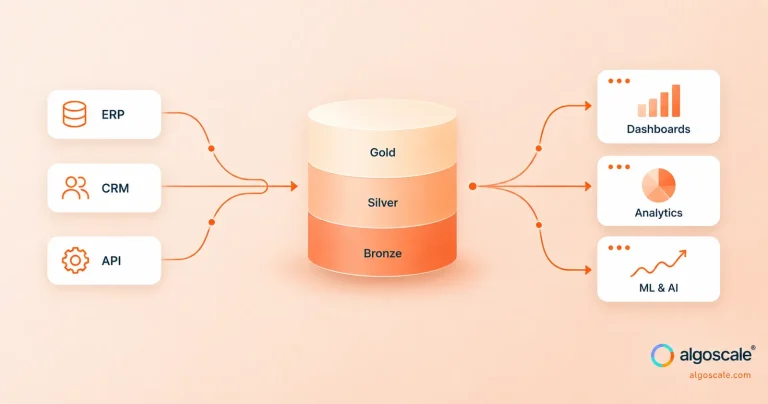
A data lakehouse is a technology architecture, not an organizational philosophy or a vendor product category. It describes a platform design in which raw data is stored in low-cost cloud object storage such as Amazon S3 or Azure Data Lake Storage, governed through an open table format such as Apache Iceberg or Delta Lake that provides ACID transactions and schema enforcement, and served to downstream consumers through compute engines for SQL analytics, machine learning, and streaming workloads. The defining characteristic of a data lakehouse is that it eliminates the traditional division between a data lake and a data warehouse by layering warehouse-grade governance on top of data lake storage economics.
An AWS data lakehouse implementation typically involves Amazon S3 for storage, AWS Glue for cataloging and ETL, Lake Formation for access governance, and Athena or Redshift for query serving. An Azure data lakehouse deployment commonly uses ADLS Gen2 for storage, Azure Synapse Analytics for compute, and Microsoft Purview for governance and data discovery. The cloud data lake becomes the central storage foundation on which all analytical workloads, batch SQL, streaming analytics, and machine learning, converge without the cost and rigidity of proprietary warehouse formats.
Data Mesh: An Organizational and Ownership Philosophy
Data mesh, introduced by Zhamak Dehghani in 2019, is not a technology. It is an organizational and architectural philosophy that challenges the centralized data warehouse or data lake model by advocating for domain-oriented, decentralized data ownership. In a data mesh model, individual business domains such as marketing, supply chain, or customer success own their own data products and are responsible for their quality, availability, and documentation. Central teams provide self-serve infrastructure capabilities, but they do not own or manage the data on behalf of the domains.
Data mesh rests on four core principles: domain-oriented decentralized data ownership, treating data as a product, self-serve data infrastructure as a platform, and federated computational governance. The motivation is the observation that centralized data engineering teams become organizational bottlenecks as data volume and organizational complexity grow. By distributing ownership to the domains closest to the data, mesh advocates argue that data quality improves and analytical velocity increases because the people who best understand the data are also accountable for its reliability. Critically, a data mesh does not prescribe any specific technology stack. It can be implemented on top of a data lakehouse, a warehouse, or a distributed set of domain-managed databases.
Data Fabric: A Vendor-Driven Abstraction and Integration Layer
Data fabric is primarily a vendor-defined concept, popularized by Gartner and embraced by companies including IBM, Informatica, SAP, and Talend. It describes a unified data management layer that sits across heterogeneous data sources and provides consistent metadata management, data integration, data quality enforcement, and access governance regardless of where the underlying data physically resides. A data fabric is less about where your data lives and more about how you connect, catalog, and govern data that is already distributed across multiple systems, clouds, and on-premises environments.
The technology underpinnings of a data fabric typically include an active metadata layer that continuously discovers and classifies data across sources, AI-augmented recommendations for data integration mappings and data quality rules, a unified policy engine for access governance, and connectors to a wide range of existing data stores. A data fabric does not require you to migrate or consolidate your data. It builds an abstraction layer on top of your existing landscape to make data more discoverable and consistently governed without disrupting the underlying systems. This is its primary strength and its primary limitation: it works with what you have, but it does not fundamentally change the underlying data architecture.
Table 1: Data Fabric vs. Data Mesh vs. Data Lakehouse — Conceptual Comparison
| Dimension | Data Lakehouse | Data Mesh | Data Fabric |
| Nature | Technical storage and analytics architecture | Organizational ownership philosophy | Vendor-defined metadata and integration pattern |
| Primary Problem Addressed | Unified storage with governance and analytics | Central team bottlenecks and slow delivery | Data access and consistency across silos |
| Who Defined It | Databricks and academic research community | Zhamak Dehghani via ThoughtWorks | Gartner and enterprise software vendors |
| Data Ownership Model | Central data engineering team manages platform | Domain teams own their data products | Federated with central policy governance |
| Infrastructure Focus | Cloud object storage and open table format | Domain-owned self-serve data products | Active metadata and integration connectors |
| Governance Approach | Unity Catalog, Lake Formation, Purview | Federated standards enforced by platform | Centralized active metadata and AI policy |
| Team Structure Required | Centralized data engineering platform team | Decentralized domain data engineering teams | Platform team plus domain contributors |
| When It Makes Sense | Unified analytics and ML platform at scale | Large orgs with many independent domains | Multi-cloud and legacy integration scenarios |
How All Three Work Together in Practice
One of the most important insights about these three concepts is that they are not mutually exclusive. Large organizations often implement all three at different layers of their architecture. A data lakehouse serves as the technical foundation, providing cloud data lake storage, open table format semantics, and compute serving for analytical workloads. A data mesh governance model determines how ownership and accountability for data products stored in that lakehouse is organized across business domains. A data fabric layer can add metadata management and cross-system connectivity on top, enabling discovery and governance of data that lives outside the lakehouse as well as within it.
This layered understanding is important because vendor marketing frequently blurs these boundaries. A vendor selling a data catalog or integration platform may describe their product as a data fabric solution, a data mesh enabler, and a lakehouse governance layer all in the same sentence. Separating the concepts helps you evaluate vendor claims with more precision: the lakehouse is where data lives and is governed, the mesh is how ownership is organized across teams, and the fabric is how metadata and access are unified across systems including those outside the lakehouse.
Organizational Maturity and the Right Starting Point
The choice of which concept to prioritize depends heavily on your organization’s size, data maturity, and team structure. A mid-sized company with a single central data team and a manageable number of data sources does not need a data mesh. The overhead of establishing domain data product ownership, federated governance councils, and self-serve infrastructure platforms is likely to slow delivery rather than accelerate it. For this organization, building a well-governed data lakehouse is the right first move and will deliver the most analytical value in the shortest timeframe.
A large enterprise with hundreds of business units, thousands of data sources, and a central data team perpetually backlogged with requests from domain teams is a much better candidate for introducing data mesh organizational principles. Importantly, the mesh does not replace the lakehouse architecture. It provides the organizational structure that determines how teams publish and consume data products within and across lakehouses. Data fabric tooling becomes most valuable as the data landscape grows more heterogeneous and maintaining consistent metadata across many legacy and cloud systems becomes a real operational burden for the governance team.
Table 2: Implementation Readiness Guide — When to Adopt Each Concept
| Organizational Scenario | Best Fit | Primary Rationale |
| Small to mid-size org, single central data team, single cloud | Data Lakehouse | Lowest complexity, highest near-term ROI |
| Rapidly growing org needing unified BI and ML platform | Data Lakehouse with governed catalog | Unified platform with RBAC and data discovery |
| Large enterprise with domain teams blocked by central bottleneck | Data Mesh on lakehouse foundation | Decentralize ownership while sharing infrastructure |
| Multi-cloud plus legacy on-premises hybrid environment | Data Fabric plus Lakehouse | Fabric for cross-system connectivity, lakehouse for analytics |
| Enterprise with many acquired companies and disparate systems | Data Fabric first then Lakehouse | Discover and govern before consolidating storage |
| Platform team building internal data marketplace for self-service | Data Mesh governance model | Domain data products with SLAs and discoverability |
| Highly regulated industry requiring unified audit and compliance | Data Lakehouse with centralized governance | Centralized control satisfies compliance requirements |
Practical Guidance for Architecture Decision-Makers
If you are building a modern data platform from scratch or evaluating your current architecture against these frameworks, the most practical starting point is to separate the technical question from the organizational one. The technical question, specifically what platform should store and serve your data, has a reasonably clear answer for most organizations: a cloud-native data lakehouse built on open table formats, governed through a catalog service, and served through a mix of SQL engines and ML platforms. The organizational question of how to structure ownership, accountability, and self-service data access is where data mesh principles become relevant, and that answer depends on your organizational size and the degree of autonomy your business domains currently have.
Resist the temptation to adopt the most architecturally sophisticated solution before your organization has the maturity and team capacity to execute it. Organizations that have launched data mesh initiatives prematurely frequently find that their domain teams lack the engineering capability to build and maintain data products autonomously, resulting in a mesh that exists in governance documentation but not in practice. Starting with a well-governed, well-documented data lakehouse and gradually introducing domain ownership as teams mature is a more reliable path to the same destination, and it delivers analytical value throughout the journey rather than only after a multi-year transformation.
Why Choose AlgoScale for Your Enterprise Data Strategy
Choosing between a data lakehouse, data mesh, and data fabric is not about selecting a single approach, it’s about designing a data strategy that aligns with your organization’s goals, operating model, and long-term growth. Every business has unique requirements, from modernizing legacy infrastructure to enabling self-service analytics, strengthening governance, and preparing for AI-driven innovation.
At AlgoScale, we help organizations evaluate their current data landscape and define the right enterprise data architecture for their needs. Our experts combine deep technical expertise with a business-first approach to design scalable data platforms, implement cloud-native lakehouse architectures, establish effective governance frameworks, and support evolving data ownership models. Whether you’re building a modern analytics platform, modernizing legacy systems, or planning a phased transformation toward a more agile data ecosystem, we deliver practical solutions that drive measurable business outcomes.
With extensive experience across AWS, Azure, data engineering, governance, and analytics, AlgoScale enables organizations to build secure, scalable, and future-ready data platforms that support both current business needs and future AI initiatives. Connect with AlgoScale to develop an enterprise data strategy that accelerates innovation while ensuring flexibility, governance, and long-term success.