

Enterprise data platforms are going through one of the biggest shifts we have seen in the last decade. For years, organizations relied on two separate systems to manage their data: a data warehouse for structured, business-ready information, and a data lake for raw, large-scale storage. Running both meant duplicate infrastructure, duplicate governance rules, and constant friction between analytics teams and data engineering teams. Today, a data lakehouse is changing that equation. By combining the low cost, flexible storage of a data lake with the reliability, structure, and performance of a data warehouse, a data lakehouse gives enterprises a single platform to store, process, and analyze all their data in one place.
As more companies move toward real time analytics, machine learning, and AI driven decision making, legacy systems are struggling to keep pace. Rigid schemas, slow batch cycles, and siloed storage were built for a world where data volumes were smaller and use cases were simpler. That world no longer exists, and the data lakehouse is emerging as the platform built for what enterprises need next.
What Is a Data Lakehouse?
A data lakehouse is a unified data management platform that merges the openness and scalability of a data lake with the structure, governance, and query performance normally associated with a data warehouse. Instead of copying data between a lake and a warehouse, a data lakehouse stores everything, structured tables, semi structured logs, and unstructured files, on the same open storage layer and applies warehouse style features directly on top of it.
This is made possible by open table formats such as Delta Lake, Apache Iceberg, and Apache Hudi, which bring ACID transactions, schema enforcement, time travel, and indexing to files sitting in cloud object storage. The result is a platform where data engineers, analysts, and data scientists can all work from the same source of truth, without maintaining separate copies for different tools. For enterprises evaluating a data lakehouse for the first time, the biggest draw is usually this: one platform, one copy of data, many types of workloads.
Why Legacy Data Systems Are Losing Ground
Traditional data warehouses were designed for structured, relational data and predictable reporting workloads. They perform well for that purpose, but enterprises today deal with clickstream data, sensor data, logs, images, and semi structured JSON from dozens of applications. Forcing all of that into a rigid warehouse schema is expensive and slow.
Legacy data lakes solved the storage problem but introduced a new one: without transaction support or schema management, lakes often turned into unreliable, hard to query data swamps. Enterprises ended up building a warehouse next to the lake anyway, copying curated data back and forth, which added cost, latency, and governance headaches.
● Duplicate pipelines and duplicate storage costs across the warehouse and the lake
● Data freshness delays caused by nightly batch jobs feeding the warehouse
● Difficulty supporting machine learning and AI workloads that need raw and historical data
● Siloed governance policies that differ between the lake and the warehouse
● Rising licensing and compute costs as data volumes grow year over year
These limitations are why so many enterprises are re-architecting their stack around a data lakehouse rather than continuing to patch two separate systems. The cost of maintaining parallel infrastructure rarely shows up as one line item, it shows up as slower project delivery, more engineering hours spent reconciling data between systems, and analysts who no longer trust which copy of a table is current. Over time, that erosion of trust becomes just as damaging as the technical debt itself, because teams start building their own shadow copies of data to work around it, which only adds to the sprawl.
Data Warehouse vs Data Lake vs Data Lakehouse
Before choosing a platform, it helps to see how these three approaches actually compare on the factors that matter most to enterprise teams.
| Feature | Data Warehouse | Data Lake | Data Lakehouse |
| Data types supported | Structured only | Structured, semi structured, unstructured | Structured, semi structured, unstructured |
| Storage cost | High | Low | Low |
| Schema approach | Schema on write | Schema on read | Flexible, schema enforced on write or read |
| Transaction support (ACID) | Yes | No | Yes, through open table formats |
| Query performance | High for SQL and BI | Inconsistent | High, warehouse grade |
| Machine learning readiness | Limited | Good, but unreliable data quality | Strong, with governed and raw data together |
| Best suited for | Reporting and BI on curated data | Cheap large scale raw storage | Unified analytics, BI, and ML on one platform |
Understanding Lakehouse Architecture
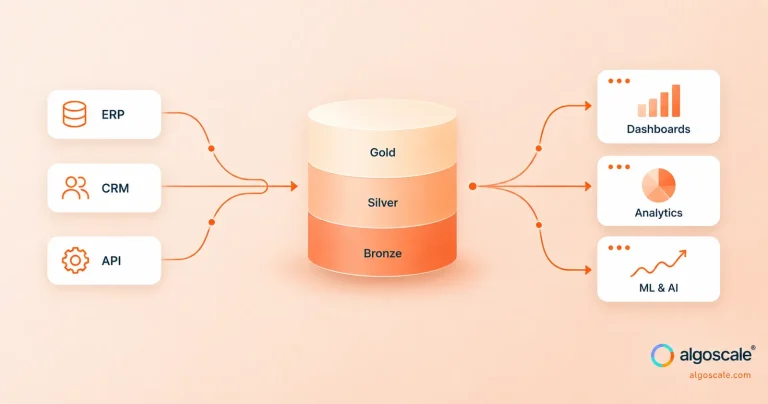
Lakehouse architecture typically follows a layered design that separates ingestion, storage, table management, compute, and consumption, while keeping everything on top of a single copy of data. This design is what allows a data lakehouse to support both traditional BI reporting and modern AI workloads without duplicating pipelines.
At the base sits open cloud object storage, where raw data lands in a bronze zone before being cleaned and organized into silver and gold zones. Above that, an open table format layer adds transactional guarantees, versioning, and a shared catalog, so every engine reading from the platform sees a consistent, reliable view of the data. Compute engines for SQL, Spark based processing, and machine learning then read directly from this layer, and the results flow into dashboards, applications, and models. Because the table format layer decouples storage from compute, teams can scale each independently and avoid the cost of over provisioning either one.
AWS Data Lake House: Building a Lakehouse on Amazon Web Services
Amazon Web Services offers one of the most mature paths to an aws data lake house, built primarily around Amazon S3 as the storage layer. S3 provides virtually unlimited, low cost object storage, and it has become the de facto foundation for open table formats such as Apache Iceberg and Delta Lake in AWS environments.
On top of S3, AWS Glue handles data cataloging and ETL, while AWS Lake Formation adds fine grained permissions and governance across the entire lakehouse. For querying, teams typically use Amazon Athena for serverless SQL, Redshift Spectrum when they need to join lakehouse data with an existing warehouse, and Amazon EMR for large scale Spark processing. Once curated, that data can flow into Amazon QuickSight for dashboards or Amazon SageMaker for machine learning, all without moving data out of S3. This combination is why so many enterprises already running on AWS choose to build their aws data lake house instead of standing up a separate warehouse product.

Azure Data Lake House: Microsoft’s Approach to the Lakehouse
Microsoft’s path to an azure data lake house centers on Azure Data Lake Storage Gen2, which combines the scalability of Blob Storage with a hierarchical namespace built for analytics workloads. This makes it a natural fit for Delta Lake, the open table format that Microsoft has invested in heavily across its data platform.
Azure Synapse Analytics gives enterprises a single workspace for SQL based analytics, while Azure Databricks provides the Spark engine most teams use for large scale transformation and machine learning on the same Delta tables. Microsoft Purview adds governance, lineage, and cataloging across the platform, and Power BI connects directly to the lakehouse for reporting, avoiding a separate extract step. For organizations already standardized on the Microsoft ecosystem, an azure data lake house lets data teams keep everything, ingestion, storage, compute, and reporting, inside tools they already use every day.

AWS Data Lakehouse vs Azure Data Lakehouse
Both clouds can support a full data lakehouse, but the tooling, defaults, and integration points differ enough to matter when choosing a platform.
| Capability | AWS Data Lakehouse | Azure Data Lakehouse |
| Core storage | Amazon S3 | Azure Data Lake Storage Gen2 |
| Common table format | Apache Iceberg (also supports Delta and Hudi) | Delta Lake |
| Primary SQL engine | Amazon Athena / Redshift Spectrum | Azure Synapse Analytics |
| Spark and ML engine | Amazon EMR / SageMaker | Azure Databricks / Azure Machine Learning |
| Governance and catalog | AWS Glue Data Catalog, AWS Lake Formation | Microsoft Purview, Unity Catalog |
| Native BI tool | Amazon QuickSight | Power BI |
| Best fit for | Enterprises already running on AWS or needing broad table format flexibility | Enterprises standardized on Microsoft 365, Dynamics, and Power Platform |
The Rise of Cloud Data Lake Strategies
Beyond any single vendor, the broader trend is enterprises consolidating around a cloud data lake as the center of gravity for their data strategy. A cloud data lake removes the physical limits of on premises storage, scales compute up or down based on demand, and lets teams pay only for what they use. Combined with open table formats, a cloud data lake stops being just cheap storage and becomes the foundation for governed, query ready analytics.
This shift also supports multi cloud and hybrid strategies. Because open table formats are not tied to a single vendor, enterprises can run a cloud data lake on AWS, Azure, or both, and still query it with a consistent set of tools. That flexibility, combined with the elimination of duplicate pipelines between a lake and a warehouse, is a major reason the data lakehouse model continues to gain ground across industries such as retail, healthcare, financial services, and manufacturing.
Moving to a cloud data lake also changes how enterprises plan for growth. Instead of forecasting storage and compute capacity months in advance and paying for headroom that sits idle most of the year, teams can scale storage independently from compute and let usage, not procurement cycles, dictate cost. For finance and IT leadership, that shift from fixed infrastructure spend to consumption based spend is often as compelling as the technical benefits, and it is one of the main reasons cloud data lake adoption keeps accelerating even in years where overall IT budgets are flat.
What This Means for Enterprises Going Forward
The direction enterprise data platforms are heading in is clear. As AI and machine learning move from experimental projects to core business processes, the platforms that win will be the ones that can serve raw data, curated data, real time streams, and historical archives from a single, governed layer. A data lakehouse is purpose built for exactly that, which is why migration away from legacy, siloed systems is accelerating rather than slowing down.
Enterprises that made early investments in either a pure warehouse or a pure lake are now facing a decision point: keep maintaining two systems and absorbing the cost of moving data between them, or consolidate onto a lakehouse architecture that supports both today’s reporting needs and tomorrow’s AI workloads. Given the pace at which data volumes and use cases are growing, waiting is becoming the more expensive option.
How Algoscale Helps Enterprises Get There
Algoscale works with enterprises across the US to design, build, and migrate data lakehouse platforms on both AWS and Azure, tailored to each organization’s existing stack, data volumes, and governance requirements. From setting up open table formats and cataloging to building the pipelines, security model, and BI layer on top, Algoscale’s team handles the full path from a legacy warehouse or lake to a production ready data lakehouse. For enterprises that want the cost efficiency of a cloud data lake without sacrificing the reliability their reporting and AI teams depend on, Algoscale provides the engineering depth to make that transition smooth, secure, and built to scale.